Dittrich S, Kohsakowski S, Wittek B, Hengst C, Gökce B, Barcikowski S, Reichenberger S
Technical Chemistry I and Center for Nanointegration Duisburg-Essen (CENIDE), University of Duisburg-Essen, Universitaetsstrasse 7, D-45141 Essen, Germany.
ZBT GmbH Zentrum für Brennstoffzellen Technik, Carl-Benz-Strasse 201, D-47057 Duisburg, Germany.
Nanomaterials (Basel). 2020 Aug 12;10(8):1582. doi: 10.3390/nano10081582.
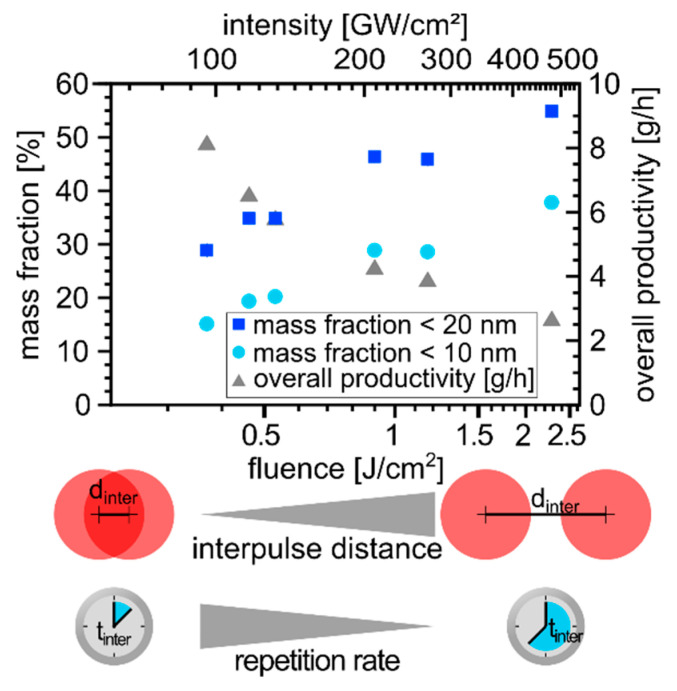
PtPd catalysts are state-of-the-art for automotive diesel exhaust gas treatment. Although wet-chemical preparation of PtPd nanoparticles below 3 nm and kg-scale synthesis of supported PtPd/AlO are already established, the partial segregation of the bimetallic nanoparticles remains an issue that adversely affects catalytic performance. As a promising alternative, laser-based catalyst preparation allows the continuous synthesis of surfactant-free, solid-solution alloy nanoparticles at the g/h-scale. However, the required productivity of the catalytically relevant size fraction <10 nm has yet to be met. In this work, by optimization of ablation and fragmentation conditions, the continuous flow synthesis of nanoparticles with a productivity of the catalytically relevant size fraction <10 nm of >1 g/h is presented via an in-process size tuning strategy. After the laser-based preparation of hectoliters of colloid and more than 2 kg of PtPd/AlO wash coat, the laser-generated catalysts were benchmarked against an industry-relevant reference catalyst. The conversion of CO by laser-generated catalysts was found to be equivalent to the reference, while improved activity during NO oxidation was achieved. Finally, the present study validates that laser-generated catalysts meet the size and productivity requirements for industrial standard operating procedures. Hence, laser-based catalyst synthesis appears to be a promising alternative to chemical-based preparation of alloy nanoparticles for developing industrial catalysts, such as those needed in the treatment of exhaust gases.
铂钯催化剂是汽车柴油废气处理的先进技术。尽管已经实现了低于3纳米的铂钯纳米颗粒的湿化学制备以及负载型铂钯/氧化铝的千克级合成,但双金属纳米颗粒的部分偏析仍然是一个问题,对催化性能产生不利影响。作为一种有前景的替代方法,基于激光的催化剂制备能够以克/小时的规模连续合成无表面活性剂的固溶体合金纳米颗粒。然而,催化相关尺寸分数<10纳米所需的生产率尚未达到。在这项工作中,通过优化烧蚀和破碎条件,通过过程中尺寸调整策略,实现了催化相关尺寸分数<10纳米、生产率>1克/小时的纳米颗粒的连续流动合成。在基于激光制备了数百升胶体和超过2千克的铂钯/氧化铝涂层后,将激光生成的催化剂与工业相关的参考催化剂进行了基准测试。发现激光生成的催化剂对一氧化碳的转化率与参考催化剂相当,同时在一氧化氮氧化过程中实现了更高的活性。最后,本研究验证了激光生成的催化剂满足工业标准操作程序的尺寸和生产率要求。因此,基于激光的催化剂合成似乎是开发工业催化剂(如废气处理所需的催化剂)时,合金纳米颗粒化学制备的一种有前景的替代方法。