School of Nursing, Faculty of Medical and Health Sciences University of Auckland, 85 Park Road, Grafton, Auckland, New Zealand.
Division of Health Sciences, University of Otago, Dunedin, New Zealand.
BMC Palliat Care. 2020 Aug 17;19(1):127. doi: 10.1186/s12904-020-00633-x.
The supportive hospice aged residential exchange (SHARE) is a new model of palliative care education that has been designed for residential aged care. The goal of SHARE is to help clinical staff improve palliative care within residential aged care facilities and to improve specialist palliative care nurses' knowledge and skill to care for frail older people.
The experiences of 18 bereaved families concerning the palliative care journey (both at the start and finish of a one-year implementation of SHARE) were explored using semi-structured interviews.
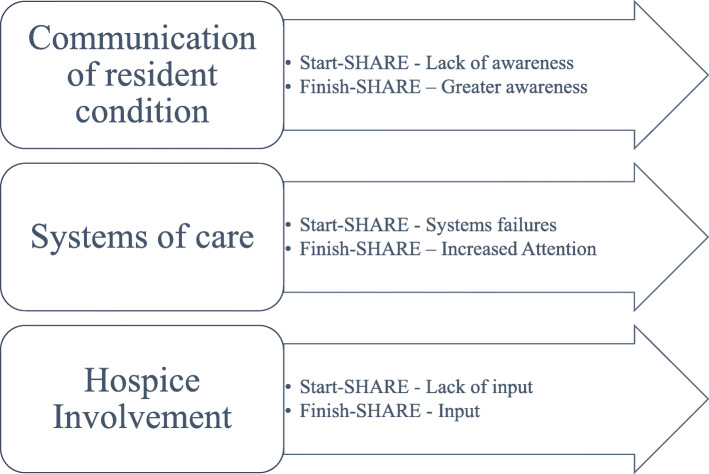
Three themes were important to bereaved families' experience: communication with staff, systems of care, and hospice involvement. Sub-themes indicating changes in these three components of care between the start and finish of SHARE was identified. A fourth theme highlighted challenges (relationship with GP, staff shortages, and turnover) that continued across SHARE.
Findings indicated that SHARE benefited families (improved communication and support) through the end of life journey of their relatives, but challenges remained.
支持性临终关怀养老院交流(SHARE)是一种新的姑息治疗教育模式,专为养老院设计。SHARE 的目标是帮助临床工作人员在养老院改善姑息治疗,并提高专科姑息治疗护士照顾体弱老年人的知识和技能。
使用半结构化访谈探讨了 18 个丧亲家庭在姑息治疗之旅(SHARE 实施一年前后)的经历。
丧亲家庭的经历有三个重要主题:与工作人员的沟通、护理系统和临终关怀的参与。在 SHARE 开始和结束时,确定了这三个护理组成部分的变化。第四个主题突出了在 SHARE 期间仍然存在的挑战(与全科医生的关系、人员短缺和人员流动)。
研究结果表明,SHARE 通过其亲属的临终关怀之旅使家庭受益(改善了沟通和支持),但挑战依然存在。