Biswas Akash, Zekios Constantinos L, Georgakopoulos Stavros V
ECE, Florida International University, Miami, 33199, USA.
Sci Rep. 2020 Aug 17;10(1):13884. doi: 10.1038/s41598-020-70434-y.
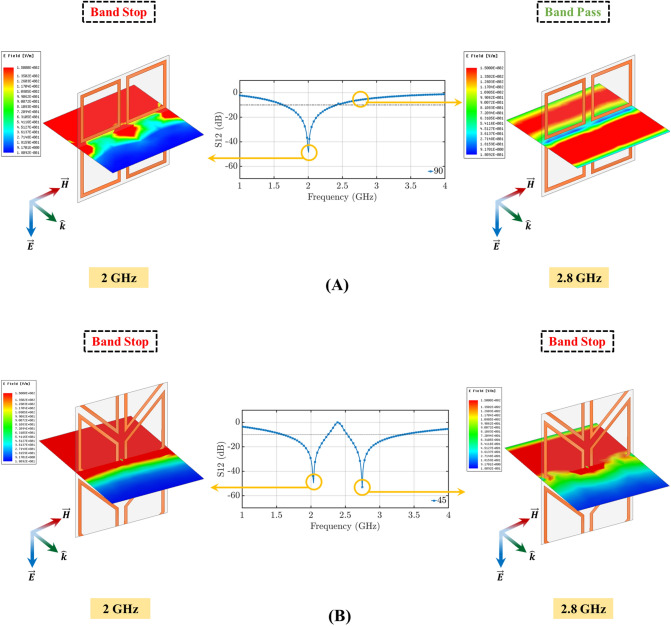
Frequency selective surfaces (FSSs) have been used to control and shape electromagnetic waves. Previous design approaches use complex geometries that are challenging to implement. With the purpose to transform electromagnetic waves, we morph the shapes of FSS designs based on origami patterns to attain new degrees of freedom and achieve enhanced electromagnetic performance. Specifically, using origami patterns with strongly coupled electromagnetic resonators, we transform a single-band FSS to a dual-band FSS. We explain this transformation by showing that both symmetric and anti-symmetric modes are excited due to the strong coupling and suitable orientation of the elements. Also, our origami FSS can fold/unfold thereby tuning (i.e., reconfiguring) its dual-band performance. Therefore, the proposed FSS is a dynamic reconfigurable electromagnetic structure whereas traditional FSSs are static and cannot change their performance.
频率选择表面(FSS)已被用于控制和塑造电磁波。以往的设计方法使用的复杂几何形状实施起来具有挑战性。为了变换电磁波,我们基于折纸图案对FSS设计的形状进行变形,以获得新的自由度并实现增强的电磁性能。具体而言,通过使用具有强耦合电磁谐振器的折纸图案,我们将单频FSS变换为双频FSS。我们通过表明由于元件的强耦合和合适的取向,对称模式和反对称模式均被激发来解释这种变换。此外,我们的折纸FSS可以折叠/展开,从而调谐(即重新配置)其双频性能。因此,所提出的FSS是一种动态可重构电磁结构,而传统的FSS是静态的,无法改变其性能。