Center for Medical Ethics and Health Policy, Baylor College of Medicine, Houston, TX, USA.
Rice University, Houston, TX, USA.
Genet Med. 2020 Dec;22(12):2003-2010. doi: 10.1038/s41436-020-0928-9. Epub 2020 Aug 18.
The use of genomic sequencing (GS) in military settings poses unique considerations, including the potential for GS to impact service members' careers. The MilSeq Project investigated the use of GS in clinical care of active duty Airmen in the United States Air Force (USAF).
We assessed perceived risks, benefits, and attitudes toward use of GS in the USAF among patient participants (n = 93) and health-care provider participants (HCPs) (n = 12) prior to receiving or disclosing GS results.
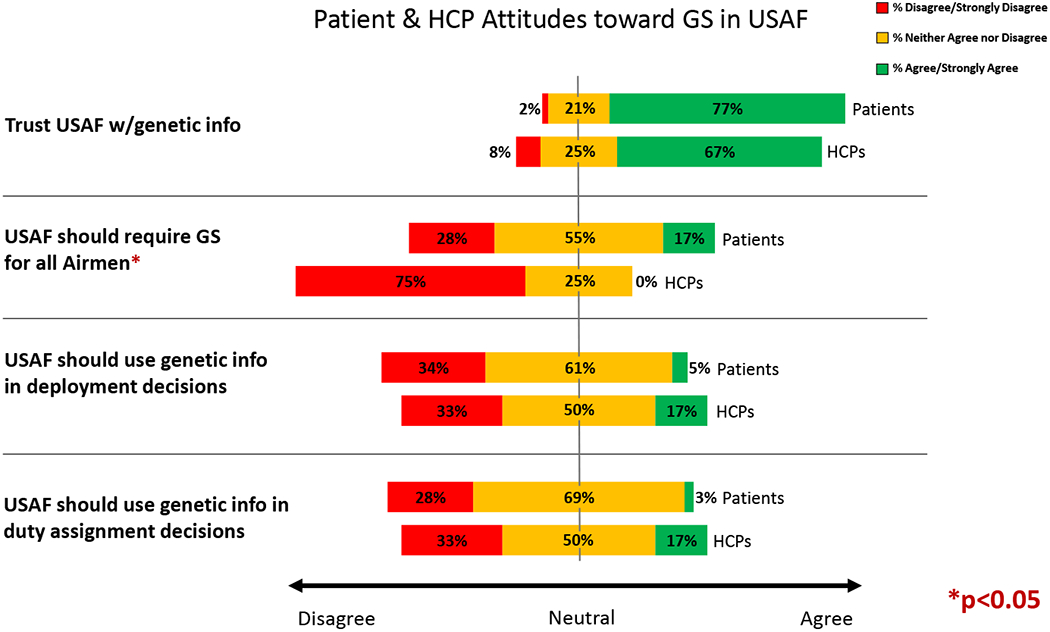
Participants agreed that there are health benefits associated with GS (90% patients, 75% HCPs), though more HCPs (75%) than patients (40%) agreed that there are risks (p = 0.048). The majority of both groups (67% HCPs, 77% patients) agreed that they trust the USAF with genetic information, but far fewer agreed that genetic information should be used to make decisions about deployment (5% patients, 17% HCPs) or duty assignments (3% patients, 17% HCPs). Despite their hesitancy, patients were supportive of the USAF testing for nondisease traits that could impact their duty performance. Eighty-seven percent of patients did not think their GS results would influence their career.
Results suggest favorable attitudes toward the use of GS in the USAF when not used for deployment or assignment decisions.
在军事环境中使用基因组测序(GS)带来了独特的考虑因素,包括 GS 可能对军人的职业生涯产生影响。MilSeq 项目调查了在美国空军(USAF)现役飞行员的临床护理中使用 GS 的情况。
我们在接受或披露 GS 结果之前,评估了患者参与者(n=93)和医疗保健提供者参与者(HCPs)(n=12)对 GS 在 USAF 中使用的感知风险、益处和态度。
参与者一致认为 GS 与健康益处相关(90%的患者,75%的 HCPs),尽管 HCPs(75%)比患者(40%)更同意存在风险(p=0.048)。两组中大多数(67%的 HCPs,77%的患者)都同意他们信任 USAF 处理遗传信息,但很少有人同意使用遗传信息来决定部署(5%的患者,17%的 HCPs)或任务分配(3%的患者,17%的 HCPs)。尽管他们犹豫不决,但患者还是支持 USAF 测试可能影响其任务表现的非疾病特征。87%的患者认为他们的 GS 结果不会影响他们的职业生涯。
结果表明,当 GS 不用于部署或任务分配决策时,在 USAF 中使用 GS 的态度良好。