Center for Medical Ethics and Health Policy, Baylor College of Medicine, Houston, Texas.
Division of Genetics and Genomics, The Manton Center for Orphan Disease Research, Boston Children's Hospital.
Pediatrics. 2019 Jan;143(Suppl 1):S6-S13. doi: 10.1542/peds.2018-1099C.
There is interest in applying genomic sequencing (GS) to newborns' clinical care. Here we explore parents' and clinicians' attitudes toward and perceptions of the risks, benefits, and utility of newborn GS compared with newborn screening (NBS) prior to receiving study results.
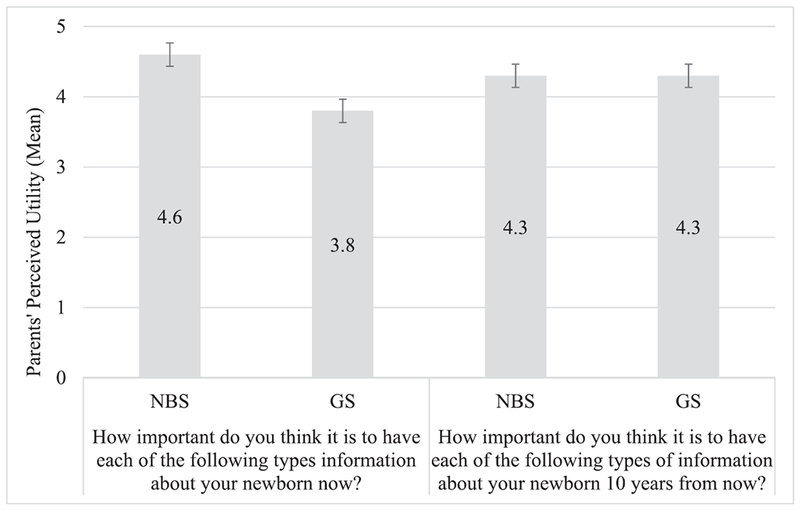
The BabySeq Project is a randomized controlled trial used to explore the impact of integrating GS into the clinical care of newborns. Parents ( = 493) of enrolled infants ( = 309) and clinicians ( = 144) completed a baseline survey at enrollment. We examined between-group differences in perceived utility and attitudes toward NBS and GS. Open-ended responses about risks and benefits of each technology were categorized by theme.
The majority of parents (71%) and clinicians (51%) agreed that there are health benefits of GS, although parents and clinicians agreed more that there are risks associated with GS (35%, 70%) than with NBS (19%, 39%; all < .05). Parents perceived more benefit and less risk of GS than did clinicians. Clinicians endorsed concerns about privacy and discrimination related to genomic information more strongly than did parents, and parents anticipated benefits of GS that clinicians did not.
Parents and clinicians are less confident in GS than NBS, but parents perceive a more favorable risk/benefit ratio of GS than do clinicians. Clinicians should be aware that parents' optimism may stem from their perceived benefits beyond clinical utility.
将基因组测序(GS)应用于新生儿临床护理受到关注。在此,我们探讨了父母和临床医生对新生儿 GS 与新生儿筛查(NBS)的风险、益处和实用性的态度和看法,而这些看法是在收到研究结果之前得出的。
BabySeq 项目是一项随机对照试验,用于探索将 GS 整合到新生儿临床护理中的影响。入组婴儿的父母(=493)和临床医生(=144)在入组时完成了基线调查。我们比较了两组对 NBS 和 GS 的感知效用和态度的差异。对每种技术的风险和益处的开放性回答按照主题进行了分类。
大多数父母(71%)和临床医生(51%)认为 GS 具有健康益处,尽管父母和临床医生都认为 GS 存在风险(35%,70%),而不是 NBS(19%,39%;均<.05)。父母认为 GS 的益处更多,风险更小,而临床医生则认为 GS 的益处和风险都比 NBS 更大。临床医生比父母更强烈地关注与基因组信息相关的隐私和歧视问题,而父母则预期 GS 会带来临床医生没有预期到的益处。
父母和临床医生对 GS 的信心不如 NBS,但父母对 GS 的风险/效益比的看法比临床医生更有利。临床医生应该意识到,父母的乐观态度可能源于他们对 GS 的临床效用之外的益处的看法。