Department of Public Health Sciences, University of Miami, 1120 NW 14th ST, Miami, FL, 33136, USA.
Urban Health Solutions, Miami, FL, USA.
J Racial Ethn Health Disparities. 2021 Jun;8(3):763-772. doi: 10.1007/s40615-020-00838-z. Epub 2020 Aug 17.
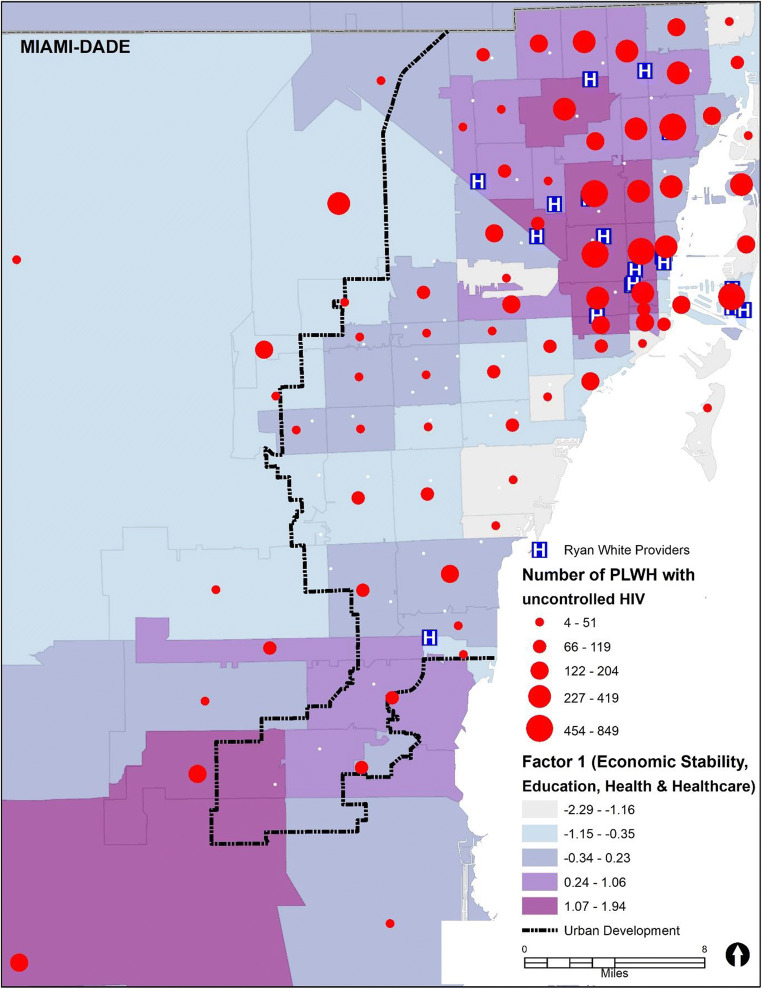
There were 28,055 people living with HIV (PLWH) in Miami-Dade County (MDC) in 2017; 40.1% was either out of care or was not virally suppressed (uncontrolled HIV). The purpose of this study was to determine the association between the social determinants of health (SDOH) and the number of persons with uncontrolled HIV in MDC.
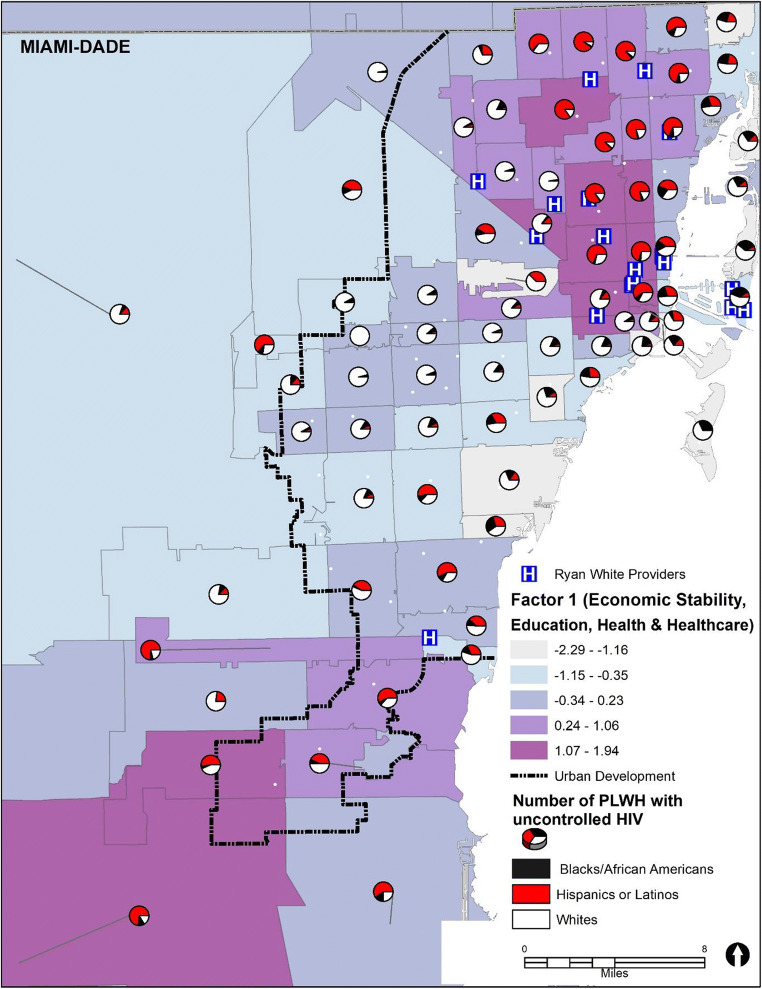
This cross-sectional study included PLWH 15 and older with uncontrolled HIV in MDC, 2017. Data on PLWH's viral load, age, gender, mode of HIV transmission, and race/ethnicity were aggregated to the ZIP code level. All five SDOH per HealthyPeople 2020 were represented: economic stability, education, social and community context, health and healthcare, and neighborhood and built environment.
Descriptive analyses on all study variables and a principal component analysis on the SDOH variables were performed. To account for overdispersion, multivariate negative binomial regressions were run while controlling for confounders and testing for significant interactions.
The results of the regression analysis indicated that an increase in Factor 1 (economic stability, education, and health and healthcare determinants) was associated with a statistically significant increase in the number of PLWH with uncontrolled HIV. Additionally, we found a significant interaction between Factor 1 and White race. Among persons of low socioeconomic status, White race is associated with a reduction in PLWH with uncontrolled HIV.
These results suggest that reducing poverty and increasing education and rates of health insurance should result in significant reductions in PLWH with uncontrolled HIV. These results have the potential to influence future policy, interventions for retention, adherence, and continuity of care to improve suppression rates in MDC.
2017 年,迈阿密-戴德县(MDC)有 28055 名艾滋病毒感染者(PLWH);其中 40.1%的人要么脱离治疗,要么病毒未得到抑制(HIV 未得到控制)。本研究的目的是确定健康的社会决定因素(SDOH)与 MDC 中未得到控制的 HIV 感染者人数之间的关联。
本横断面研究纳入了 MDC 中未得到控制的 15 岁及以上的 PLWH,2017 年。PLWH 的病毒载量、年龄、性别、HIV 传播途径和种族/族裔的数据被汇总到邮政编码级别。所有五个 HealthyPeople 2020 的 SDOH 都有代表:经济稳定性、教育、社会和社区环境、健康和医疗保健以及邻里和建筑环境。
对所有研究变量进行描述性分析,并对 SDOH 变量进行主成分分析。为了考虑过度分散,在控制混杂因素并检验显著交互作用的情况下,进行了多变量负二项回归分析。
回归分析的结果表明,Factor 1(经济稳定性、教育和健康和医疗保健决定因素)的增加与未得到控制的 HIV 感染者人数的统计学显著增加相关。此外,我们发现 Factor 1 和白人种族之间存在显著的交互作用。在社会经济地位较低的人群中,白人种族与未得到控制的 HIV 感染者人数减少有关。
这些结果表明,减少贫困和提高教育水平以及医疗保险率应会导致未得到控制的 HIV 感染者人数显著减少。这些结果有可能影响未来的政策、保留、坚持和连续性护理干预措施,以提高 MDC 的抑制率。