Laboratory Department, Union Jiangbei Hospital, Wuhan, China.
Emergency Department, China-Japan Friendship Hospital, Beijing, China.
Ann Med. 2021 Dec;53(1):34-42. doi: 10.1080/07853890.2020.1811887. Epub 2020 Oct 1.
Studies have demonstrated the diagnostic efficiency of antibody testing in COVID-19 infection. There is limited data on the IgM/IgG changes in asymptomatic and discharged patients with reoccurring positive nucleic acid test (RPNAT). This study aims to investigate these IgM/IgG changes.
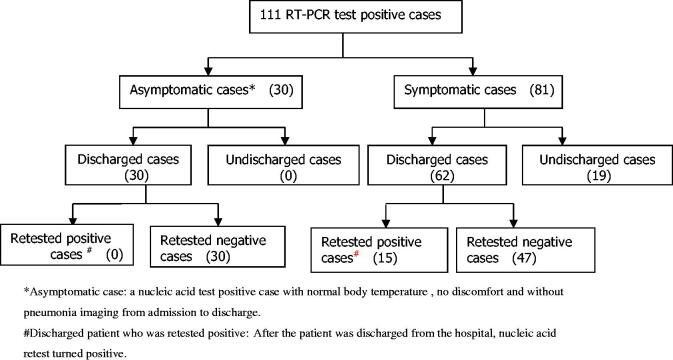
There were 111 patients with positive nucleic acid test (NAT) and 40 suspected patients enrolled in the study. The serum SARS-CoV-2 specific IgM/IgG antibody levels were retrospectively analysed with the disease progress in asymptomatic and RPNAT patients.
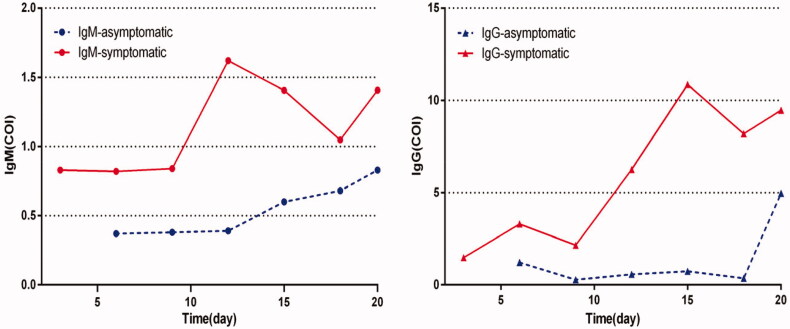
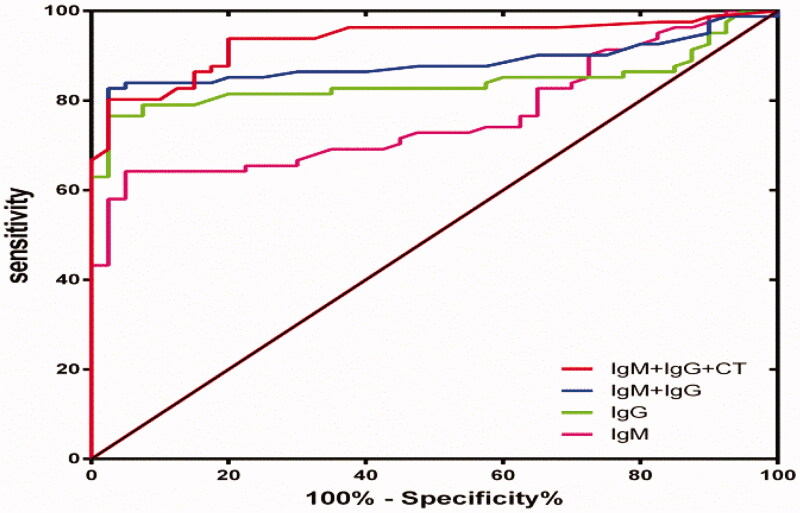
The best overall performance was found by combining the IgM, IgG, and CT; 95.1% sensitivity and 75% specificity. This was tested in 111 RT-PCR positive cases. The median IgM and IgG levels were lower in the asymptomatic group compared to the symptomatic group ( < .01). Among 15 RPNAT cases, the IgM levels of the RPNAT group at the time of discharge (IgM2.79, IQR: 0.95-5.37) and retest (IgM 2.35, IQR: 0.88-8.65) were significantly higher than those of the non-reoccurring positive nucleic acid test group (Non-RPNAT) (IgM on discharge: 0.59, IQR: 0.33-1.22, IgG on retest: 0.92, IQR: 0.51-1.58).
Serum SARS-CoV-2 specific IgM/IgG antibody levels remained at a low level during hospitalisation for asymptomatic patients. Elevated IgM levels may have implications in the identification of RPNAT patients before discharge. Key messages This study determined the IgM/IgG changes in asymptomatic and RPNAT patients. The rate of serum SARS-CoV-2 specific IgM/IgG antibody levels increase in the asymptomatic group was lower than in the symptomatic group during hospitalisation. The IgM level did not decrease significantly at discharge in the RPNAT patients, and was higher than that of the Non-RPNAT group on discharge. These results highlight the importance of timely monitoring of IgM levels to identify RPNAT patients before discharge.
研究表明抗体检测在 COVID-19 感染中的诊断效率。关于无症状和出院后核酸检测(RPNAT)再次阳性患者的 IgM/IgG 变化,数据有限。本研究旨在探讨这些 IgM/IgG 的变化。
共纳入 111 例核酸检测阳性(NAT)患者和 40 例疑似患者。回顾性分析无症状和 RPNAT 患者的疾病进展与 SARS-CoV-2 特异性 IgM/IgG 抗体水平。
在 111 例 RT-PCR 阳性病例中,IgM、IgG 和 CT 联合检测的整体性能最佳;敏感性为 95.1%,特异性为 75%。无症状组的 IgM 和 IgG 中位数水平低于有症状组( < .01)。在 15 例 RPNAT 病例中,RPNAT 组出院时(IgM2.79,IQR:0.95-5.37)和复测时(IgM 2.35,IQR:0.88-8.65)的 IgM 水平明显高于非再发性阳性核酸检测组(Non-RPNAT)(出院时 IgM:0.59,IQR:0.33-1.22,复测时 IgG:0.92,IQR:0.51-1.58)。
无症状患者住院期间血清 SARS-CoV-2 特异性 IgM/IgG 抗体水平仍处于低水平。IgM 水平升高可能提示出院前 RPNAT 患者的识别。
本研究确定了无症状和 RPNAT 患者的 IgM/IgG 变化。无症状组住院期间血清 SARS-CoV-2 特异性 IgM/IgG 抗体水平升高率低于有症状组。RPNAT 患者出院时 IgM 水平未明显下降,且高于 Non-RPNAT 组。这些结果强调了及时监测 IgM 水平以识别出院前 RPNAT 患者的重要性。