Department of Cardiology, University Medical Centre Groningen, University of Groningen, Groningen, the Netherlands.
Eur J Heart Fail. 2020 Nov;22(11):2065-2074. doi: 10.1002/ejhf.1988. Epub 2020 Sep 22.
Cardiac specificity provides an advantage in correlating heart failure (HF) biomarker plasma levels with indices of cardiac function and remodelling, as shown for natriuretic peptides. Using bioinformatics, we explored the cardiac specificity of secreted proteins and investigated in more detail the relationship of Dickkopf-3 (DKK3) gene expression and DKK3 plasma concentrations with cardiac function and remodelling in (pre)clinical studies.
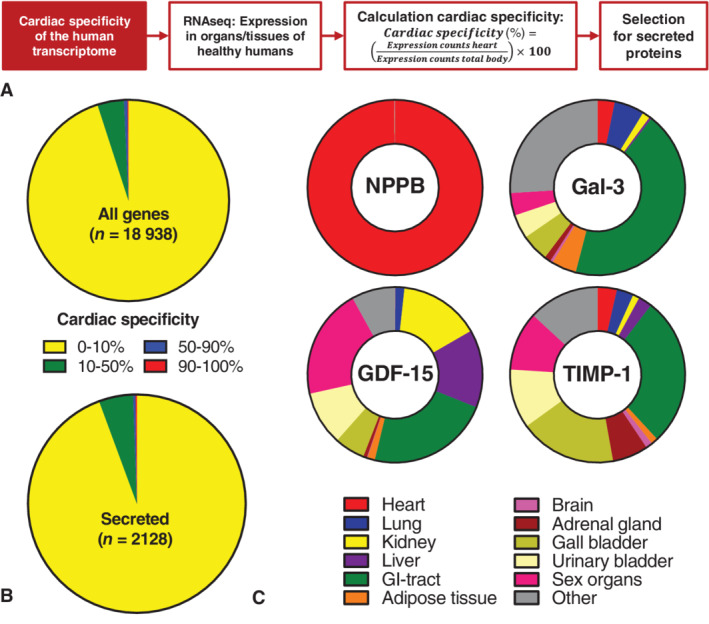
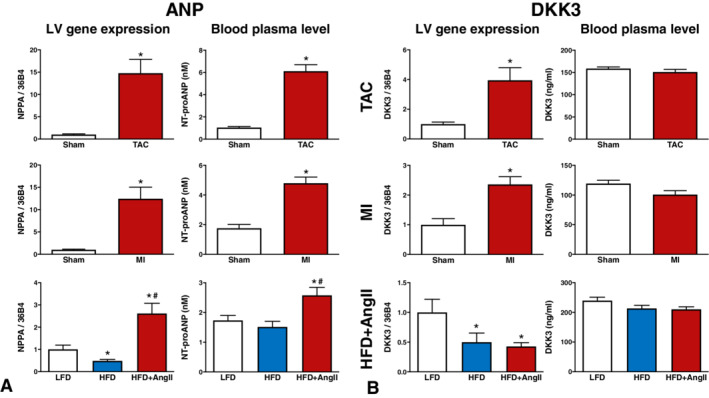
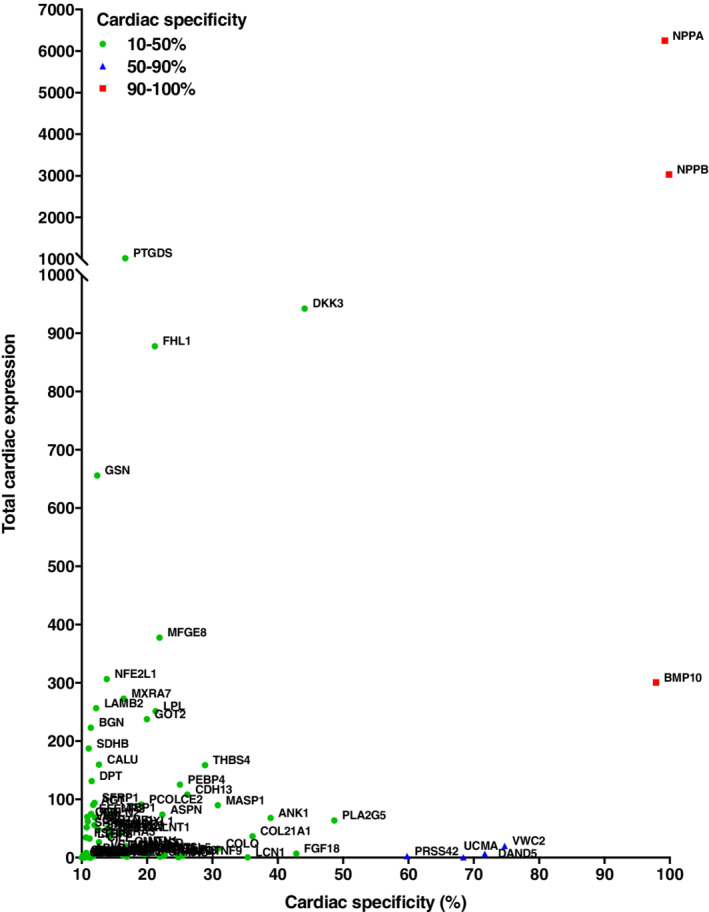
The cardiac specificity of secreted proteins was determined using RNAseq data for a large panel of organs and tissues. This showed that natriuretic peptides (NPPA and NPPB) are highly cardiac-specific (>99%), whereas other HF biomarkers, including galectin-3 (Gal-3, LGALS3) and growth differentiation factor-15 (GDF-15), lack cardiac specificity (<4%). DKK3 was cardiac-enriched (44%), warranting further investigation. In three different HF mouse models, cardiac Dkk3 expression was altered, but DKK3 plasma concentrations were not. In humans, DKK3 plasma concentrations were higher in HF patients (n = 2090) in comparison with age- and sex-matched controls without HF (n = 240) (46.4 ng/mL vs. 36.3 ng/mL; P < 0.001). Multivariate regression analysis revealed that DKK3 was strongly associated with HF risk factors and comorbidities, including age, kidney function and atrial fibrillation. After correction for existing prediction models, DKK3 did not independently predict HF outcome [all-cause mortality/HF hospitalization, hazard ratio 1.13 (0.79-1.61) per DKK3 doubling; P = 0.503].
Of actively secreted HF biomarkers, only natriuretic peptides showed high cardiac specificity. Despite a cardiac specificity of 44%, secreted DKK3 had limited additional diagnostic and prognostic value.
与心力衰竭(HF)生物标志物的血浆水平与心脏功能和重构的指数相关联,心脏特异性提供了一个优势,正如利钠肽所显示的那样。我们使用生物信息学方法探索了分泌蛋白的心脏特异性,并在更详细地研究了 Dickkopf-3(DKK3)基因表达与心脏功能和重构的关系。在临床前研究中。
使用大量器官和组织的 RNAseq 数据确定了分泌蛋白的心脏特异性。这表明利钠肽(NPPA 和 NPPB)具有高度的心脏特异性(>99%),而其他 HF 生物标志物,包括半乳糖凝集素-3(Gal-3,LGALS3)和生长分化因子-15(GDF-15),缺乏心脏特异性(<4%)。 DKK3 是心脏富集的(44%),需要进一步研究。在三种不同的 HF 小鼠模型中,心脏 Dkk3 表达发生改变,但 DKK3 血浆浓度未发生改变。在人类中,HF 患者(n=2090)的 DKK3 血浆浓度高于年龄和性别匹配的无 HF 对照组(n=240)(46.4ng/mL 与 36.3ng/mL;P<0.001)。多元回归分析显示,DKK3 与 HF 的危险因素和合并症密切相关,包括年龄、肾功能和心房颤动。在纠正现有预测模型后,DKK3 不能独立预测 HF 结局[全因死亡率/HF 住院,每 DKK3 加倍的危险比为 1.13(0.79-1.61);P=0.503]。
在主动分泌的 HF 生物标志物中,只有利钠肽显示出高心脏特异性。尽管心脏特异性为 44%,但分泌的 DKK3 的诊断和预后价值有限。