Zhu Jianzhi, Xiao Tingting, Zhang Jiulong, Che Hailong, Shi Yuxin, Shi Xiangyang, van Hest Jan C M
Bio-Organic Chemistry, Institute for Complex Molecular Systems, Eindhoven University of Technology, 5600 MB Eindhoven, The Netherlands.
State Key Laboratory for Modification of Chemical Fibers and Polymer Materials, International Joint Laboratory for Advanced Fiber and Low-dimension Materials, College of Chemistry, Chemical Engineering and Biotechnology, Donghua University, Shanghai 201620, People's Republic of China.
ACS Nano. 2020 Sep 22;14(9):11225-11237. doi: 10.1021/acsnano.0c03080. Epub 2020 Aug 18.
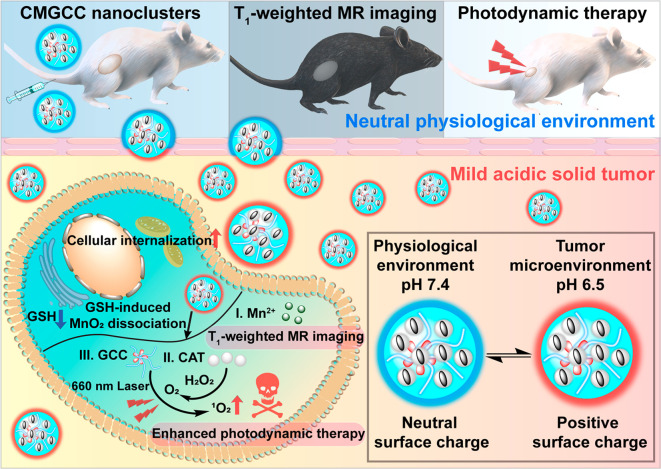
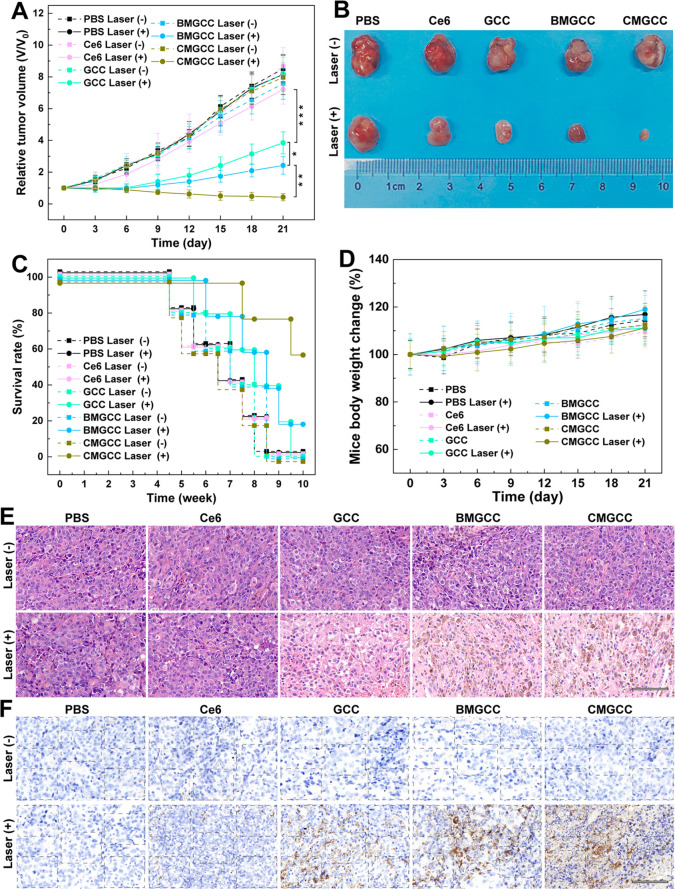
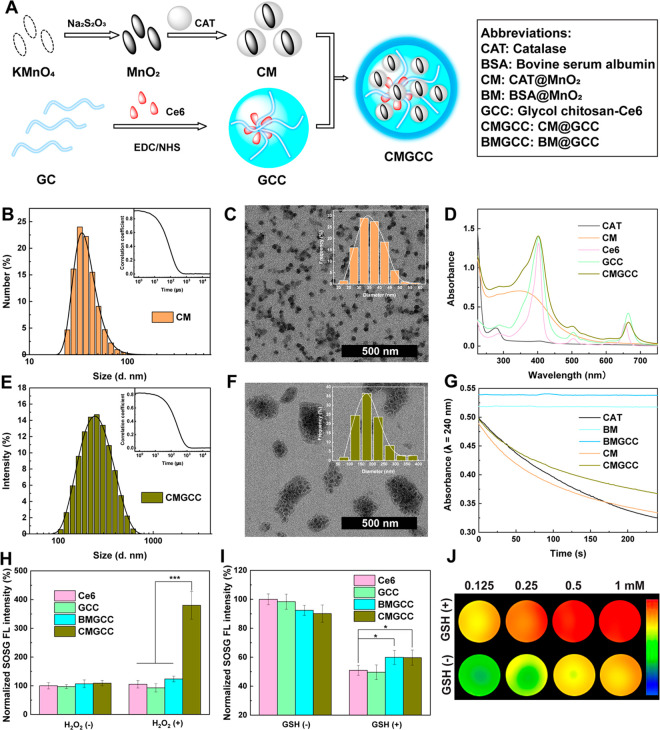
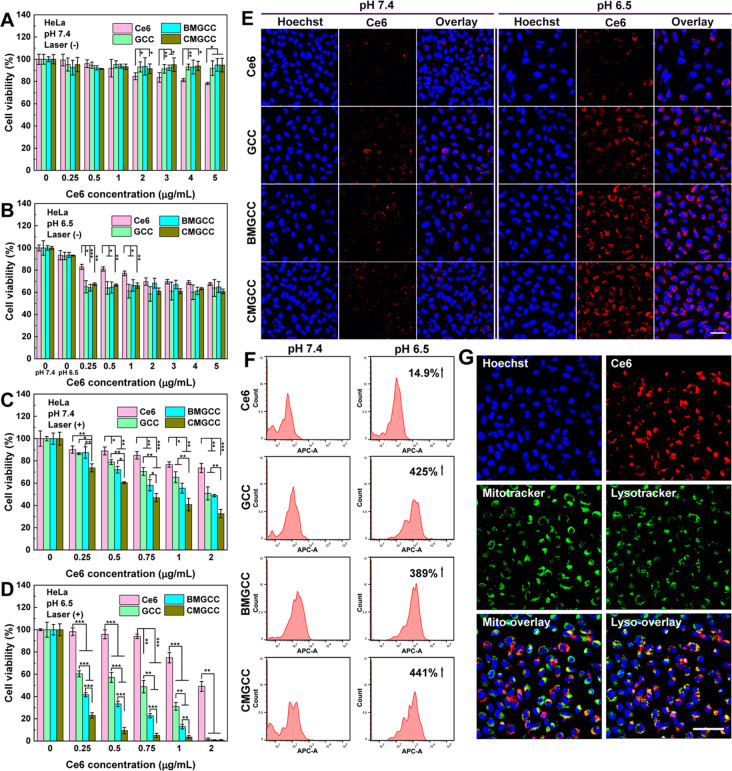
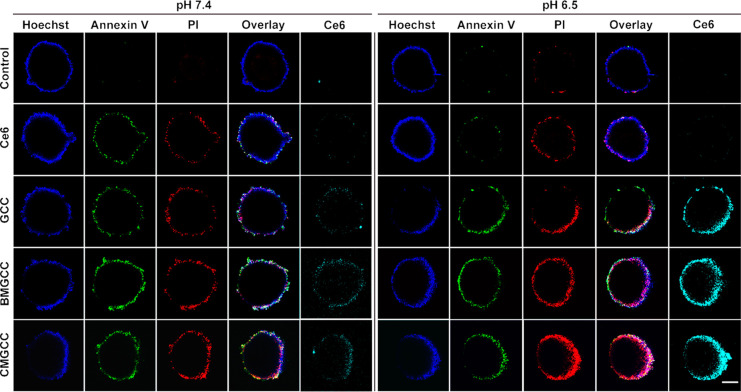
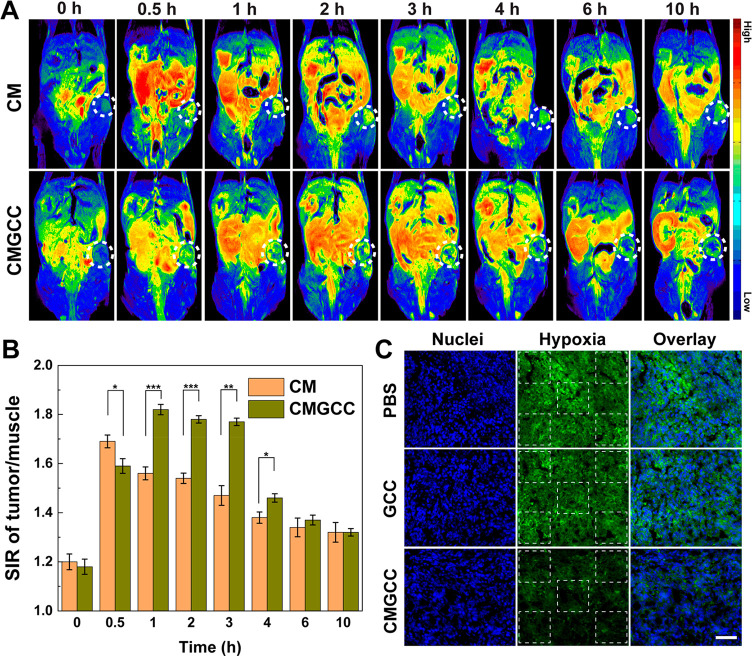
Photodynamic therapy (PDT) is an effective noninvasive therapeutic method that employs photosensitizers (PSs) converting oxygen to highly cytotoxic singlet oxygen (O) under light irradiation. The conventional PDT efficacy is, however, compromised by the nonspecific delivery of PSs to tumor tissue, the hypoxic tumor microenvironment, and the reduction of generated O by the intracellular antioxidant glutathione (GSH). Herein, an intelligent multifunctional synergistic nanoplatform (CMGCC) for -weighted magnetic resonance (MR) imaging-guided enhanced PDT is presented, which consists of nanoparticles composed of catalase (CAT) and manganese dioxide (MnO) that are integrated within chlorin-e6-modified glycol chitosan (GC) polymeric micelles. In this system, (1) GC polymers with pH-sensitive surface charge switchability from neutral to positive could improve the PS accumulation within the tumor region, (2) CAT could effectively reoxygenate the hypoxic tumor catalyzing endogenous hydrogen peroxide to O, and (3) MnO could consume the intracellular GSH while simultaneously producing Mn as a contrast agent for -weighted MR imaging. The CMGCC particles possess uniform size distribution, well-defined structure, favorable enzyme activity, and superior O generation ability. Both and experiments demonstrate that the CMGCC exhibit significantly enhanced PDT efficacy toward HeLa cells and subcutaneous HeLa tumors. Our study thereby demonstrates this to be a promising synergistic theranostic nanoplatform with highly efficient PDT performance for cancer therapy.
光动力疗法(PDT)是一种有效的非侵入性治疗方法,该方法利用光敏剂(PSs)在光照射下将氧气转化为具有高度细胞毒性的单线态氧(O)。然而,传统的PDT疗效受到以下因素的影响:PSs向肿瘤组织的非特异性递送、缺氧的肿瘤微环境以及细胞内抗氧化剂谷胱甘肽(GSH)对所产生的O的消耗。在此,我们提出了一种用于加权磁共振(MR)成像引导下增强PDT的智能多功能协同纳米平台(CMGCC),它由包含过氧化氢酶(CAT)和二氧化锰(MnO)的纳米颗粒组成,这些纳米颗粒整合在二氢卟吩 - e6修饰的壳聚糖(GC)聚合物胶束中。在这个系统中,(1)具有pH敏感表面电荷从中性转变为正性的GC聚合物可以改善PS在肿瘤区域的积累,(2)CAT可以通过催化内源性过氧化氢生成O有效地使缺氧肿瘤再充氧,并且(3)MnO可以消耗细胞内的GSH,同时产生Mn作为加权MR成像的造影剂。CMGCC颗粒具有均匀的尺寸分布、明确的结构、良好的酶活性和优异的O生成能力。体外和体内实验均表明,CMGCC对HeLa细胞和皮下HeLa肿瘤表现出显著增强的PDT疗效。我们的研究因此证明这是一种有前景的协同诊疗纳米平台,具有用于癌症治疗的高效PDT性能。