Qi Ying, Huang Jia-Lin, Zhang Shi-Bao
Key Laboratory for Economic Plants and Biotechnology, Kunming Institute of Botany, Chinese Academy of Sciences, Kunming, Yunnan, China.
University of Chinese Academy of Sciences, Beijing, China.
AoB Plants. 2020 Jul 20;12(4):plaa034. doi: 10.1093/aobpla/plaa034. eCollection 2020 Aug.
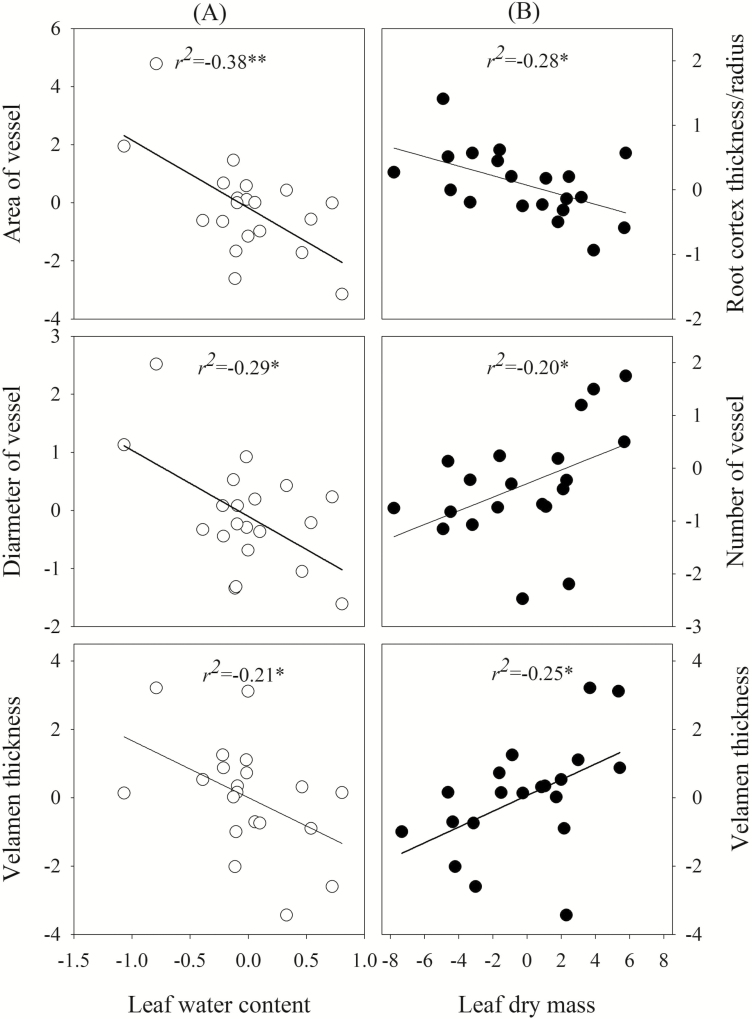
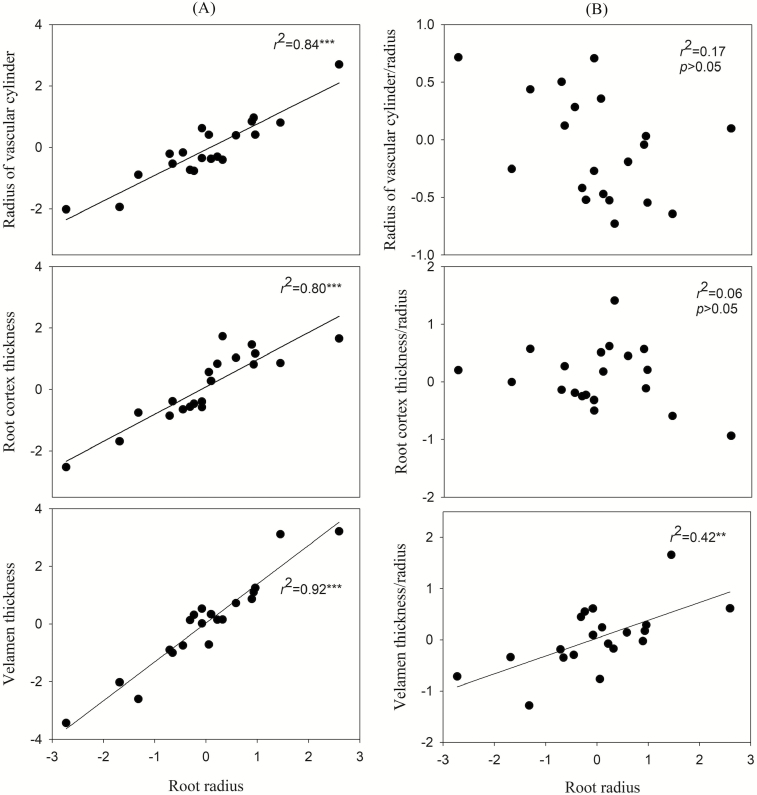
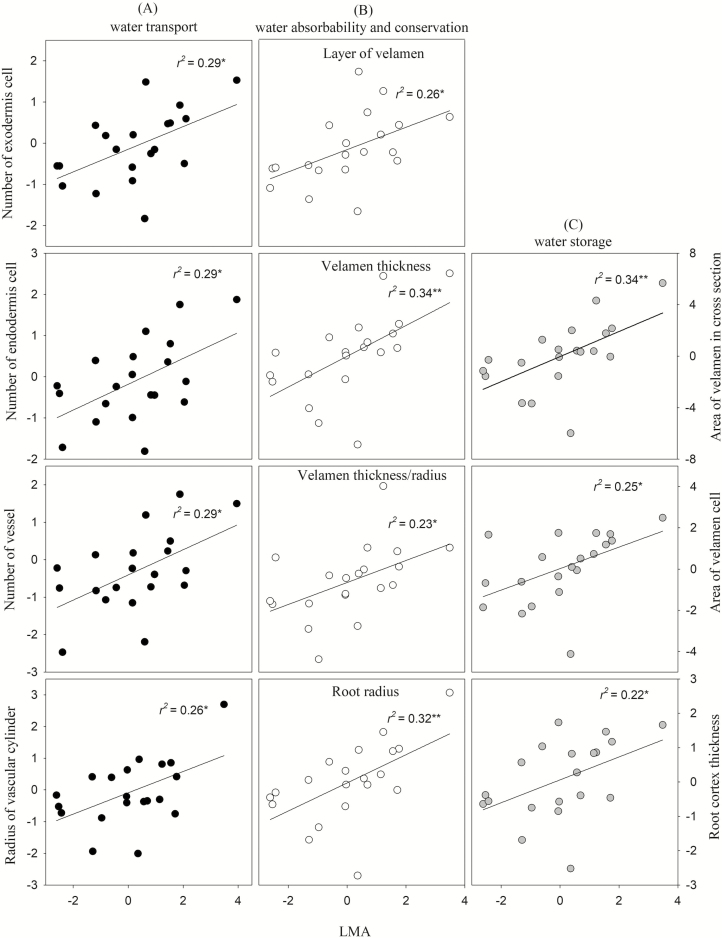
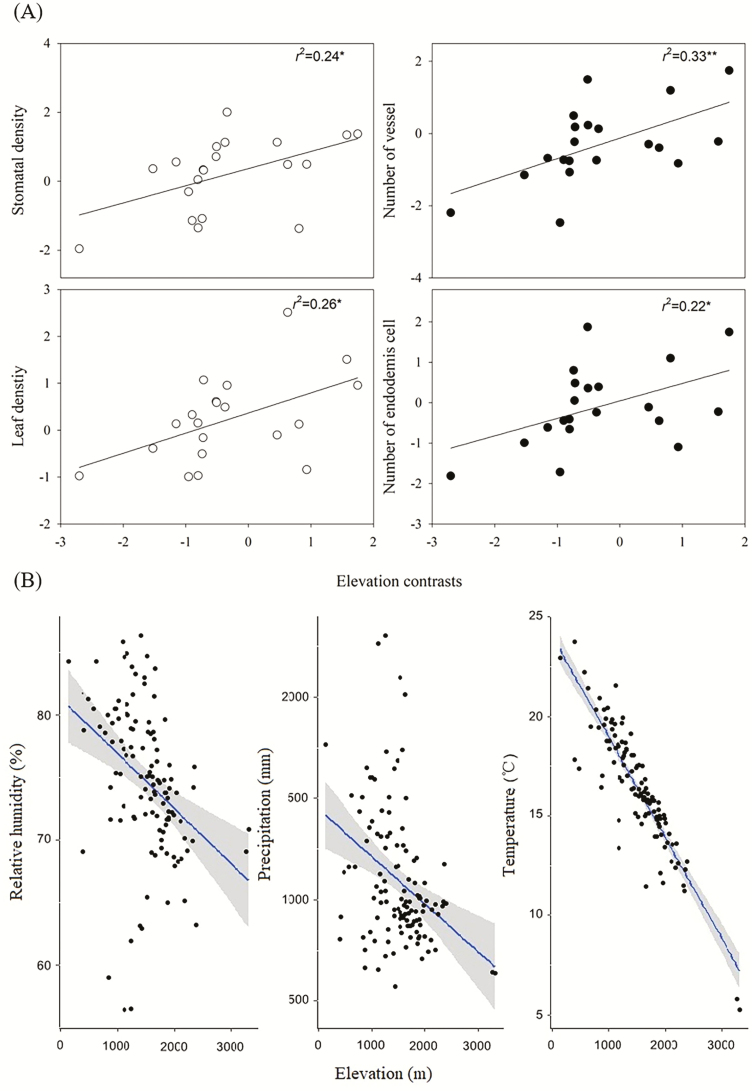
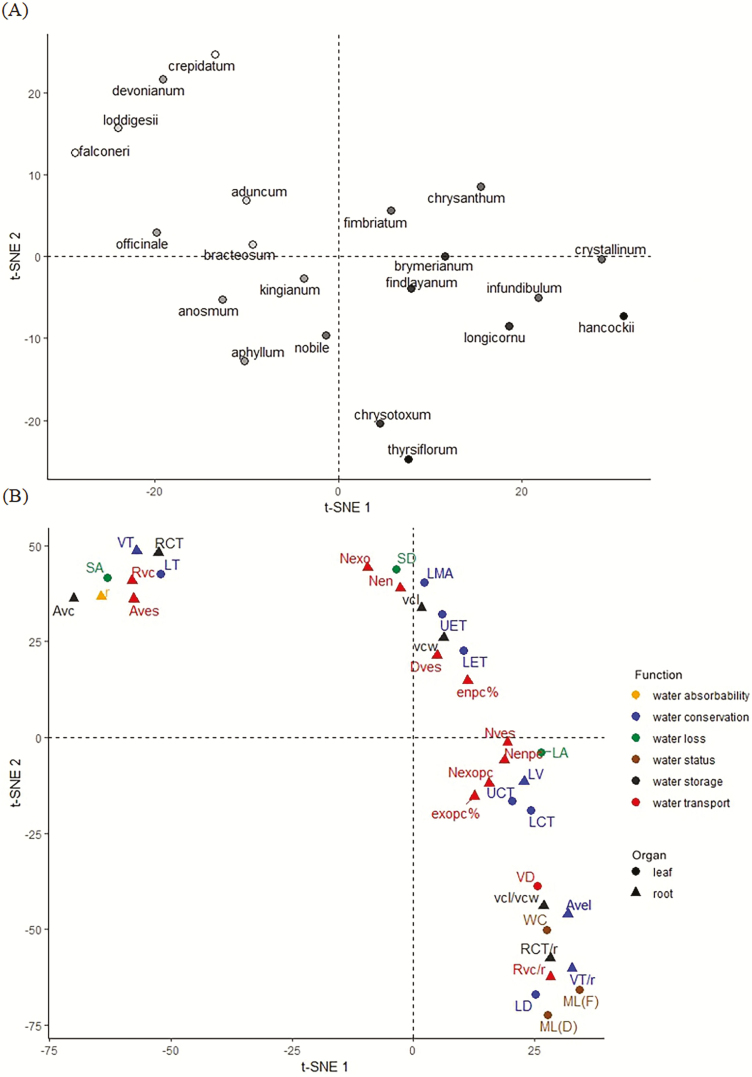
The whole-plant economic spectrum concept predicts that leaf and root traits evolve in coordination to cope with environmental stresses. However, this hypothesis is difficult to test in many species because their leaves and roots are exposed to different environments, above- and below-ground. In epiphytes, both leaves and roots are exposed to the atmosphere. Thus, we suspect there are consistent water conservation strategies in leaf and root traits of epiphytes due to similar selection pressures. Here, we measured the functional traits of 21 species in the genus , which is one of the largest epiphytic taxa in the family Orchidaceae, and used phylogenetically independent contrasts to test the relationships among traits, and between traits and the environment. Our results demonstrate that species with a thicker velamen tended to have thicker roots, a thicker root cortex and vascular cylinder, and a larger number of vessels in the root. Correspondingly, these species also had higher leaf mass per area, and thicker leaf lower cuticles. Leaf and root traits associated with water conservation showed significantly positive relationships. The number of velamen layers, leaf density and the ratio of vascular cylinder radius to root radius were significantly affected by the species' differing environments. Thus, traits related to water conservation and transport may play an important role in helping cope with the cool and dry conditions found at high elevations. These findings confirmed the hypothesis that leaf and root traits have evolved in coordination, and also provide insights into trait evolution and ecological adaptation in epiphytic orchids.
全株经济谱概念预测,叶片和根系性状会协同进化以应对环境压力。然而,这一假设在许多物种中难以验证,因为它们的叶片和根系暴露于不同的环境中,即地上和地下环境。在附生植物中,叶片和根系都暴露于大气中。因此,我们推测由于相似的选择压力,附生植物的叶片和根系性状存在一致的水分保持策略。在此,我们测量了兰科最大的附生类群之一某属21个物种的功能性状,并使用系统发育独立对比来检验性状之间以及性状与环境之间的关系。我们的结果表明,根被较厚的物种往往具有更粗的根系、更厚的根皮层和维管束柱,以及根中更多的导管。相应地,这些物种的单位面积叶质量也更高,叶片下表皮更厚。与水分保持相关的叶片和根系性状呈现出显著的正相关关系。根被层数、叶片密度以及维管束柱半径与根半径的比值受物种不同环境的显著影响。因此,与水分保持和运输相关的性状可能在帮助某属植物应对高海拔地区凉爽干燥的条件方面发挥重要作用。这些发现证实了叶片和根系性状协同进化的假设,也为附生兰花的性状进化和生态适应提供了见解。