Department of Biomedical Science, University of Sheffield, Western Bank, Sheffield S10 2TN, U.K.
Biochem Soc Trans. 2020 Aug 28;48(4):1297-1308. doi: 10.1042/BST20190404.
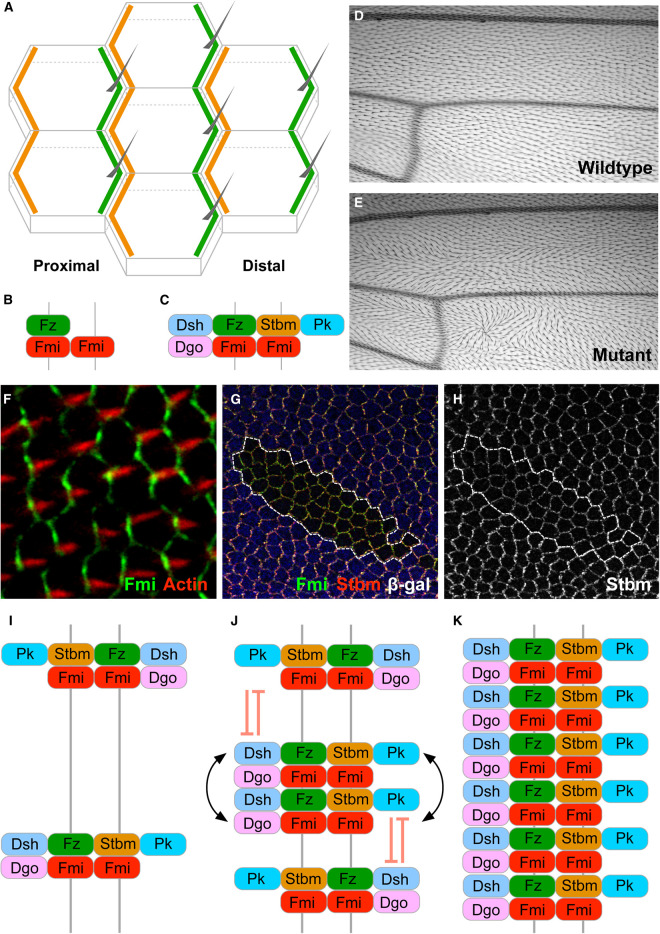
Planar polarity refers to cellular polarity in an orthogonal plane to apicobasal polarity, and is seen across scales from molecular distributions of proteins to tissue patterning. In many contexts it is regulated by the evolutionarily conserved 'core' planar polarity pathway that is essential for normal organismal development. Core planar polarity pathway components form asymmetric intercellular complexes that communicate polarity between neighbouring cells and direct polarised cell behaviours and the formation of polarised structures. The core planar polarity pathway consists of six structurally different proteins. In the fruitfly Drosophila melanogaster, where the pathway is best characterised, an intercellular homodimer of the seven-pass transmembrane protein Flamingo interacts on one side of the cell junction with the seven-pass transmembrane protein Frizzled, and on the other side with the four-pass transmembrane protein Strabismus. The cytoplasmic proteins Diego and Dishevelled are co-localised with Frizzled, and Prickle co-localises with Strabismus. Between these six components there are myriad possible molecular interactions, which could stabilise or destabilise the intercellular complexes and lead to their sorting into polarised distributions within cells. Post-translational modifications are key regulators of molecular interactions between proteins. Several post-translational modifications of core proteins have been reported to be of functional significance, in particular phosphorylation and ubiquitination. In this review, we discuss the molecular control of planar polarity and the molecular ecology of the core planar polarity intercellular complexes. Furthermore, we highlight the importance of understanding the spatial control of post-translational modifications in the establishment of planar polarity.
平面极性是指与顶底极性正交的细胞极性,从蛋白质的分子分布到组织模式,在各个尺度上都可见到。在许多情况下,它受到进化保守的“核心”平面极性途径的调节,该途径对于正常的生物体发育是必不可少的。核心平面极性途径的组成部分形成不对称的细胞间复合物,在相邻细胞之间传递极性,并指导极化细胞行为和极化结构的形成。核心平面极性途径由六种结构不同的蛋白质组成。在果蝇 Drosophila melanogaster 中,该途径的特征最为明显,七跨膜蛋白 Flamingo 的细胞间同源二聚体在细胞连接的一侧与七跨膜蛋白 Frizzled 相互作用,另一侧与四跨膜蛋白 Strabismus 相互作用。细胞质蛋白 Diego 和 Dishevelled 与 Frizzled 共定位,Prickle 与 Strabismus 共定位。在这六个组成部分之间,存在着无数可能的分子相互作用,这些相互作用可以稳定或破坏细胞间复合物,并导致它们在细胞内进行极化分布。翻译后修饰是蛋白质之间分子相互作用的关键调节剂。已经报道了几种核心蛋白的翻译后修饰具有功能意义,特别是磷酸化和泛素化。在这篇综述中,我们讨论了平面极性的分子控制以及核心平面极性细胞间复合物的分子生态学。此外,我们强调了理解翻译后修饰的空间控制在建立平面极性中的重要性。