Zheng Guoqiao, Sundquist Kristina, Sundquist Jan, Försti Asta, Hemminki Akseli, Hemminki Kari
Division of Molecular Genetic Epidemiology, German Cancer Research Center (DKFZ), Heidelberg D-69120, Germany.
Division of Cancer Epidemiology, German Cancer Research Center (DKFZ), Heidelberg D-69120, Germany.
Clin Epidemiol. 2020 Aug 6;12:857-864. doi: 10.2147/CLEP.S256662. eCollection 2020.
Most literature on second primary cancers (SPCs) focuses on possible factors, which may increase the risk of these cancers, and little attention has been paid for the overall incidence differences between first primary cancers (FPCs) and same SPCs. We wanted to compare the incidence rates for all common cancers when these were diagnosed as FPCs and SPCs after invasive and in situ squamous cell carcinoma (SCC) of the skin, which are usually treated by surgery only.
Cancers were identified from the Swedish Cancer Registry from the years 1990 through to 2015, and they included, in addition to skin cancers, 20 male cancers totaling 484,850 patients and 22 female cancers totaling 452,909 patients. Standardized incidence rates and relative risks (RRs) were calculated for sex-specific common cancers as FPC and as SPC after skin SCC. Spearman rank correlations were used in the analysis of incidence ranking of FPC and SPC.
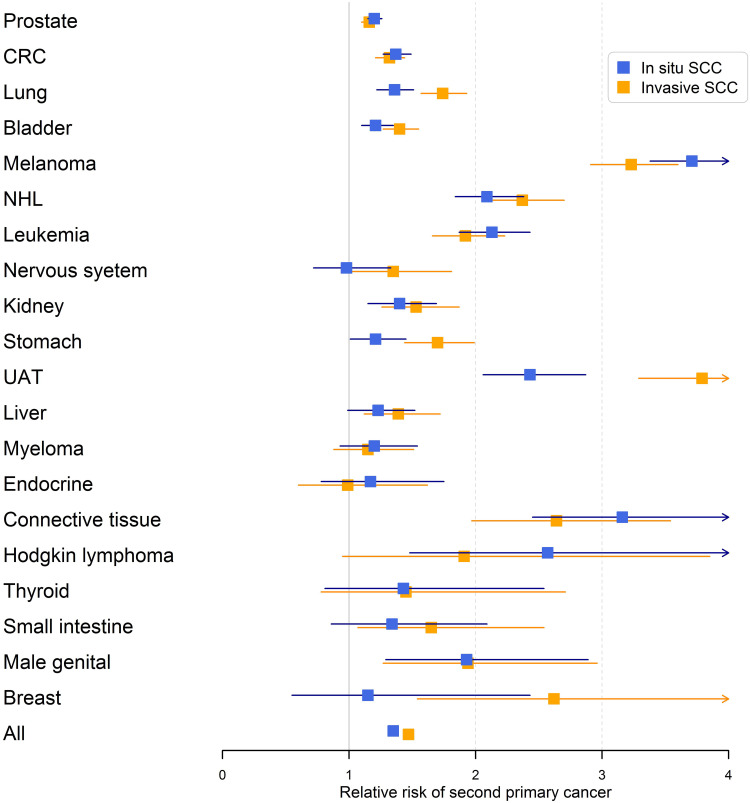
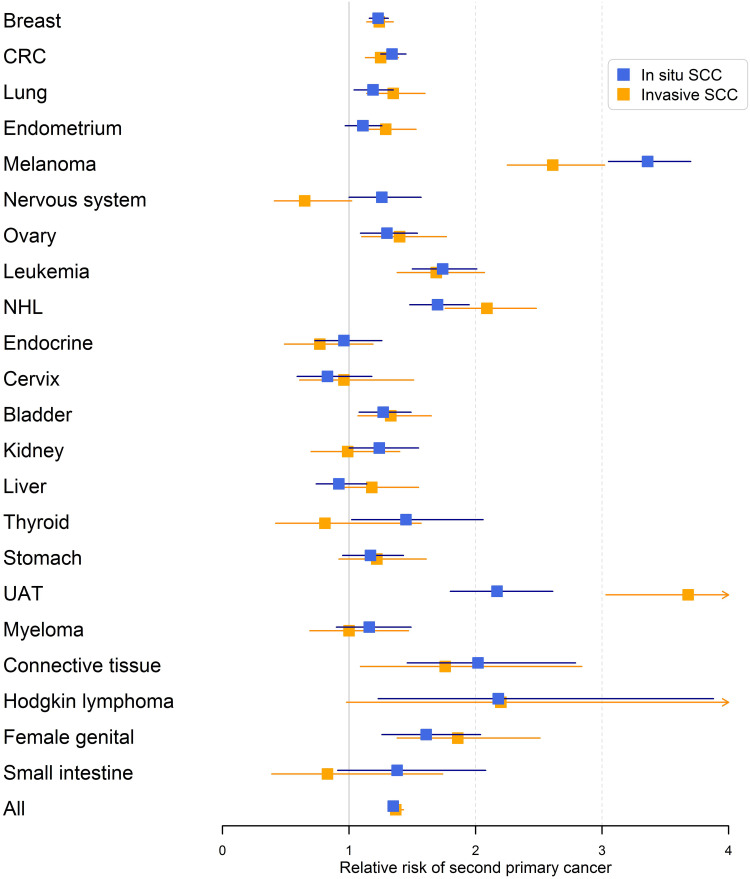
Of total, 29,061 men and 23,533 women developed invasive SCC and 27,842 men and 36,383 women in situ SCC. The total number of 20 other male cancers was 484,850 and of 22 female cancers it was 452,909. Rank correlations ranged from 0.90 to 0.96 (P~5×10), indicating that overall skin SCC did not interfere with SPC formation. The exceptions were increased SPC risks for melanoma, sharing risk factors with skin SCC, and non-Hodgkin and Hodgkin lymphoma, and cancers of the upper aerodigestive tract, connective tissue, and male and female genitals suggesting contribution by skin cancer initiated immune dysfunction.
The incidence ranking of SPCs after skin cancers largely follows the incidence ranking of FPCs indicating that overall skin SCC does not greatly interfere with the intrinsic carcinogenic process. The main deviations in incidence between FPC and SPC appeared to be due to shared risk factors or immunological processes promoting immune responsive cancer types.
大多数关于第二原发性癌症(SPC)的文献都聚焦于可能增加这些癌症风险的因素,而对于第一原发性癌症(FPC)和同一SPC之间的总体发病率差异关注甚少。我们希望比较所有常见癌症在被诊断为FPC以及在皮肤浸润性和原位鳞状细胞癌(SCC)后作为SPC时的发病率,皮肤SCC通常仅通过手术治疗。
从瑞典癌症登记处识别出1990年至2015年的癌症病例,除皮肤癌外,包括20种男性癌症共484,850例患者以及22种女性癌症共452,909例患者。计算了特定性别常见癌症作为FPC以及皮肤SCC后作为SPC的标准化发病率和相对风险(RR)。在分析FPC和SPC的发病率排名时使用了Spearman等级相关性。
总共有29,061名男性和23,533名女性发生浸润性SCC,27,842名男性和36,383名女性发生原位SCC。其他20种男性癌症的总数为484,850例,22种女性癌症的总数为452,909例。等级相关性范围为0.90至0.96(P~5×10),表明总体皮肤SCC不会干扰SPC的形成。例外情况是黑色素瘤的SPC风险增加,其与皮肤SCC有共同风险因素,以及非霍奇金淋巴瘤和霍奇金淋巴瘤,还有上消化道、结缔组织以及男性和女性生殖器的癌症,这表明皮肤癌引发的免疫功能障碍起到了作用。
皮肤癌后SPC的发病率排名在很大程度上遵循FPC的发病率排名,这表明总体皮肤SCC不会对内在致癌过程产生很大干扰。FPC和SPC之间发病率的主要偏差似乎是由于共同的风险因素或促进免疫反应性癌症类型的免疫过程。