López-Cano Carolina, Gutiérrez-Carrasquilla Liliana, Barbé Ferran, Sánchez Enric, Hernández Marta, Martí Raquel, Ceperuelo-Mallafre Vicky, Dalmases Mireia, Fernández-Veledo Sonia, Vendrell Joan, Hernández Cristina, Simó Rafael, Lecube Albert
Endocrinology and Nutrition Department, University Hospital Arnau de Vilanova, Obesity, Diabetes and Metabolism (ODIM) Research Group, IRBLleida, University of Lleida, 25198 Lleida, Spain.
Respiratory Department, University Hospital Arnau de Vilanova-Santa María, Translational Research in Respiratory Medicine, IRBLleida, Universityof Lleida, 25198 Lleida, Spain.
J Clin Med. 2020 Aug 13;9(8):2632. doi: 10.3390/jcm9082632.
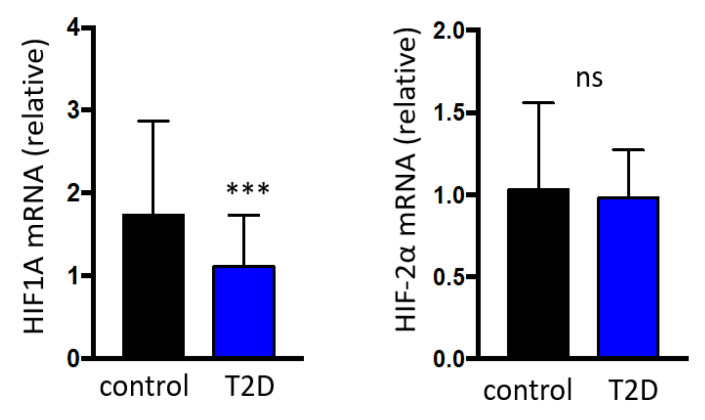
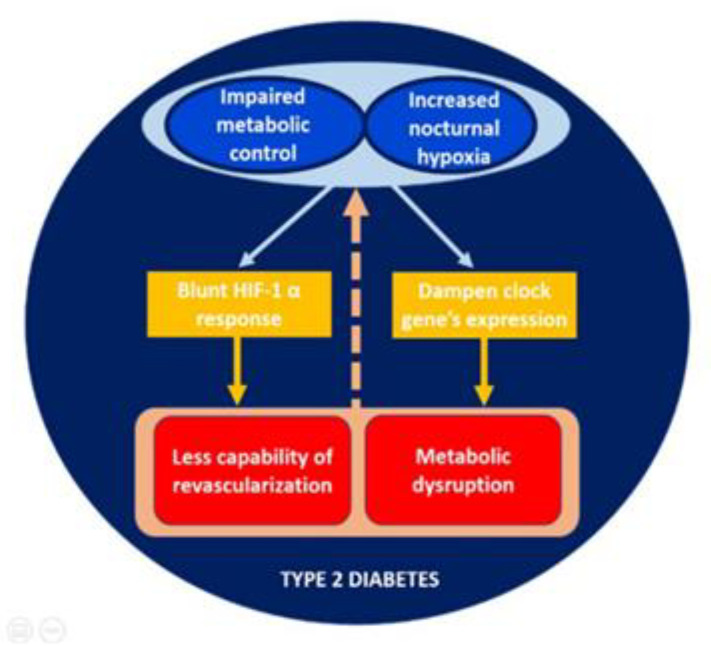
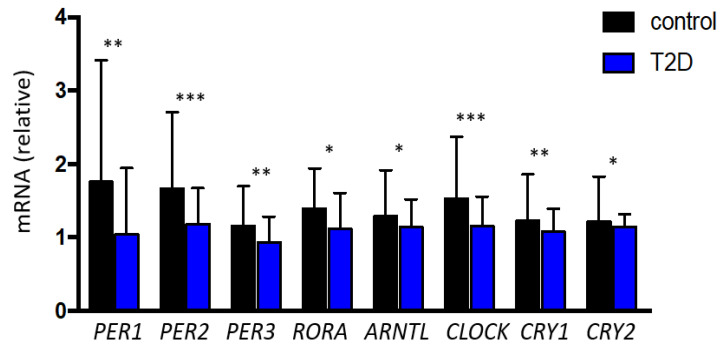
Limited reports exist on the relationships between regulation of oxygen homeostasis and circadian clock genes in type 2 diabetes. We examined whether the expression of Hypoxia-Inducible Factor-1α (HIF-1α) and HIF-2α relates to changes in the expression of clock genes (Period homolog proteins (PER)1, PER2, PER3, Retinoid-related orphan receptor alpha (RORA), Aryl hydrocarbon receptor nuclear translocator-like protein 1 (ARNTL), Circadian locomotor output cycles kaput (CLOCK), and Cryptochrome proteins (CRY) 1 and CRY2) in patients with type 2 diabetes. A total of 129 subjects were evaluated in this cross-sectional study (48% with diabetes). The gene expression was measured by polymerase chain reaction. The lactate and pyruvate levels were used as surrogate of the hypoxia induced anaerobic glycolysis activity. Patients with diabetes showed an increased plasma concentration of both lactate (2102.1 ± 688.2 vs. 1730.4 ± 694.4 uM/L, = 0.013) and pyruvate (61.9 ± 25.6 vs. 50.3 ± 23.1 uM/L, = 0.026) in comparison to controls. However, this finding was accompanied by a blunted HIF-1α expression (1.1 (0.2 to 5.0) vs. 1.7 (0.4 to 9.2) arbitrary units (AU), ≤ 0.001). Patients with diabetes also showed a significant reduction of all assessed clock genes' expression. Univariate analysis showed that HIF-1α and almost all clock genes were significantly and negatively correlated with HbA1c concentration. In addition, positive correlations between HIF-1α and the clock genes were observed. The stepwise multivariate regression analysis showed that HbA1c and clock genes independently predicted the expression of HIF-1α. Type 2 diabetes modifies the expression of HIF-1α and clock genes, which correlates with the degree of metabolic control.
关于2型糖尿病中氧稳态调节与生物钟基因之间的关系,现有报道有限。我们研究了缺氧诱导因子-1α(HIF-1α)和HIF-2α的表达是否与2型糖尿病患者生物钟基因(周期同源蛋白(PER)1、PER2、PER3、类视黄醇相关孤儿受体α(RORA)、芳烃受体核转运蛋白样蛋白1(ARNTL)、昼夜运动输出周期蛋白(CLOCK)以及隐花色素蛋白(CRY)1和CRY2)表达的变化相关。在这项横断面研究中,共评估了129名受试者(48%患有糖尿病)。通过聚合酶链反应测量基因表达。乳酸和丙酮酸水平用作缺氧诱导的无氧糖酵解活性的替代指标。与对照组相比,糖尿病患者的血浆乳酸浓度(2102.1±688.2 vs. 1730.4±694.4 μM/L,P = 0.013)和丙酮酸浓度(61.9±25.6 vs. 50.3±23.1 μM/L,P = 0.026)均升高。然而,这一发现伴随着HIF-1α表达减弱(1.1(0.2至5.0)vs. 1.7(0.4至9.2)任意单位(AU),P≤0.001)。糖尿病患者还显示所有评估的生物钟基因表达均显著降低。单变量分析表明,HIF-1α和几乎所有生物钟基因与糖化血红蛋白(HbA1c)浓度均呈显著负相关。此外,观察到HIF-1α与生物钟基因之间存在正相关。逐步多变量回归分析表明,HbA1c和生物钟基因可独立预测HIF-1α的表达。2型糖尿病会改变HIF-1α和生物钟基因的表达,这与代谢控制程度相关。