Gordan Richard, Fefelova Nadezhda, Gwathmey Judith K, Xie Lai-Hua
Department of Cell Biology and Molecular Medicine, Rutgers University-New Jersey Medical School, Newark, NJ 07103, USA.
Antioxidants (Basel). 2020 Aug 16;9(8):758. doi: 10.3390/antiox9080758.
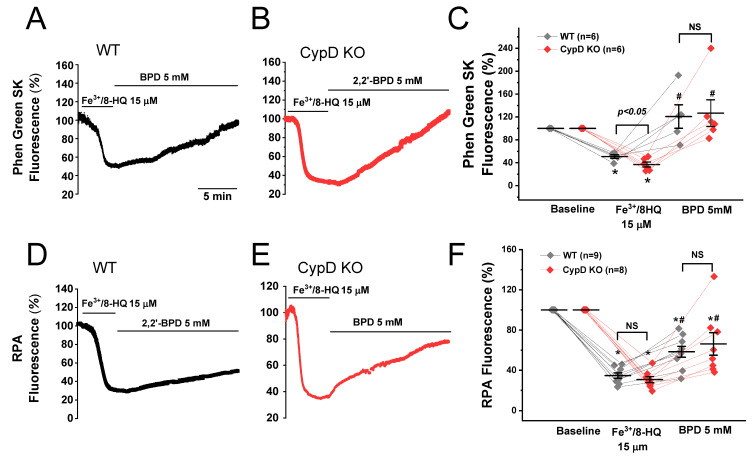
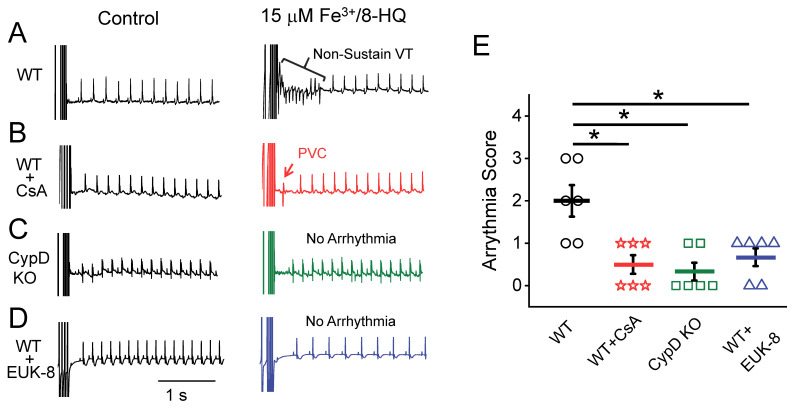
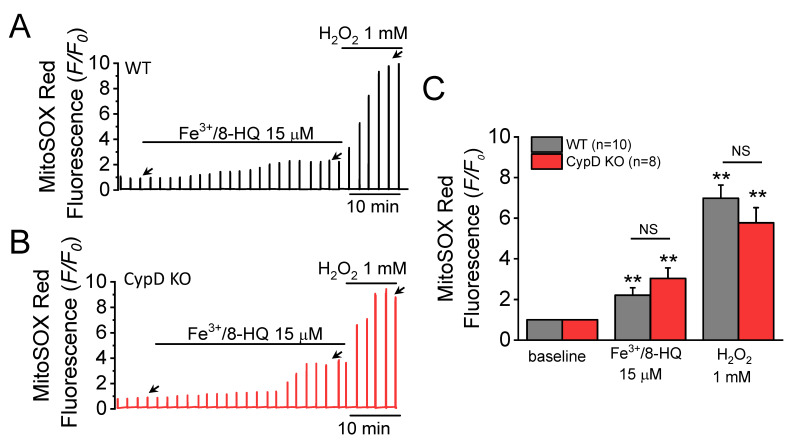
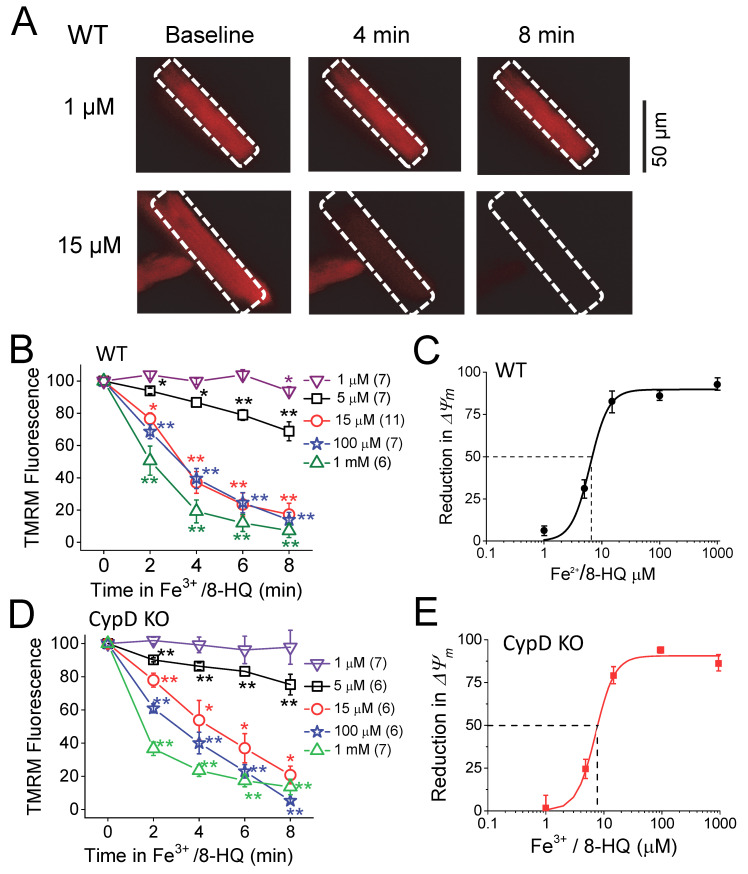
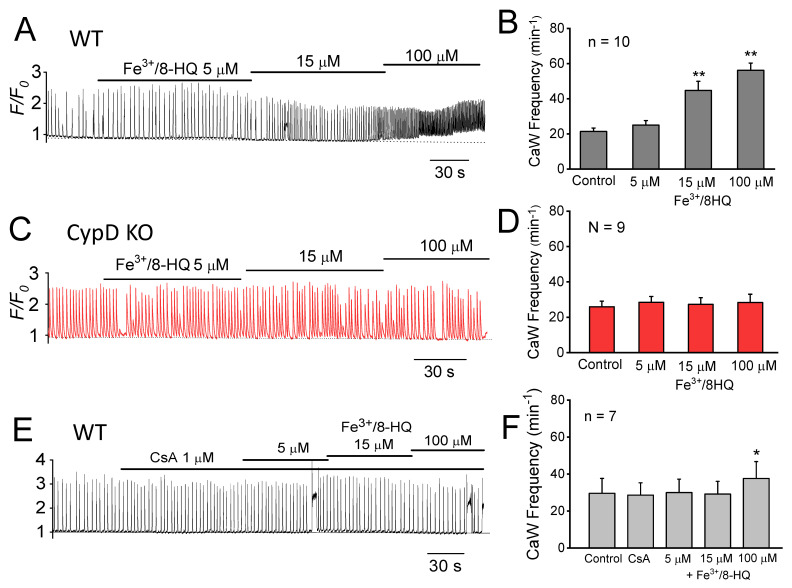
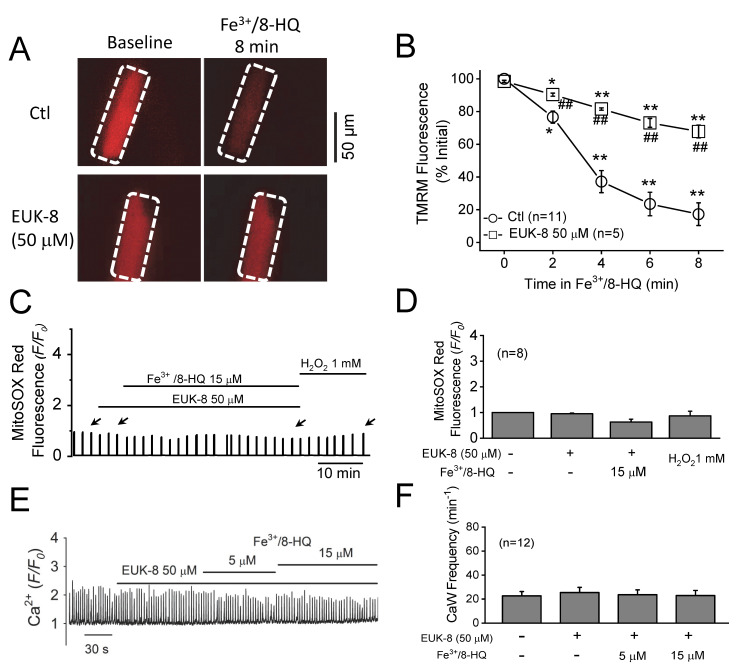
Iron (Fe) plays an essential role in many physiological processes. Hereditary hemochromatosis or frequent blood transfusions often cause iron overload (IO), which can lead to cardiomyopathy and arrhythmias; however, the underlying mechanism is not well defined. In the present study, we assess the hypothesis that IO promotes arrhythmias via reactive oxygen species (ROS) production, mitochondrial membrane potential (∆) depolarization, and disruption of cytosolic Ca dynamics. In ventricular myocytes isolated from wild type (WT) mice, both cytosolic and mitochondrial Fe levels were elevated following perfusion with the Fe/8-hydroxyquinoline (8-HQ) complex. IO promoted mitochondrial superoxide generation (measured using MitoSOX Red) and induced the depolarization of the Δ (measured using tetramethylrhodamine methyl ester, TMRM) in a dose-dependent manner. IO significantly increased the rate of Ca wave (CaW) formation measured in isolated ventricular myocytes using Fluo-4. Furthermore, in ex-vivo Langendorff-perfused hearts, IO increased arrhythmia scores as evaluated by ECG recordings under programmed S1-S2 stimulation protocols. We also carried out similar experiments in cyclophilin D knockout (CypD KO) mice in which the mitochondrial permeability transition pore (mPTP) opening is impaired. While comparable cytosolic and mitochondrial Fe load, mitochondrial ROS production, and depolarization of the ∆ were observed in ventricular myocytes isolated from both WT and CypD KO mice, the rate of CaW formation in isolated cells and the arrhythmia scores in ex-vivo hearts were significantly lower in CypD KO mice compared to those observed in WT mice under conditions of IO. The mPTP inhibitor cyclosporine A (CsA, 1 µM) also exhibited a protective effect. In conclusion, our results suggest that IO induces mitochondrial ROS generation and ∆ depolarization, thus opening the mPTP, thereby promoting CaWs and cardiac arrhythmias. Conversely, the inhibition of mPTP ameliorates the proarrhythmic effects of IO.
铁(Fe)在许多生理过程中起着至关重要的作用。遗传性血色素沉着症或频繁输血常导致铁过载(IO),这可能会引发心肌病和心律失常;然而,其潜在机制尚未明确。在本研究中,我们评估了以下假说:IO通过活性氧(ROS)生成、线粒体膜电位(∆)去极化以及细胞溶质钙动力学紊乱促进心律失常。在从野生型(WT)小鼠分离的心室肌细胞中,用Fe/8-羟基喹啉(8-HQ)复合物灌注后,细胞溶质和线粒体铁水平均升高。IO以剂量依赖的方式促进线粒体超氧化物生成(使用MitoSOX Red测量)并诱导∆去极化(使用四甲基罗丹明甲酯,TMRM测量)。IO显著增加了使用Fluo-4在分离的心室肌细胞中测量的钙波(CaW)形成速率。此外,在离体Langendorff灌注心脏中,根据程序S1-S2刺激方案下的心电图记录评估,IO增加了心律失常评分。我们还在亲环蛋白D基因敲除(CypD KO)小鼠中进行了类似实验,其中线粒体通透性转换孔(mPTP)开放受损。虽然在从WT和CypD KO小鼠分离的心室肌细胞中观察到了相当的细胞溶质和线粒体铁负荷、线粒体ROS生成以及∆去极化,但在IO条件下,与WT小鼠相比,CypD KO小鼠分离细胞中的CaW形成速率和离体心脏中的心律失常评分显著更低。mPTP抑制剂环孢素A(CsA,1 µM)也表现出保护作用。总之,我们的结果表明,IO诱导线粒体ROS生成和∆去极化,从而打开mPTP,进而促进CaW和心律失常。相反,抑制mPTP可改善IO的促心律失常作用。