Escher Felicitas, Pietsch Heiko, Aleshcheva Ganna, Wenzel Philip, Fruhwald Friedrich, Stumpf Christian, Westermann Dirk, Bauersachs Johann, Enseleit Frank, Ruschitzka Frank, Nägele Herbert, Laugwitz Karl-Ludwig, Haake Hendrik, Frey Norbert, Brachmann Johannes, Huber Kurt, Braun-Dullaeus Rüdiger Christian, Bergmann Martin W, Strotmann Jörg, Grönefeld Gerian, Krülls-Münch Jürgen, Westenfeld Ralf, Skurk Carsten, Landmesser Ulf, Pieske Burkert, Gross Ulrich M, Morawietz Lars, Schultheiss Heinz-Peter
Institute of Cardiac Diagnostics and Therapy, IKDT GmbH, 12203 Berlin, Germany.
Department of Cardiology, Charité-University Medicine Berlin, Campus Virchow-Klinikum, 13353 Berlin, Germany.
J Clin Med. 2020 Aug 19;9(9):2689. doi: 10.3390/jcm9092689.
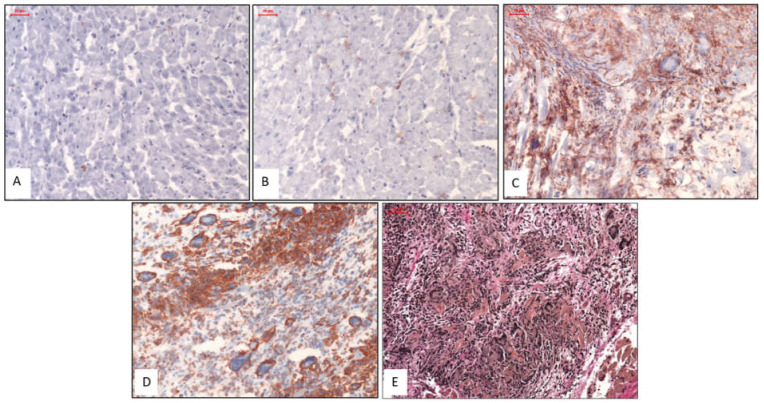
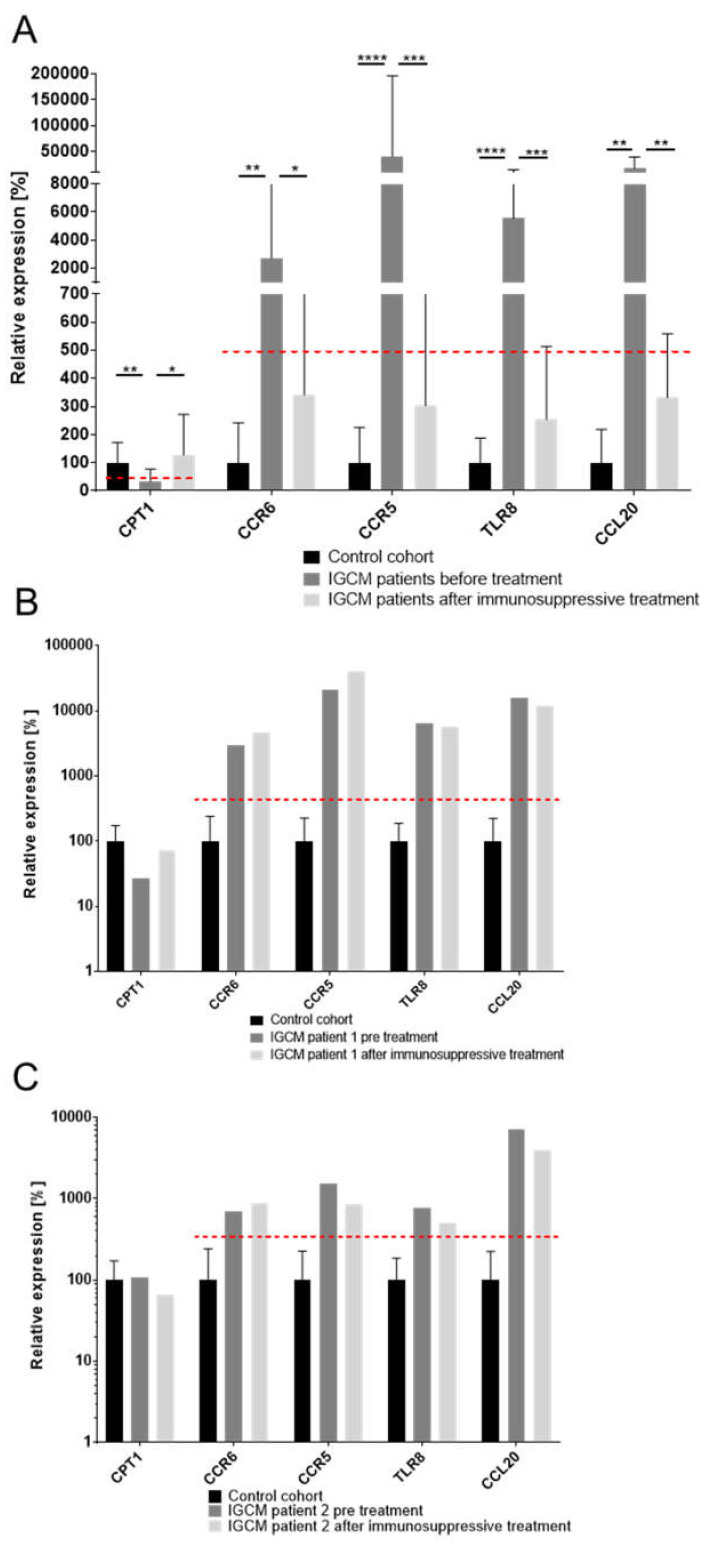
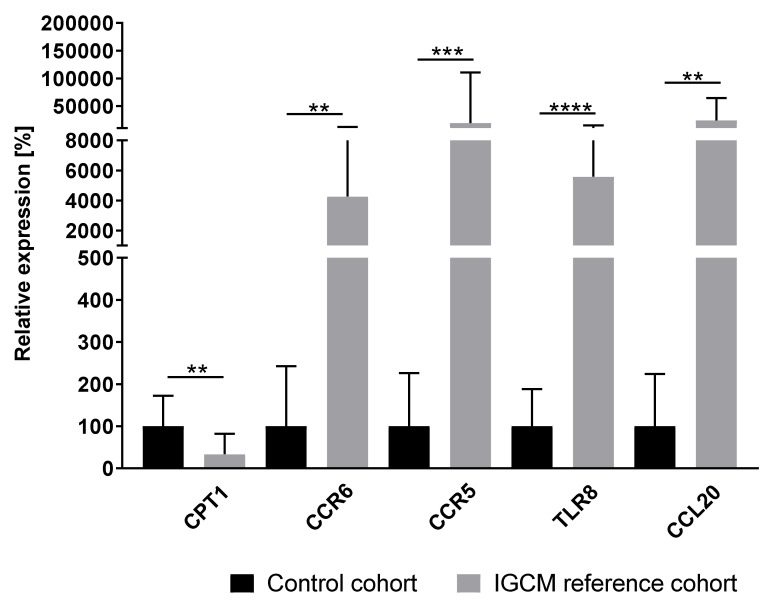
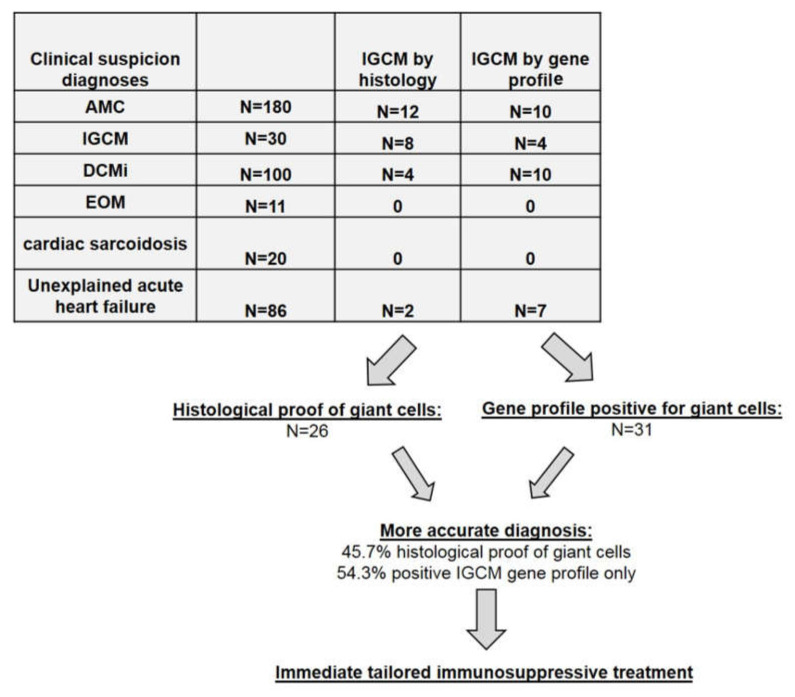
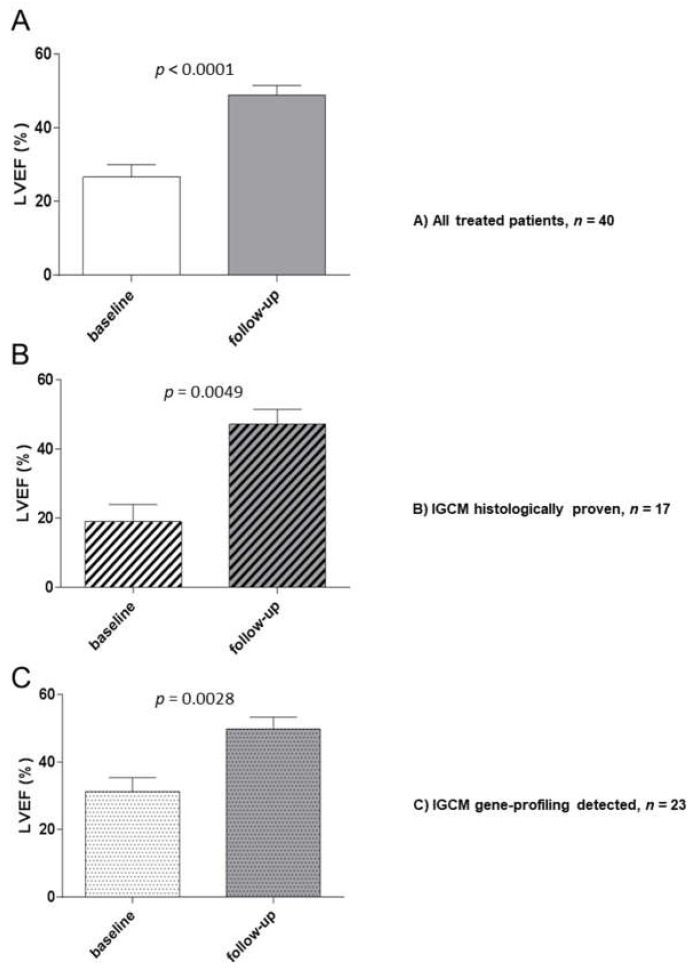
The diagnostic approach to idiopathic giant-cell myocarditis (IGCM) is based on identifying various patterns of inflammatory cell infiltration and multinucleated giant cells (GCs) in histologic sections taken from endomyocardial biopsies (EMBs). The sampling error for detecting focally located GCs by histopathology is high, however. The aim of this study was to demonstrate the feasibility of gene profiling as a new diagnostic method in clinical practice, namely in a large cohort of patients suffering from acute cardiac decompensation. : In this retrospective multicenter study, EMBs taken from = 427 patients with clinically acute cardiac decompensation and suspected acute myocarditis were screened (mean age: 47.03 ± 15.69 years). In each patient, the EMBs were analyzed on the basis of histology, immunohistology, molecular virology, and gene-expression profiling. Out of the total of = 427 patient samples examined, GCs could be detected in 26 cases (6.1%) by histology. An established myocardial gene profile consisting of 27 genes was revealed; this was narrowed down to a specified profile of five genes () which serve to identify histologically proven IGCM with high specificity in 25 of the 26 patients (96.2%). Once this newly established profiling approach was applied to the remaining patient samples, an additional = 31 patients (7.3%) could be identified as having IGCM without any histologic proof of myocardial GCs. In a subgroup analysis, patients diagnosed with IGCM using this gene profiling respond in a similar fashion to immunosuppressive therapy as patients diagnosed with IGCM by conventional histology alone. : Myocardial gene-expression profiling is a promising new method in clinical practice, one which can predict IGCM even in the absence of any direct histologic proof of GCs in EMB sections. Gene profiling is of great clinical relevance in terms of a) overcoming the sampling error associated with purely histologic examinations and b) monitoring the effectiveness of therapy.
特发性巨细胞性心肌炎(IGCM)的诊断方法基于在取自心内膜心肌活检(EMB)的组织切片中识别炎症细胞浸润和多核巨细胞(GCs)的各种模式。然而,通过组织病理学检测局灶性GCs的抽样误差很高。本研究的目的是证明基因谱分析作为一种新的诊断方法在临床实践中的可行性,即在一大群急性心脏失代偿患者中。在这项回顾性多中心研究中,对427例临床急性心脏失代偿且疑似急性心肌炎患者的EMB进行了筛查(平均年龄:47.03±15.69岁)。对每位患者的EMB进行了组织学、免疫组织学、分子病毒学和基因表达谱分析。在总共检测的427份患者样本中,通过组织学在26例(6.1%)中检测到了GCs。揭示了一个由27个基因组成的既定心肌基因谱;将其缩小到一个特定的5个基因的谱,这5个基因在26例患者中的25例(96.2%)中用于以高特异性识别经组织学证实的IGCM。一旦将这种新建立的谱分析方法应用于其余患者样本,另外31例患者(7.3%)可被确定为患有IGCM,而无任何心肌GCs的组织学证据。在亚组分析中,使用这种基因谱分析诊断为IGCM的患者对免疫抑制治疗的反应与仅通过传统组织学诊断为IGCM的患者相似。心肌基因表达谱分析是临床实践中一种有前景的新方法,即使在EMB切片中没有任何GCs直接组织学证据的情况下也能预测IGCM。基因谱分析在以下方面具有重要临床意义:a)克服与单纯组织学检查相关的抽样误差;b)监测治疗效果。