Institute for Cardiac Diagnostics and Therapy (IKDT), Berlin, Germany
Department of Cardiology, Charité, CVK--Universitätsmedizin Berlin, Berlin, Germany.
J Am Heart Assoc. 2017 Aug 18;6(8):e005352. doi: 10.1161/JAHA.116.005352.
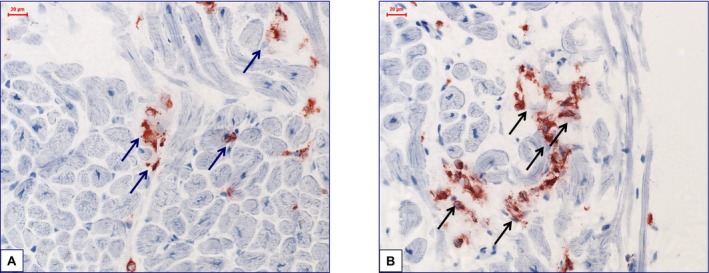
The authors analyzed the effects of perforin-dependent infiltration on long-term mortality in patients with inflammatory cardiomyopathy (CMi). We previously demonstrated that left ventricular function deteriorates and progresses to substantial cardiac dysfunction in patients with perforin-positive cardiac cell infiltration.
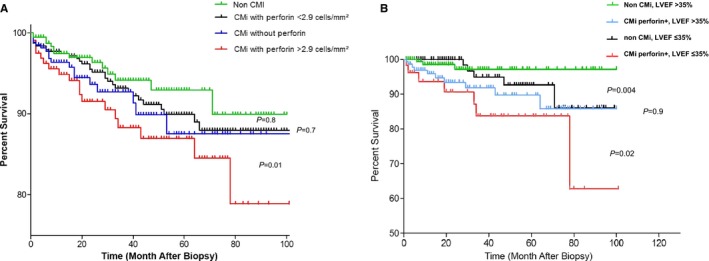
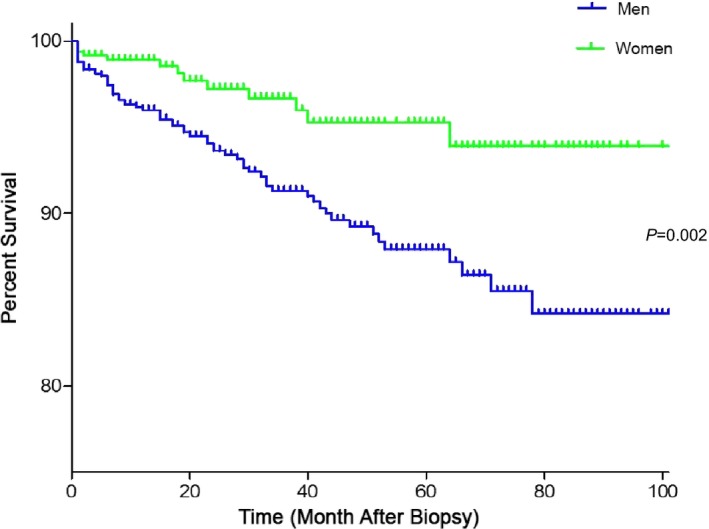
Between 2003 and 2013, 2389 consecutive patients with clinically suspected CMi who underwent endomyocardial biopsies were enrolled. Endomyocardial biopsies were performed at first admission after exclusion of ischemic or valvular heart disease, and CMi was confirmed in 1717 patients. Follow-up was up to 10.1 years (median 0.47 years; interquartile range, 0.03-2.56 years) and information on vital status was obtained from official resident data files. Multivariable statistical analysis was conducted for all patients with CMi regarding significant predictors of all-cause mortality or need for heart transplantation. Multiple Cox regression analysis revealed perforin above the calculated cutoff point of 2.9 cells/mm² as a strong predictor of impaired survival with a hazard ratio of 1.881 (95% confidence interval, 1.177-3.008; =0.008), independent of left ventricular function and other myocardial inflammation markers (CD3, macrophage-1 antigen, leukocyte function-associated antigen-1, human leukocyte antigen-1, and intercellular cell adhesion molecule-1). Unexpectedly, male sex emerged as another strong adverse predictor of survival in CMi (hazard ratio, 1.863; confidence interval, 1.096-3.168 [=0.022]). Whereas left ventricular ejection fraction course is adversely affected by myocardial perforin, multivariate analysis indicates that left ventricular ejection fraction explains only part of the observed overall mortality.
High perforin-positive cardiac cell infiltration and male sex are independent adverse predictors of long-term mortality in CMi. Furthermore, exact quantification of immunohistochemically detected infiltrates is necessary to assess the prognosis.
作者分析了穿孔素依赖性浸润对炎症性心肌病(CMi)患者长期死亡率的影响。我们之前的研究表明,在穿孔素阳性的心肌细胞浸润患者中,左心室功能恶化并进展为严重的心脏功能障碍。
在 2003 年至 2013 年间,连续纳入 2389 例经临床疑似 CMi 行心内膜心肌活检的患者。在排除缺血性或瓣膜性心脏病后,于首次入院时进行心内膜心肌活检,并在 1717 例患者中确诊为 CMi。随访时间最长达 10.1 年(中位数 0.47 年;四分位距,0.03-2.56 年),并从官方居民数据文件中获取生存状态信息。对所有 CMi 患者进行多变量统计分析,以确定全因死亡率或需要心脏移植的所有显著预测因子。多元 Cox 回归分析显示,穿孔素高于计算出的 2.9 个细胞/mm²的截止点是生存受损的强烈预测因子,风险比为 1.881(95%置信区间,1.177-3.008;=0.008),独立于左心室功能和其他心肌炎症标志物(CD3、巨噬细胞-1 抗原、白细胞功能相关抗原-1、人类白细胞抗原-1 和细胞间黏附分子-1)。出乎意料的是,男性也是 CMi 生存的另一个强烈不利预测因子(风险比,1.863;置信区间,1.096-3.168[=0.022])。虽然左心室射血分数的变化受到心肌穿孔素的不利影响,但多变量分析表明,左心室射血分数仅能解释观察到的总死亡率的一部分。
高穿孔素阳性的心肌细胞浸润和男性是 CMi 患者长期死亡率的独立不利预测因子。此外,还需要对免疫组织化学检测到的浸润物进行精确定量,以评估预后。