Department of Biomedical Science and Bateson Centre, University of Sheffield, Sheffield S10 2TN, UK.
Philos Trans R Soc Lond B Biol Sci. 2020 Oct 12;375(1809):20200087. doi: 10.1098/rstb.2020.0087. Epub 2020 Aug 24.
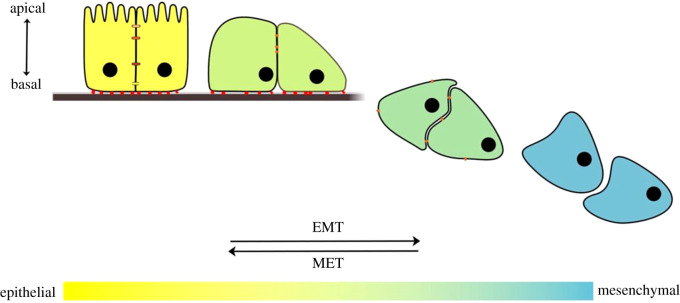
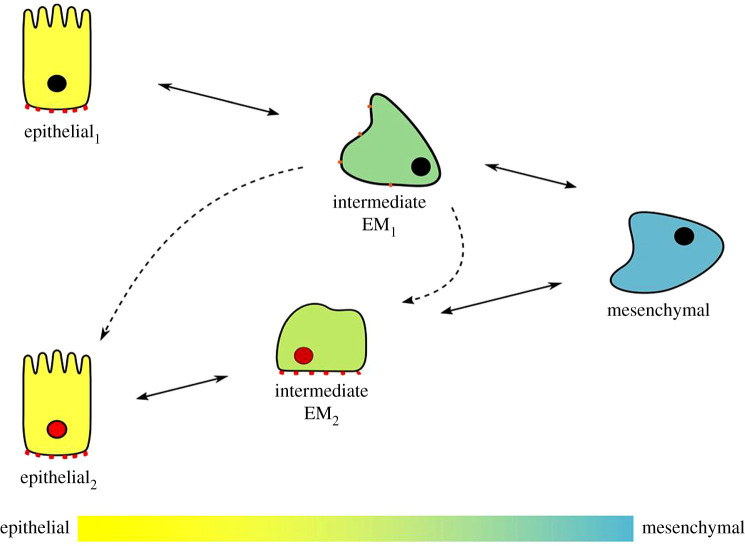
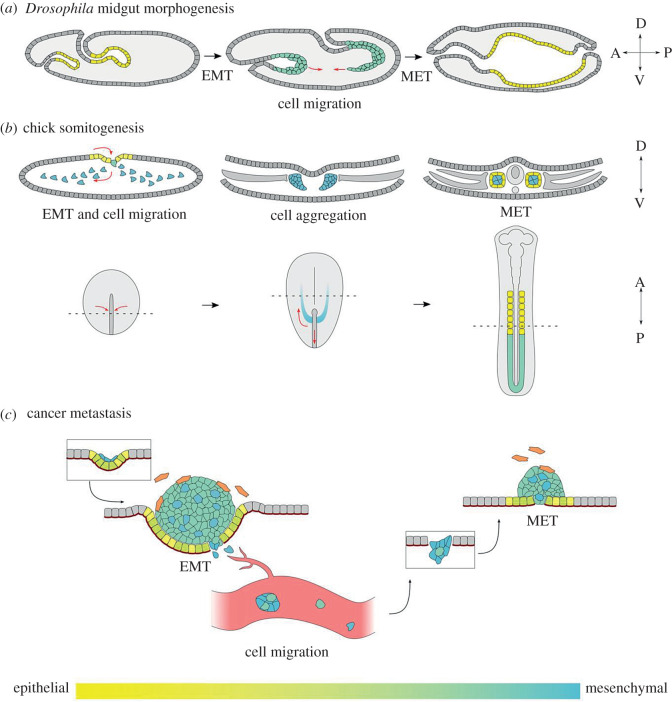
Many cells possess epithelial-mesenchymal plasticity (EMP), which allows them to shift reversibly between adherent, static and more detached, migratory states. These changes in cell behaviour are driven by the programmes of epithelial-mesenchymal transition (EMT) and mesenchymal-epithelial transition (MET), both of which play vital roles during normal development and tissue homeostasis. However, the aberrant activation of these processes can also drive distinct stages of cancer progression, including tumour invasiveness, cell dissemination and metastatic colonization and outgrowth. This review examines emerging common themes underlying EMP during tissue morphogenesis and malignant progression, such as the context dependence of EMT transcription factors, a central role for partial EMTs and the nonlinear relationship between EMT and MET. This article is part of a discussion meeting issue 'Contemporary morphogenesis'.
许多细胞具有上皮-间充质可塑性(EMP),这使它们能够在粘附、静止和更分离、迁移状态之间可逆地转换。细胞行为的这些变化是由上皮-间充质转化(EMT)和间充质-上皮转化(MET)程序驱动的,这两个程序在正常发育和组织稳态中都起着至关重要的作用。然而,这些过程的异常激活也可以驱动癌症进展的不同阶段,包括肿瘤侵袭、细胞扩散以及转移定植和生长。这篇综述考察了在组织形态发生和恶性进展过程中 EMP 背后的新兴共同主题,例如 EMT 转录因子的上下文依赖性、部分 EMT 的核心作用以及 EMT 和 MET 之间的非线性关系。本文是“当代形态发生”讨论会议议题的一部分。