National Institute on Drug Abuse Intramural Research Program, National Institutes of Health, Baltimore, United States.
Department of Psychology, University of California, Los Angeles, Los Angeles, United States.
Elife. 2020 Aug 24;9:e59998. doi: 10.7554/eLife.59998.
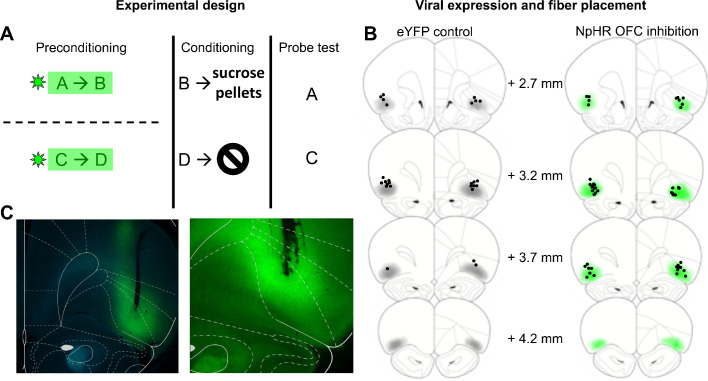
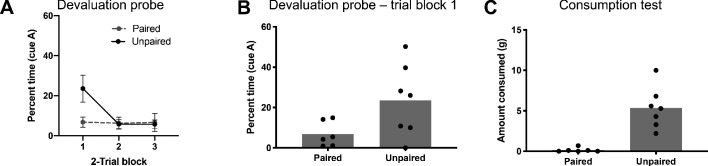
The orbitofrontal cortex (OFC) is necessary for inferring value in tests of model-based reasoning, including in sensory preconditioning. This involvement could be accounted for by representation of value or by representation of broader associative structure. We recently reported neural correlates of such broader associative structure in OFC during the initial phase of sensory preconditioning (Sadacca et al., 2018). Here, we used optogenetic inhibition of OFC to test whether these correlates might be necessary for value inference during later probe testing. We found that inhibition of OFC during cue-cue learning abolished value inference during the probe test, inference subsequently shown in control rats to be sensitive to devaluation of the expected reward. These results demonstrate that OFC must be online during cue-cue learning, consistent with the argument that the correlates previously observed are not simply downstream readouts of sensory processing and instead contribute to building the associative model supporting later behavior.
眶额皮层(OFC)对于推断基于模型推理测试中的价值是必要的,包括在感觉条件作用中。这种参与可以通过价值的表示来解释,也可以通过更广泛的联想结构的表示来解释。我们最近在感觉条件作用的初始阶段报告了 OFC 中更广泛的联想结构的神经相关物(Sadacca 等人,2018 年)。在这里,我们使用光遗传学抑制 OFC 来测试这些相关物是否可能对于后期探测测试中的价值推断是必要的。我们发现,在提示-提示学习期间抑制 OFC 会消除在探针测试中的价值推断,而在控制大鼠中,这种推断随后显示出对预期奖励的贬值是敏感的。这些结果表明,OFC 必须在提示-提示学习期间在线,这与之前观察到的相关物不是简单的感官处理的下游读数的论点一致,而是有助于构建支持后期行为的联想模型。