Lee Kang-Bok, Han Sumin, Jeong Yeasung
Harbert College of Business, Auburn University, United States of America.
Physica A. 2020 Dec 1;559:125090. doi: 10.1016/j.physa.2020.125090. Epub 2020 Aug 18.
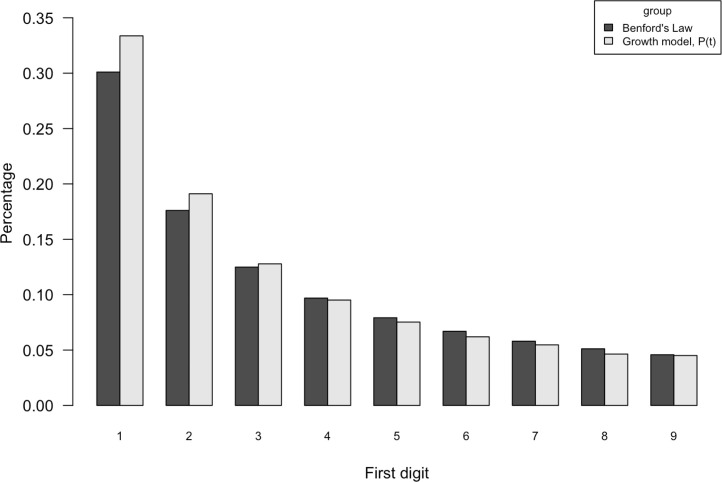
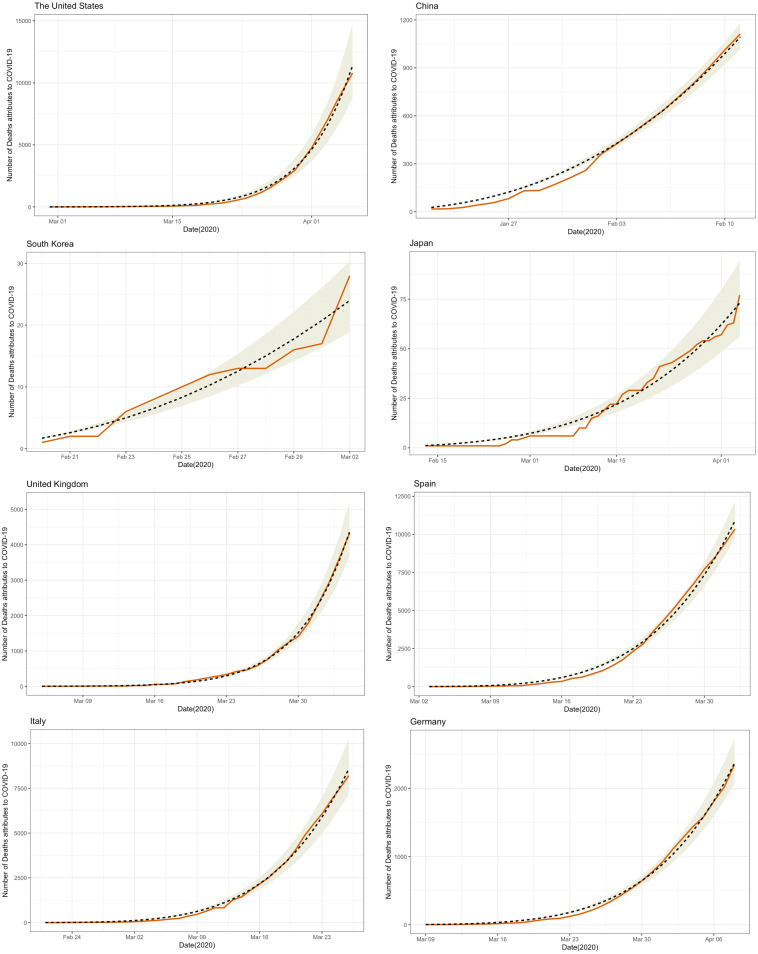
For many countries attempting to control the fast-rising number of coronavirus cases and deaths, the race is on to "flatten the curve," since the spread of coronavirus disease 2019 (COVID-19) has taken on pandemic proportions. In the absence of significant control interventions, the curve could be steep, with the number of COVID-19 cases growing exponentially. In fact, this level of proliferation may already be happening, since the number of patients infected in Italy closely follows an exponential trend. Thus, we propose a test. When the numbers are taken from an exponential distribution, it has been demonstrated that they automatically follow Benford's Law (BL). As a result, if the current control interventions are successful and we flatten the curve (i.e., we slow the rate below an exponential growth rate), then the number of infections or deaths will obey BL. For this reason, BL may be useful for assessing the effects of the current control interventions and may be able to answer the question, "How flat is flat enough?" In this study, we used an epidemic growth model in the presence of interventions to describe the potential for a flattened curve, and then investigated whether the epidemic growth model followed BL for ten selected countries with a relatively high mortality rate. Among these countries, South Korea showed a particularly high degree of control intervention. Although all of the countries have aggressively fought the epidemic, our analysis shows that all countries except for Japan satisfied BL, indicating the growth rates of COVID-19 were close to an exponential trend. Based on the simulation table in this study, BL test shows that the data from Japan is incorrect.
对于许多试图控制新冠病毒病例数和死亡数快速上升的国家来说,由于2019冠状病毒病(COVID-19)的传播已呈大流行态势,一场“拉平曲线”的竞赛正在进行。在缺乏重大控制干预措施的情况下,曲线可能会很陡峭,COVID-19病例数呈指数增长。事实上,这种增长水平可能已经出现,因为意大利的感染患者数量密切遵循指数趋势。因此,我们提出一项检验。当数据取自指数分布时,已经证明它们会自动遵循本福特定律(BL)。因此,如果当前的控制干预措施取得成功,我们拉平了曲线(即我们将增长率降至指数增长率以下),那么感染数或死亡数将遵循本福特定律。出于这个原因,本福特定律可能有助于评估当前控制干预措施的效果,并可能能够回答“多平才算足够平?”这个问题。在本研究中,我们使用了存在干预措施情况下的疫情增长模型来描述曲线变平的可能性,然后调查了十个死亡率相对较高的选定国家的疫情增长模型是否遵循本福特定律。在这些国家中,韩国的控制干预程度特别高。尽管所有国家都在积极抗击疫情,但我们的分析表明,除日本外的所有国家都符合本福特定律,这表明COVID-19的增长率接近指数趋势。基于本研究中的模拟表,本福特定律检验表明来自日本的数据是不正确的。