Mahy Caitlin E V, Masson Chelsey, Krause Amanda M, Mazachowsky Tessa R
Department of Psychology, Brock University, Canada.
Faculty of Education, University of Ottawa, Canada.
Cogn Dev. 2020 Oct-Dec;56:100934. doi: 10.1016/j.cogdev.2020.100934. Epub 2020 Aug 12.
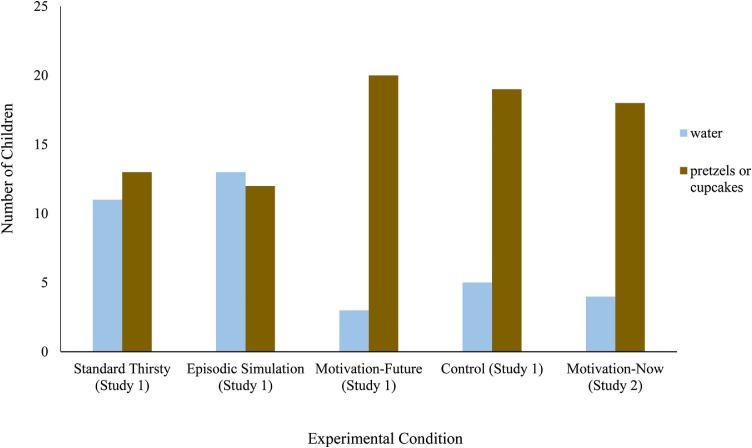
Future simulation and motivation are two strategies that might help children improve their induced-state episodic foresight. In Study 1, 3- to 5-year-old children ( = 96) consumed pretzels (to induce thirst) and were asked what they would prefer the next day, pretzels or water. Children were randomly assigned to an experimental condition: (1) a standard thirsty condition, (2) an episodic simulation condition where they imagined being hungry the next day, (3) a motivation condition where children chose between a cupcake and water, or (4) a control condition (thirst was not induced). Future preferences did not differ by age and children were less likely to choose water (vs. a cupcake) in the motivation condition compared to the standard thirsty condition. Study 2 found that 3- to 5-year-old children ( = 22) were also less likely to choose water for versus a cupcake when thirst was induced.
未来模拟和动机是两种可能有助于儿童提高诱发状态情景预见能力的策略。在研究1中,96名3至5岁的儿童食用了椒盐脆饼(以诱发口渴),并被问及第二天他们更喜欢什么,椒盐脆饼还是水。儿童被随机分配到一种实验条件下:(1)标准口渴条件,(2)情景模拟条件,即他们想象第二天会饥饿,(3)动机条件,即儿童在纸杯蛋糕和水之间进行选择,或(4)对照条件(未诱发口渴)。未来偏好不存在年龄差异,与标准口渴条件相比,儿童在动机条件下选择水(相对于纸杯蛋糕)的可能性更小。研究2发现,在诱发口渴时,22名3至5岁的儿童选择水(相对于纸杯蛋糕)的可能性也更小。