Glibert Patricia M
Horn Point Laboratory, University of Maryland Center for Environmental Science, PO Box 775, Cambridge, MD 21613 USA.
Biogeochemistry. 2020;150(2):139-180. doi: 10.1007/s10533-020-00691-6. Epub 2020 Aug 10.
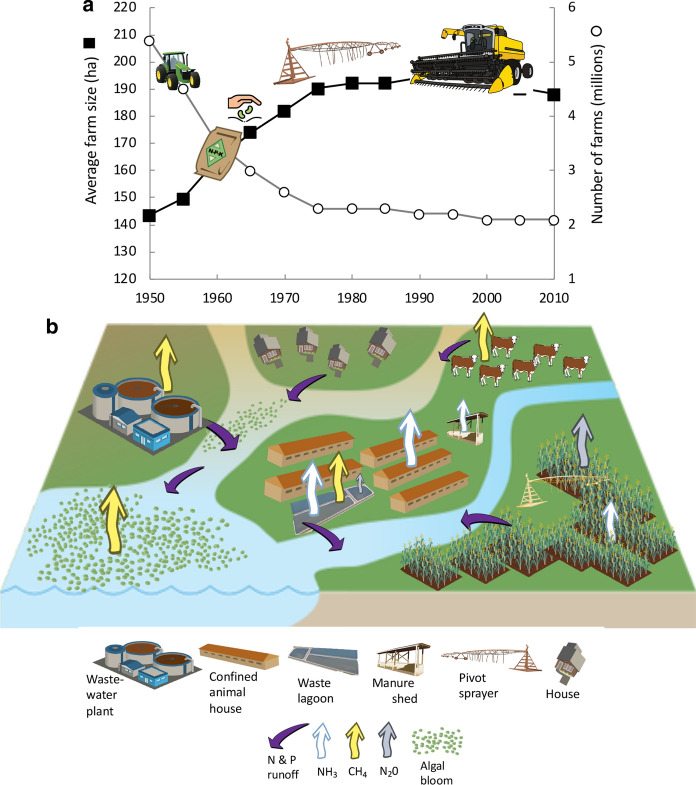
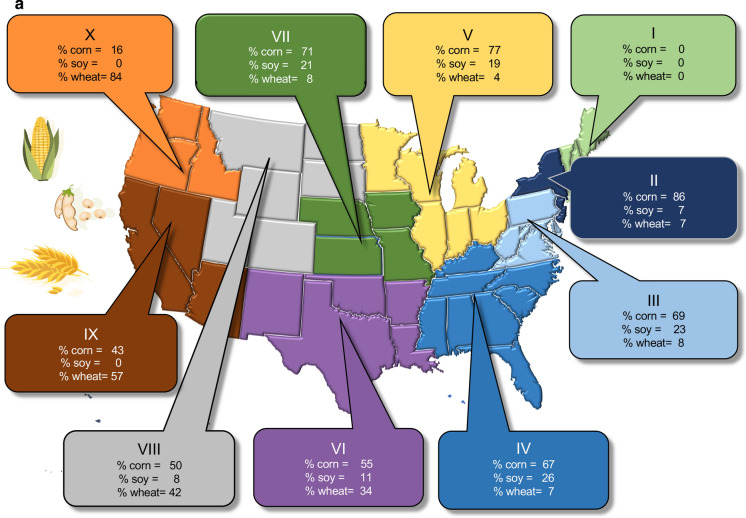
Nutrient pollution and greenhouse gas emissions related to crop agriculture and confined animal feeding operations (CAFOs) in the US have changed substantially in recent years, in amounts and forms. This review is intended to provide a broad view of how nutrient inputs-from fertilizer and CAFOs-as well as atmospheric NH and greenhouse gas emissions, are changing regionally within the US and how these changes compare with nutrient inputs from human wastewater. Use of commercial nitrogen (N) fertilizer in the US, which now exceeds 12,000,000 metric tonnes (MT) continues to increase, at a rate of 60,000 MT per year, while that of phosphorus (P) has remained nearly constant over the past decade at around 1,800,000 MT. The number of CAFOs in the US has increased nearly 10% since 2012, driven largely by a near 13% increase in hog production. The annualized inventory of cattle, dairy cows, hogs, broiler chickens and turkeys is approximately 8.7 billion, but CAFOs are highly regionally concentrated by animal sector. Country-wide, N applied by fertilizer is about threefold greater than manure N inputs, but for P these inputs are more comparable. Total manure inputs now exceed 4,000,000 MT as N and 1,400,000 MT as P. For both N and P, inputs and proportions vary widely by US region. The waste from hog and dairy operations is mainly held in open lagoons that contribute to NH and greenhouse gas (as CH and NO) emissions. Emissions of NH from animal waste in 2019 were estimated at > 4,500,000 MT. Emissions of CH from manure management increased 66% from 1990 to 2017 (that from dairy increased 134%, cattle 9.6%, hogs 29% and poultry 3%), while those of NO increased 34% over the same time period (dairy 15%, cattle 46%, hogs 58%, and poultry 14%). Waste from CAFOs contribute substantially to nutrient pollution when spread on fields, often at higher N and P application rates than those of commercial fertilizer. Managing the runoff associated with fertilizer use has improved with best management practices, but reducing the growing waste from CAFO operations is essential if eutrophication and its effects on fresh and marine waters-namely hypoxia and harmful algal blooms (HABs)-are to be reduced.
近年来,美国与作物种植及集约化动物饲养场(CAFOs)相关的营养物污染和温室气体排放,在数量和形式上都发生了显著变化。本综述旨在全面介绍来自化肥和集约化动物饲养场的营养物输入,以及大气中的氨和温室气体排放,在美国各地区是如何变化的,以及这些变化与来自人类废水的营养物输入相比情况如何。美国商业氮肥的使用量目前超过1200万公吨,并以每年6万公吨的速度持续增长,而磷肥的使用量在过去十年中一直保持在约180万公吨左右,几乎没有变化。自2012年以来,美国集约化动物饲养场的数量增加了近10%,这主要是由于生猪产量增长了近13%。牛、奶牛、猪、肉鸡和火鸡的年度存栏量约为87亿头,但集约化动物饲养场在各动物养殖领域的分布高度集中在某些地区。在全国范围内,化肥施用的氮约是粪便氮输入量的三倍,但对于磷来说,两者的输入量更具可比性。目前粪便总输入量超过400万公吨(以氮计)和140万公吨(以磷计)。对于氮和磷,输入量及其比例在美国不同地区差异很大。生猪和奶牛养殖场的粪便主要存放在露天泻湖中,这会导致氨和温室气体(如甲烷和一氧化二氮)排放。2019年动物粪便的氨排放量估计超过450万公吨。从1990年到2017年,粪便管理产生的甲烷排放量增加了66%(奶牛场增加了134%,养牛场增加了9.6%,养猪场增加了29%,家禽养殖场增加了3%),而同期一氧化二氮排放量增加了34%(奶牛场增加了15%,养牛场增加了46%,养猪场增加了58%,家禽养殖场增加了14%)。集约化动物饲养场的粪便在田间施用时,往往以高于商业化肥的氮和磷施用量大量造成营养物污染。通过最佳管理实践,对与化肥使用相关的径流管理已有改善,但如果要减少富营养化及其对淡水和海水的影响,即缺氧和有害藻华(HABs),减少集约化动物饲养场不断增加的粪便排放至关重要。