Liu Congying, Wu Xiaoqun, Niu Riuwu, Wu Xiuqi, Fan Ruguo
School of Mathematics and Statistics, Wuhan University, Hubei, 430072 China.
Hubei Key Laboratory of Computational Science, Wuhan University, Hubei, 430072 China.
Nonlinear Dyn. 2020;101(3):1777-1787. doi: 10.1007/s11071-020-05704-5. Epub 2020 Jun 15.
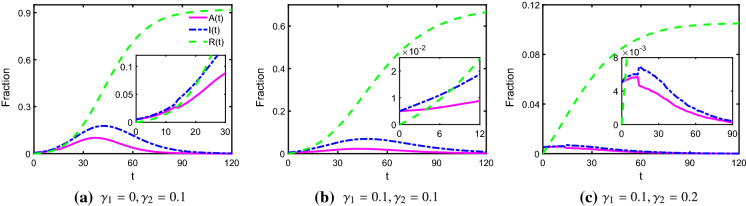
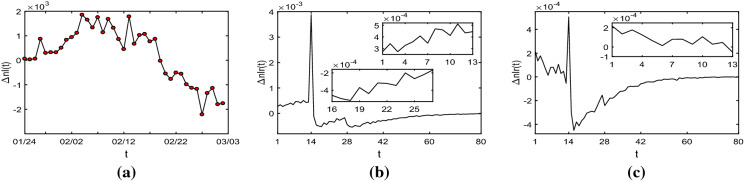
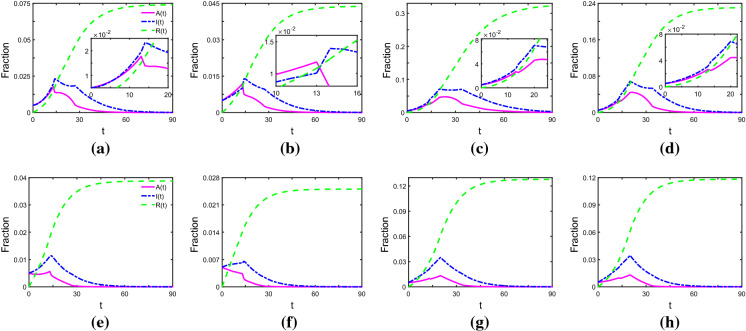
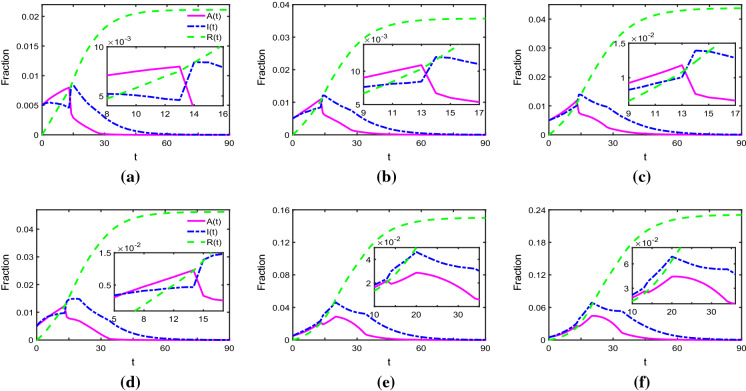
Nowadays, the novel coronavirus (COVID-19) is spreading around the world and has attracted extremely wide public attention. From the beginning of the outbreak to now, there have been many mathematical models proposed to describe the spread of the pandemic, and most of them are established with the assumption that people contact with each other in a homogeneous pattern. However, owing to the difference of individuals in reality, social contact is usually heterogeneous, and the models on homogeneous networks cannot accurately describe the outbreak. Thus, we propose a susceptible-asymptomatic-infected-removed (SAIR) model on social networks to describe the spread of COVID-19 and analyse the outbreak based on the epidemic data of Wuhan from January 24 to March 2. Then, according to the results of the simulations, we discover that the measures that can curb the spread of COVID-19 include increasing the recovery rate and the removed rate, cutting off connections between symptomatically infected individuals and their neighbours, and cutting off connections between hub nodes and their neighbours. The feasible measures proposed in the paper are in fair agreement with the measures that the government took to suppress the outbreak. Furthermore, effective measures should be carried out immediately, otherwise the pandemic would spread more rapidly and last longer. In addition, we use the epidemic data of Wuhan from January 24 to March 2 to analyse the outbreak in the city and explain why the number of the infected rose in the early stage of the outbreak though a total lockdown was implemented. Moreover, besides the above measures, a feasible way to curb the spread of COVID-19 is to reduce the density of social networks, such as restricting mobility and decreasing in-person social contacts. This work provides a series of effective measures, which can facilitate the selection of appropriate approaches for controlling the spread of the COVID-19 pandemic to mitigate its adverse impact on people's livelihood, societies and economies.
如今,新型冠状病毒(COVID-19)正在全球传播,引起了极为广泛的公众关注。从疫情爆发之初到现在,已经提出了许多数学模型来描述这一流行病的传播,其中大多数模型的建立都假设人们以均匀的模式相互接触。然而,由于现实中个体存在差异,社会接触通常是异质性的,基于均匀网络的模型无法准确描述疫情爆发情况。因此,我们提出了一种社交网络上的易感-无症状感染-感染-移除(SAIR)模型来描述COVID-19的传播,并根据武汉1月24日至3月2日的疫情数据对疫情爆发情况进行分析。然后,根据模拟结果,我们发现能够遏制COVID-19传播的措施包括提高康复率和移除率、切断有症状感染者与其邻居之间的联系以及切断枢纽节点与其邻居之间的联系。本文提出的可行措施与政府为抑制疫情所采取的措施相当一致。此外,应立即采取有效措施,否则疫情将传播得更快且持续时间更长。此外,我们利用武汉1月24日至3月2日的疫情数据来分析该市的疫情爆发情况,并解释为何在实施全面封锁的情况下,疫情爆发初期感染人数仍有所上升。此外,除上述措施外,遏制COVID-19传播的一种可行方法是降低社交网络的密度,例如限制流动性和减少面对面社交接触。这项工作提供了一系列有效措施,有助于选择合适的方法来控制COVID-19大流行的传播,以减轻其对民生、社会和经济的不利影响。