Ladha Nikhilesh, Bhardwaj Pankaj, Charan Jaykaran, Mitra Prasenjit, Goyal Jagdish Prasad, Sharma Praveen, Singh Kuldeep, Misra Sanjeev
Department of Community and Family Medicine, All India Institute of Medical Sciences (AIIMS), Jodhpur, Rajasthan India.
Department of Pharmacology, All India Institute of Medical Sciences (AIIMS), Jodhpur, Rajasthan India.
Indian J Clin Biochem. 2020 Oct;35(4):497-501. doi: 10.1007/s12291-020-00921-6. Epub 2020 Aug 19.
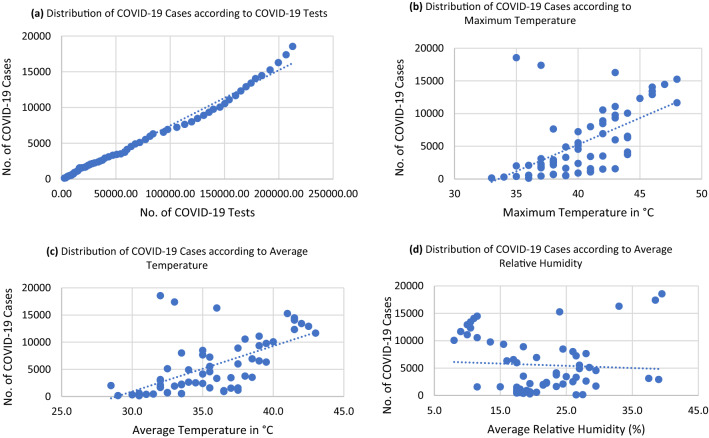
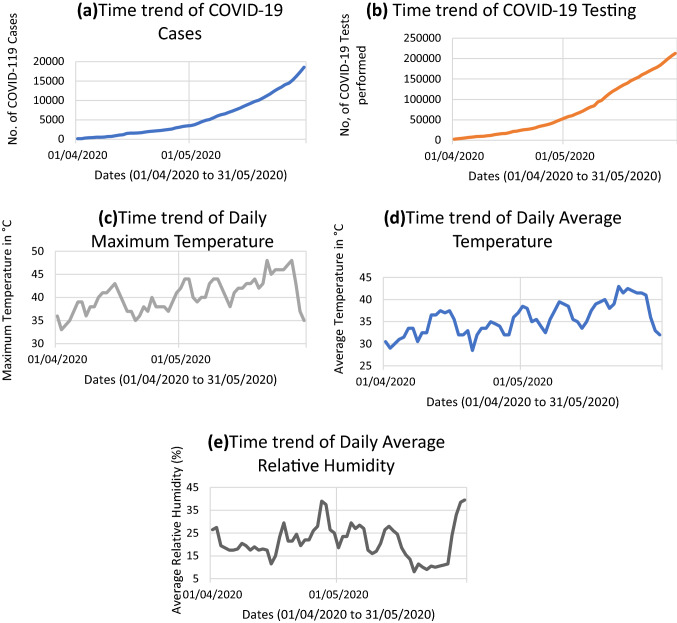
The present study explores the association between weather and COVID-19 pandemic in Delhi, India. The study used the data from daily newspaper releases from the Ministry of Health and Family Welfare, Government of India. Linear regression was run to understand the effect of the number of tests, temperature, and relative humidity on the number of COVID-19 cases in Delhi. The model was significantly able to predict number of COVID-19 cases, F (4,56) = 1213.61, < 0.05, accounting for 99.4% of the variation in COVID-19 cases with adjusted R = 98.8%. Maximum Temperature, average temperature and average relative humidity did not show statistical significance. The only number of tests was significantly associated with COVID-19 cases.
本研究探讨了印度德里天气与新冠疫情之间的关联。该研究使用了印度政府卫生和家庭福利部每日发布在报纸上的数据。进行线性回归以了解检测次数、温度和相对湿度对德里新冠病例数的影响。该模型能够显著预测新冠病例数,F(4,56)=1213.61,P<0.05,解释了新冠病例变异的99.4%,调整后的R=98.8%。最高温度、平均温度和平均相对湿度未显示出统计学意义。唯一检测次数与新冠病例数显著相关。