Shaw Jawaid A, Stiliannoudakis Spiro, Qaiser Rabia, Layman Erynn, Sima Adam, Ali Asghar
Internal Medicine, Virginia Commonwealth University, Richmond, USA.
Biostatistics, Virginia Commonwealth University, Richmond, USA.
Cureus. 2020 Jul 21;12(7):e9308. doi: 10.7759/cureus.9308.
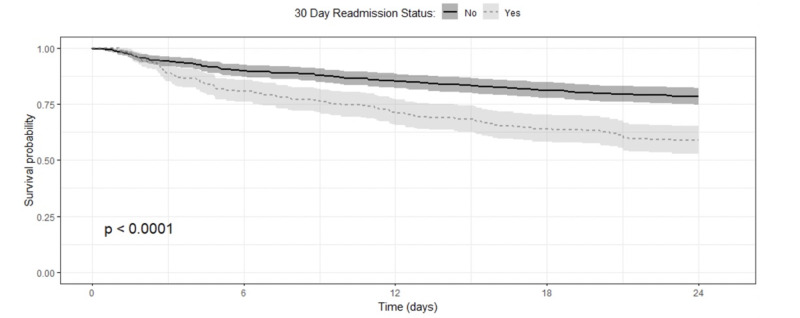
Introduction Readmission within 30 days is used as a standard quality metric for hospitalized patients. We hypothesized that patients who get readmitted within 30 days may have higher short- and long-term mortality. Material and Methods Using administrative data, we retrospectively analyzed 2,353 patients admitted to inpatient medicine service over a period of one year. The patients were matched for diagnostic group (DRG) and severity index (SI) using nearest propensity scores in a 2:1 ratio between non-readmissions (NRA) to readmissions (RA) patients. Results There was no statistically significant difference in the groups between age, sex, length of stay (LOS), race, and ethnicity. The hazard model yielded a hazard ratio (HR) of 2.06 for 30-day readmissions (95% CI of 1.55, 2.74; p=<0.001). The survival probability at 6, 12, 18, and 24 months was consistently greater for NRA patients. Conclusions Thirty-day readmissions are an independent risk factor for all-cause mortality which persists for at least two years independent of DRG and SI.
引言
30天内再入院被用作衡量住院患者质量的标准指标。我们假设30天内再入院的患者可能有更高的短期和长期死亡率。
材料与方法
我们使用管理数据,对一年内入住内科住院服务的2353名患者进行了回顾性分析。使用最近邻倾向得分,按照非再入院患者(NRA)与再入院患者(RA)2:1的比例,对患者的诊断组(DRG)和严重程度指数(SI)进行匹配。
结果
两组在年龄、性别、住院时间(LOS)、种族和民族方面无统计学显著差异。风险模型得出30天再入院的风险比(HR)为2.06(95%CI为1.55, 2.74;p<0.001)。NRA患者在6、12、18和24个月时的生存概率始终更高。
结论
30天再入院是全因死亡率的独立危险因素,且与DRG和SI无关,这种情况至少持续两年。