Department of Microbiology and Parasitology, Faculty of Pharmacy, Complutense University of Madrid, Madrid, Spain.
Department of Experimental Medicine and Surgery, University of Rome Tor Vergata, Roma, Italy.
Ann Med. 2021 Dec;53(1):43-69. doi: 10.1080/07853890.2020.1814962. Epub 2020 Sep 17.
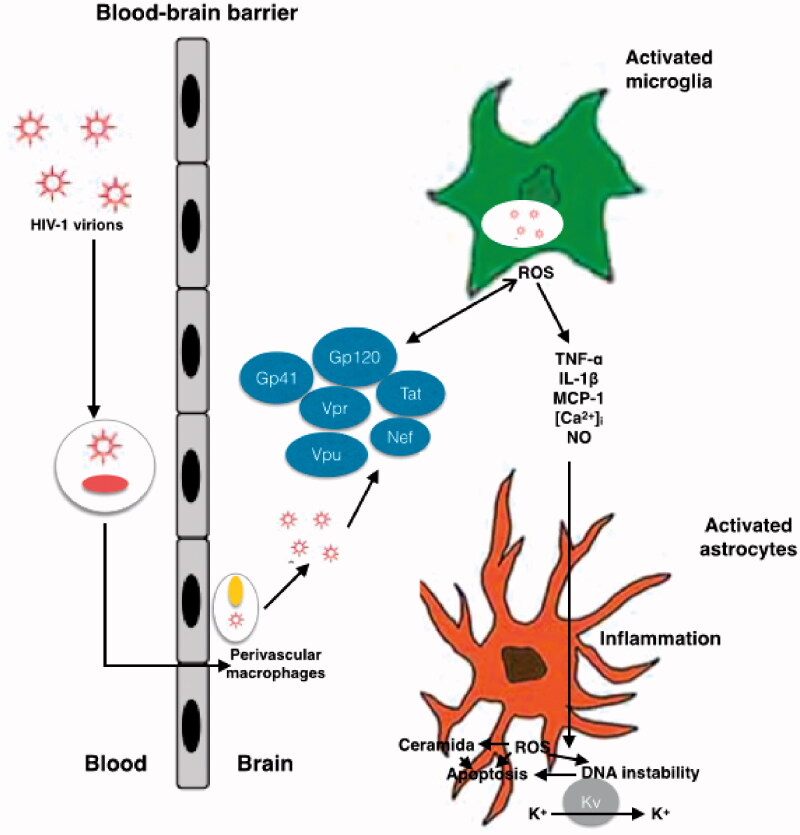
The development of effective combined anti-retroviral therapy (cART) led to a significant reduction in the death rate associated with human immunodeficiency virus type 1 (HIV-1) infection. However, recent studies indicate that considerably more than 50% of all HIV-1 infected patients develop HIV-1-associated neurocognitive disorder (HAND). Microglia are the foremost cells infected by HIV-1 in the central nervous system (CNS), and so, are also likely to contribute to the neurotoxicity observed in HAND. The activation of microglia induces the release of pro-inflammatory markers and altered secretion of cytokines, chemokines, secondary messengers, and reactive oxygen species (ROS) which activate signalling pathways that initiate neuroinflammation. In turn, ROS and inflammation also play critical roles in HAND. However, more efforts are required to understand the physiology of microglia and the processes involved in their activation in order to better understand the how HIV-1-infected microglia are involved in the development of HAND. In this review, we summarize the current state of knowledge about the involvement of oxidative stress mechanisms and role of HIV-induced ROS in the development of HAND. We also examine the academic literature regarding crucial HIV-1 pathogenicity factors implicated in neurotoxicity and inflammation in order to identify molecular pathways that could serve as potential therapeutic targets for treatment of this disease. KEY MESSAGES Neuroinflammation and excitotoxicity mechanisms are crucial in the pathogenesis of HAND. CNS infiltration by HIV-1 and immune cells through the blood brain barrier is a key process involved in the pathogenicity of HAND. Factors including calcium dysregulation and autophagy are the main challenges involved in HAND.
有效的联合抗逆转录病毒疗法 (cART) 的发展显著降低了与人类免疫缺陷病毒 1 型 (HIV-1) 感染相关的死亡率。然而,最近的研究表明,超过 50%的所有 HIV-1 感染患者都发展为 HIV-1 相关的神经认知障碍 (HAND)。小胶质细胞是 HIV-1 在中枢神经系统 (CNS) 中最先感染的细胞,因此,也可能导致 HAND 中观察到的神经毒性。小胶质细胞的激活诱导促炎标志物的释放和细胞因子、趋化因子、第二信使和活性氧物质 (ROS) 的异常分泌,这些物质激活启动神经炎症的信号通路。反过来,ROS 和炎症也在 HAND 中发挥关键作用。然而,需要更多的努力来了解小胶质细胞的生理学和它们激活的过程,以便更好地理解 HIV-1 感染的小胶质细胞如何参与 HAND 的发展。在这篇综述中,我们总结了目前关于氧化应激机制和 HIV 诱导的 ROS 在 HAND 发展中的作用的知识状态。我们还检查了关于涉及神经毒性和炎症的关键 HIV-1 致病性因素的学术文献,以确定可以作为治疗这种疾病的潜在治疗靶点的分子途径。关键信息神经炎症和兴奋毒性机制是 HAND 发病机制的关键。HIV-1 通过血脑屏障渗透到中枢神经系统和免疫细胞是 HAND 发病机制的关键过程。包括钙失调和自噬在内的因素是 HAND 中涉及的主要挑战。