Geosciences Department, Kiel University, 24118 Kiel, Germany;
Geosciences Department, Kiel University, 24118 Kiel, Germany.
Proc Natl Acad Sci U S A. 2020 Sep 8;117(36):22281-22292. doi: 10.1073/pnas.1918943117. Epub 2020 Aug 25.
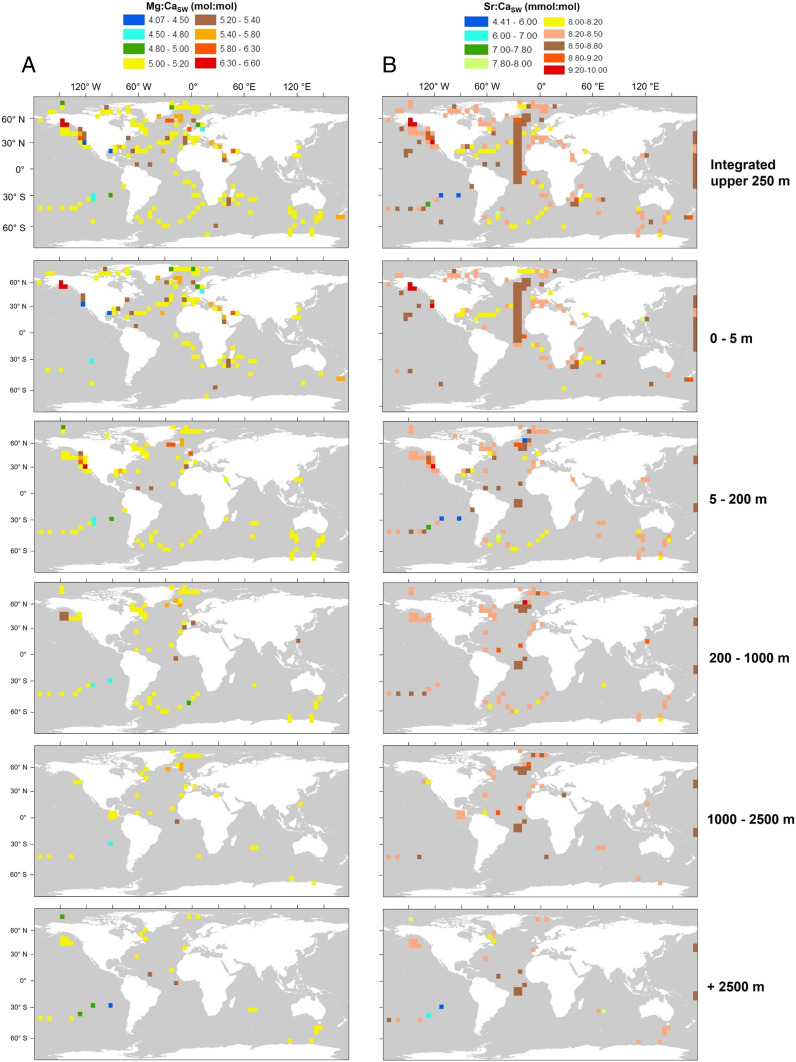
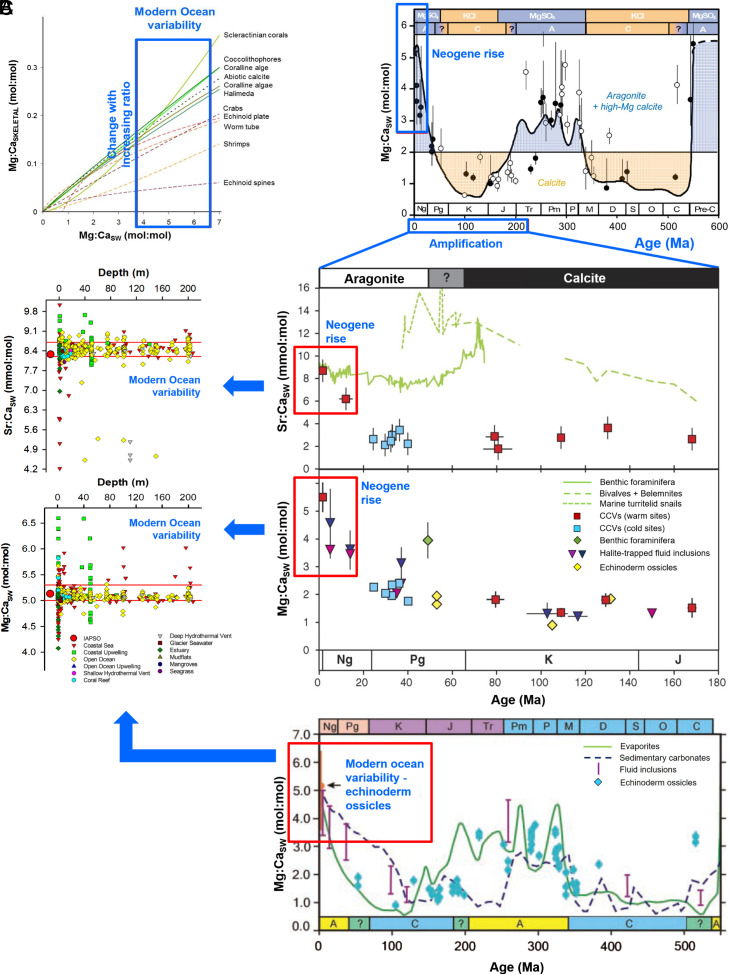
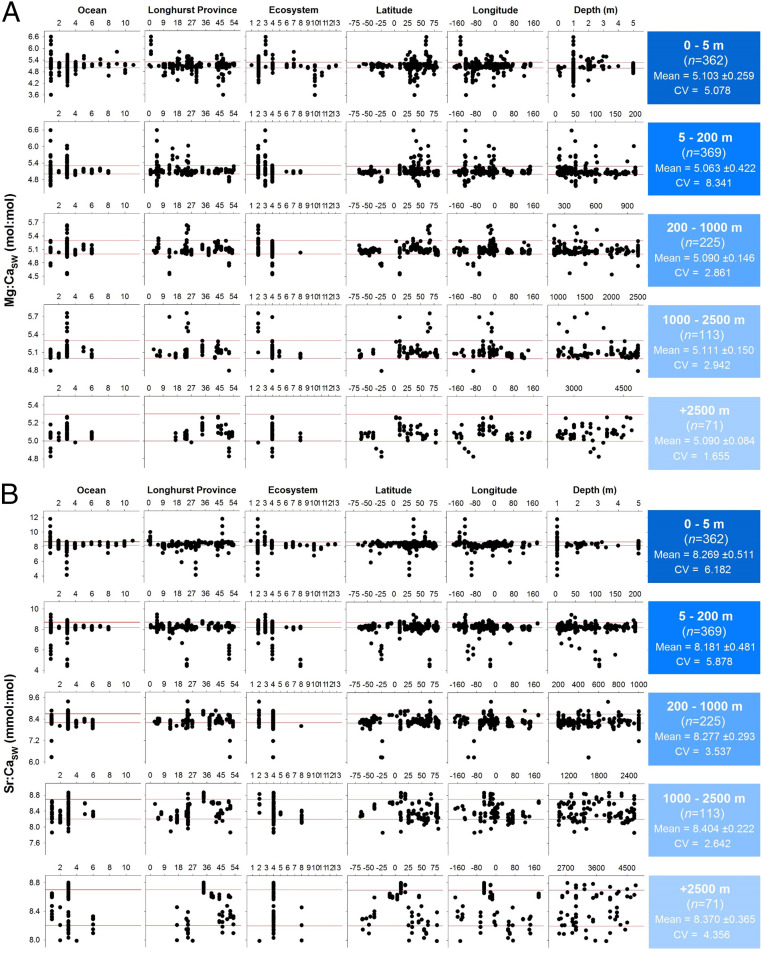
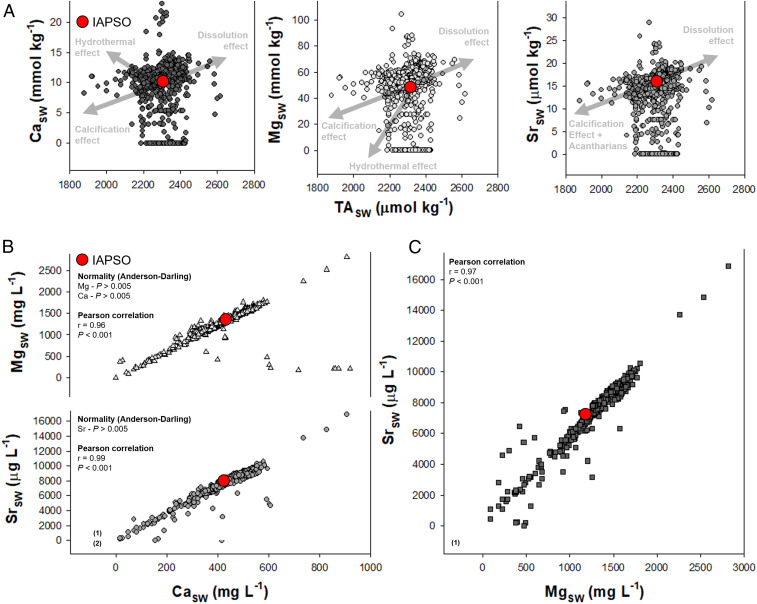
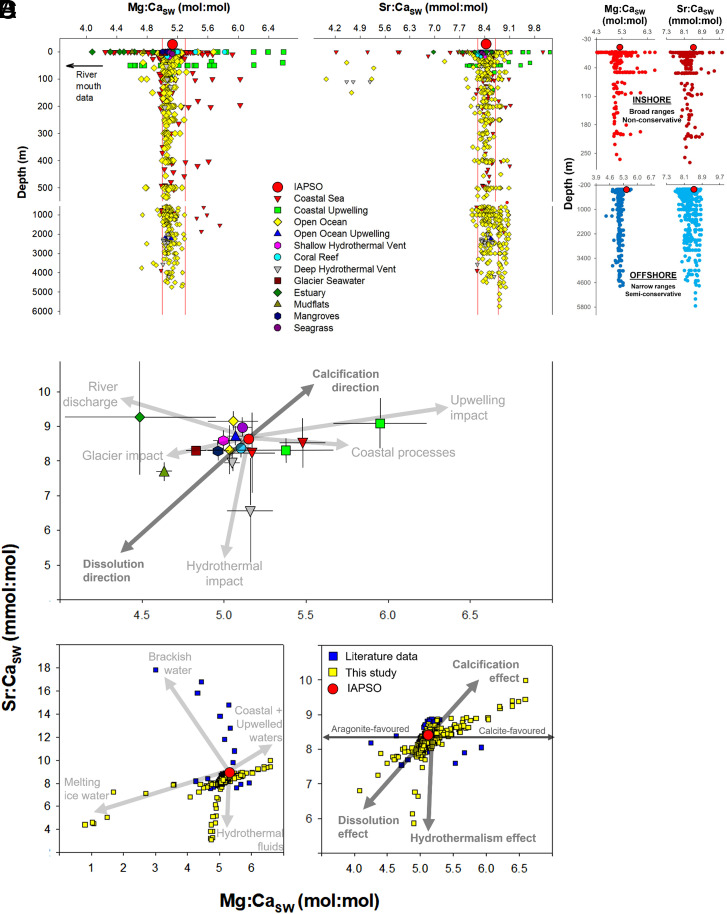
Seawater Mg:Ca and Sr:Ca ratios are biogeochemical parameters reflecting the Earth-ocean-atmosphere dynamic exchange of elements. The ratios' dependence on the environment and organisms' biology facilitates their application in marine sciences. Here, we present a measured single-laboratory dataset, combined with previous data, to test the assumption of limited seawater Mg:Ca and Sr:Ca variability across marine environments globally. High variability was found in open-ocean upwelling and polar regions, shelves/neritic and river-influenced areas, where seawater Mg:Ca and Sr:Ca ratios range from ∼4.40 to 6.40 mmol:mol and ∼6.95 to 9.80 mmol:mol, respectively. Open-ocean seawater Mg:Ca is semiconservative (∼4.90 to 5.30 mol:mol), while Sr:Ca is more variable and nonconservative (∼7.70 to 8.80 mmol:mol); both ratios are nonconservative in coastal seas. Further, the Ca, Mg, and Sr elemental fluxes are connected to large total alkalinity deviations from International Association for the Physical Sciences of the Oceans (IAPSO) standard values. Because there is significant modern seawater Mg:Ca and Sr:Ca ratios variability across marine environments we cannot absolutely assume that fossil archives using taxa-specific proxies reflect true global seawater chemistry but rather taxa- and process-specific ecosystem variations, reflecting regional conditions. This variability could reconcile secular seawater Mg:Ca and Sr:Ca ratio reconstructions using different taxa and techniques by assuming an error of 1 to 1.50 mol:mol, and 1 to 1.90 mmol:mol, respectively. The modern ratios' variability is similar to the reconstructed rise over 20 Ma (Neogene Period), nurturing the question of seminonconservative behavior of Ca, Mg, and Sr over modern Earth geological history with an overlooked environmental effect.
海水 Mg:Ca 和 Sr:Ca 比值是反映地球-海洋-大气元素动态交换的生物地球化学参数。这些比值对环境和生物体生物学的依赖性使其能够应用于海洋科学。在这里,我们呈现了一个经过测量的单实验室数据集,并结合了以前的数据,以测试全球海洋环境中海水 Mg:Ca 和 Sr:Ca 比值变化有限的假设。在开阔海域上升流和极地地区、大陆架/近岸和受河流影响的地区,海水 Mg:Ca 和 Sr:Ca 比值的变化范围分别为 ∼4.40 至 6.40mmol:mol 和 ∼6.95 至 9.80mmol:mol,发现存在高变异性。开阔海域海水 Mg:Ca 为半保守性(∼4.90 至 5.30mol:mol),而 Sr:Ca 比值变化更大且为非保守性(∼7.70 至 8.80mmol:mol);这两种比值在沿海海域均为非保守性。此外,Ca、Mg 和 Sr 元素通量与国际海洋物理科学协会(IAPSO)标准值相比存在较大的总碱度偏差。由于海洋环境中存在显著的现代海水 Mg:Ca 和 Sr:Ca 比值变化,我们不能绝对假设使用分类群特异性示踪剂的化石档案反映了真实的全球海水化学,而是反映了区域条件的分类群和过程特异性生态系统变化。这种变异性可以通过假设误差为 1 至 1.50mol:mol 和 1 至 1.90mmol:mol 来调和使用不同分类群和技术进行的现代海水 Mg:Ca 和 Sr:Ca 比值重建。现代比值的变异性与过去 20 Ma(新近纪)重建的比值升高相似,这引发了关于 Ca、Mg 和 Sr 在现代地球地质历史上半非保守行为的问题,同时也忽视了环境因素的影响。