Department of Orthopedic Sports Medicine, Technical University of Munich, Klinikum rechts der Isar, Ismaninger Str. 22, 81675, Munich, Germany.
Department of Orthopaedics and Trauma Surgery, Medical Center, Faculty of Medicine, Albert-Ludwigs-University of Freiburg, Freiburg, Germany.
Knee Surg Sports Traumatol Arthrosc. 2021 Oct;29(10):3392-3399. doi: 10.1007/s00167-020-06245-5. Epub 2020 Aug 26.
The aim of this study was, to investigate the rate of return to sports (RTS) and physical activity after implantation of PFIA and to identify factors predictive of improved postoperative sporting ability.
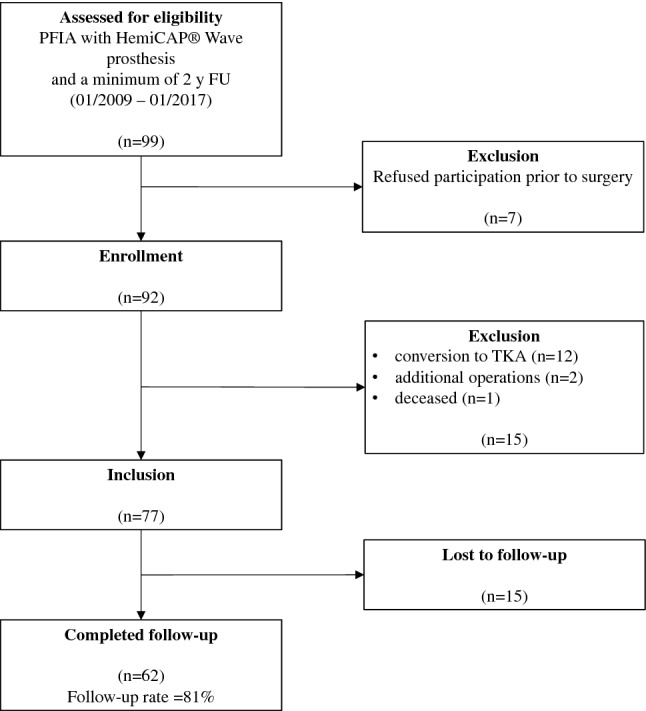
Sixty-two patients with a mean age of 46 ± 11 years, who underwent implantation of PFIA at the senior authors' institution, were enrolled. They were prospectively evaluated preoperatively and at a minimum of 2 years postoperatively with a mean follow-up of 60 ± 25 months. Clinical outcomes, return to sports and activity, type of sport or activity, subjective satisfaction, and frequency were evaluated by questionnaire.
The transformed overall Western Ontario and McMaster Universities Osteoarthritis Index (WOMAC) score improved from 67 ± 16 to 77 ± 19 (p = 0.003), Tegner activity scale results improved from 3 ± 2 points to 4 ± 1 points (p < 0.001), and scores on the visual analog scale (VAS) pain scale decreased from 6 ± 2 points to 3 ± 2 points (p < 0.001). The sports frequency increased from 1 ± 2 sessions to 2 ± 1 sessions per week (p = 0.001). Ninety-four percent of the patients who did not fail could return to the same or higher level of sports, with 74% of the patients reporting an improved ability to perform sports. No preoperative factors could be detected to significantly influence RTS after surgery.
PFIA is a valid treatment option for the active patient with end-stage isolated patellofemoral OA. Reliable improvements in knee function, pain, and participation in low-impact sports were found.
IV.
本研究旨在调查 PFIA 植入术后患者的运动重返率(RTS)和身体活动情况,并确定预测术后运动能力改善的因素。
本研究纳入了在资深作者所在机构接受 PFIA 植入术的 62 名平均年龄为 46±11 岁的患者。他们在术前和至少 2 年的术后进行了前瞻性评估,平均随访 60±25 个月。通过问卷调查评估临床结果、重返运动和活动情况、运动或活动类型、主观满意度和频率。
转化后的总体西部安大略省和麦克马斯特大学骨关节炎指数(WOMAC)评分从 67±16 分改善至 77±19 分(p=0.003),Tegner 活动量表评分从 3±2 分提高至 4±1 分(p<0.001),视觉模拟评分(VAS)疼痛评分从 6±2 分降低至 3±2 分(p<0.001)。运动频率从 1±2 次/周增加至 2±1 次/周(p=0.001)。94%的未失败患者能够恢复到相同或更高水平的运动,其中 74%的患者报告运动能力得到改善。术前没有任何因素可以显著影响术后 RTS。
PFIA 是治疗晚期孤立髌股关节炎活跃患者的有效治疗选择。研究发现,膝关节功能、疼痛和低冲击运动参与度都得到了可靠的改善。
IV。