The First Clinical Medical School, Guangzhou University of Chinese Medicine, Jichang Road 12#, District Baiyun, Guangzhou, Guangdong, China.
Yudu People's Hospital, Huancheng North Road 2#, District Yudu, Ganzhou, Jiangxi, China.
J Orthop Surg Res. 2021 Apr 15;16(1):264. doi: 10.1186/s13018-021-02414-5.
Isolated patellofemoral osteoarthritis (PF-OA) is a common subtype of knee osteoarthritis, leading to a huge economic burden on health care systems. Although previous studies have shown that patellofemoral arthroplasty (PFA) and total knee arthroplasty (TKA) have good clinical effects, it remains largely unclear which treatment is more effective for patients with isolated PF-OA. We aimed to compare postoperative function, complications, revision rates, level of physical activity, and satisfaction rate between the two surgical techniques.
Our study followed the Preferred Reporting Items for Systematic Reviews and Meta-Analysis (PRISMA) guidelines. Search of literature was conducted in MEDLINE, EMBASE, Cochrane Library, and Web of Science until November 2020. The included studies were those that provided direct comparison of postoperative outcomes between PFA and TKA. Data were extracted from eligible studies and combined to calculate the pooled odds ratio (OR) and 95% confidence interval (CI). Sensitivity analysis and subgroup analysis were conducted to evaluate heterogeneity between the two groups.
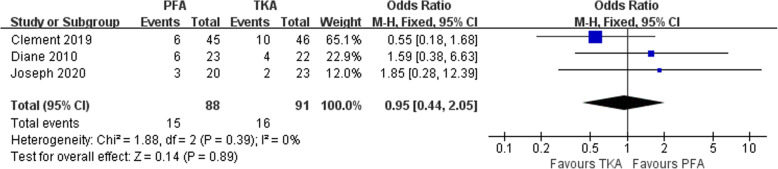
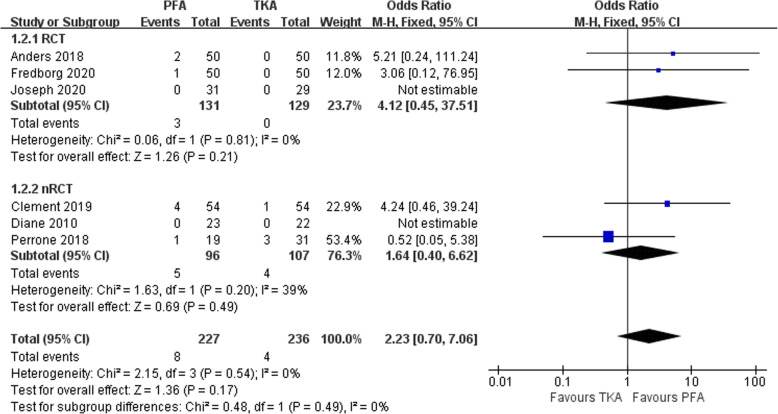
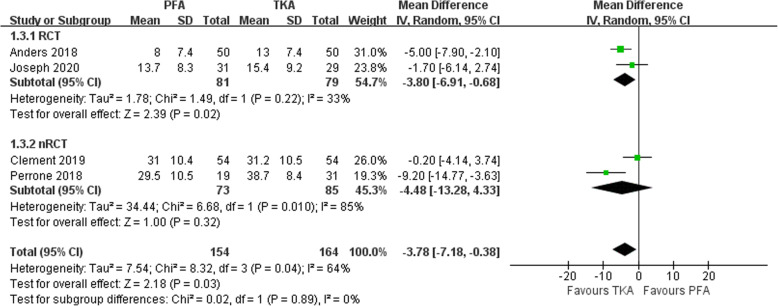
A total of 7 eligible studies (3 recent randomized controlled trials and 4 nonrandomized controlled trials) were included in this meta-analysis. The pooled results showed that both the PFA group and the TKA group had improved postoperative indicators, suggesting that the two operation modes could improve the knee function and quality of life of patients. Throughout the first 2 years postoperatively, higher activity level, and better functional recovery were observed for PFA compared with TKA in this study; moreover, the differences between the two operation modes were statistically significant (p < 0.05). We found no significant difference in complications, revision rates, and satisfaction rate between the two procedures.
Although there was no observed difference in the complications, revision rates, and satisfaction rate between PFA and TKA, PFA was superior to TKA in terms of knee function and physical activity in the first 2 years postoperatively. Therefore, PFA is a safe, effective, and less invasive treatment for patients with isolated PF-OA. Our findings are consistent with the systematic review of current evidence that PFA may be more suitable for younger patients with high activity needs. Patient selection is, therefore, thought to be of paramount importance. Individualized surgical plan should be designed according to the patient's age, BMI, KOA site, and activity level and combined with the doctor's personal experience.
孤立性髌股关节炎(PF-OA)是膝关节骨关节炎的常见亚型,给医疗保健系统带来了巨大的经济负担。尽管先前的研究表明髌股关节置换术(PFA)和全膝关节置换术(TKA)具有良好的临床效果,但对于孤立性 PF-OA 患者,哪种治疗方法更有效仍在很大程度上不清楚。我们旨在比较两种手术技术的术后功能、并发症、翻修率、身体活动水平和满意度。
我们的研究遵循系统评价和荟萃分析的首选报告项目(PRISMA)指南。在 MEDLINE、EMBASE、Cochrane 图书馆和 Web of Science 中进行文献搜索,截至 2020 年 11 月。纳入的研究是那些提供 PFA 和 TKA 术后结果直接比较的研究。从合格研究中提取数据并合并计算汇总优势比(OR)和 95%置信区间(CI)。进行敏感性分析和亚组分析以评估两组之间的异质性。
本荟萃分析共纳入 7 项合格研究(3 项近期随机对照试验和 4 项非随机对照试验)。汇总结果表明,PFA 组和 TKA 组术后指标均有改善,提示两种手术方式均能改善患者的膝关节功能和生活质量。在术后的前 2 年,与 TKA 相比,PFA 组患者的活动水平更高,功能恢复更好,而且两种手术方式之间的差异具有统计学意义(p<0.05)。我们发现两种手术方式之间在并发症、翻修率和满意度方面没有显著差异。
尽管 PFA 和 TKA 在并发症、翻修率和满意度方面没有观察到差异,但在术后的前 2 年,PFA 在膝关节功能和身体活动方面优于 TKA。因此,PFA 是治疗孤立性 PF-OA 的一种安全、有效且微创的治疗方法。我们的研究结果与当前证据的系统评价一致,即 PFA 可能更适合活动需求较高的年轻患者。因此,患者选择至关重要。应根据患者的年龄、BMI、KOA 部位和活动水平,并结合医生的个人经验,制定个体化的手术计划。