Department of Neurology and Neurological Sciences, Stanford University Medical Center, 213 Quarry Rd, Palo Alto, CA, 94305, USA.
Department of Anesthesiology, Perioperative, & Pain Medicine, Stanford University Medical Center, 300 N. Pasteur Dr, Stanford, CA, 94305, USA.
BMC Neurol. 2020 Aug 26;20(1):313. doi: 10.1186/s12883-020-01897-9.
Stroke increases the risk of cognitive impairment even several years after the stroke event. The exact mechanisms of post-stroke cognitive decline are unclear, but the immunological response to stroke might play a role. The aims of the StrokeCog study are to examine the associations between immunological responses and long-term post-stroke cognitive trajectories in individuals with ischemic stroke.
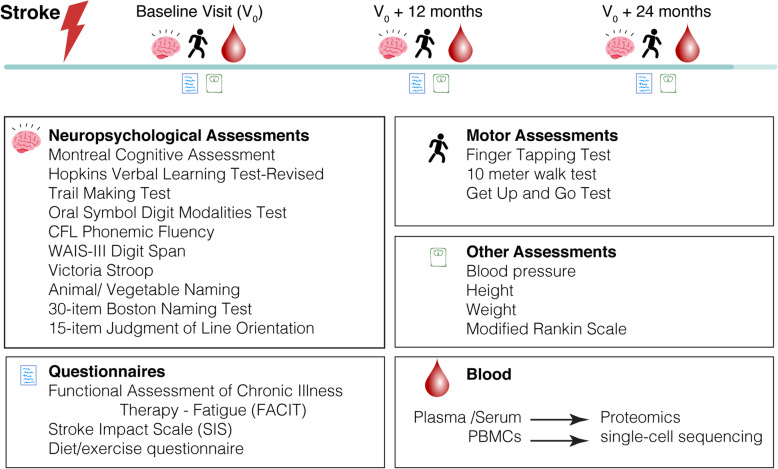
StrokeCog is a single-center, prospective, observational, cohort study. Starting 6-12 months after stroke, comprehensive neuropsychological assessment, plasma and serum, and psychosocial variables will be collected at up to 4 annual visits. Single cell sequencing of peripheral blood monocytes and plasma proteomics will be conducted. The primary outcome will be the change in global and domain-specific neuropsychological performance across annual evaluations. To explain the differences in cognitive change amongst participants, we will examine the relationships between comprehensive immunological measures and these cognitive trajectories. It is anticipated that 210 participants will be enrolled during the first 3 years of this 4-year study. Accounting for attrition, an anticipated final sample size of 158 participants with an average of 3 annual study visits will be available at the completion of the study. Power analyses indicate that this sample size will provide 90% power to detect an average cognitive change of at least 0.23 standard deviations in either direction.
StrokeCog will provide novel insight into the relationships between immune events and cognitive change late after stroke.
中风会增加认知障碍的风险,即使在中风事件发生几年后也是如此。中风后认知能力下降的确切机制尚不清楚,但中风后的免疫反应可能起作用。StrokeCog 研究的目的是研究免疫反应与缺血性中风患者长期中风后认知轨迹之间的关联。
StrokeCog 是一项单中心、前瞻性、观察性、队列研究。中风后 6-12 个月开始,将在多达 4 次年度访视中收集全面的神经心理学评估、血浆和血清以及社会心理变量。外周血单核细胞的单细胞测序和血浆蛋白质组学将进行。主要结局将是年度评估中全球和特定领域神经心理学表现的变化。为了解释参与者认知变化的差异,我们将检查综合免疫措施与这些认知轨迹之间的关系。预计在这项为期 4 年的研究的前 3 年内将有 210 名参与者入组。考虑到流失,预计在研究结束时将有 158 名参与者具有平均 3 次年度研究访视,最终样本量为 158 名。功效分析表明,该样本量将有 90%的功效来检测至少 0.23 个标准差的任何方向的平均认知变化。
StrokeCog 将为免疫事件与中风后晚期认知变化之间的关系提供新的见解。