Department of Endocrinology, Diabetes and Metabolism, Graduate School of Medicine, Nippon Medical School, 1-1-5, Sendagi, Bunkyo-ku, Tokyo, 113-8603, Japan.
Department of Gastroenterology, Nippon Medical School Chiba Hokusoh Hospital, 1715, Kamagari, Inzai, Chiba, 270-1694, Japan.
BMC Endocr Disord. 2020 Aug 26;20(1):132. doi: 10.1186/s12902-020-00613-5.
Immune checkpoint inhibitors (ICIs) can induce immune-related adverse events (irAEs) including thyroid dysfunction. There are only a few reports on Graves' disease induced by ICIs. We report a case of new-onset Graves' disease after the initiation of nivolumab therapy in a patient receiving gastric cancer treatment.
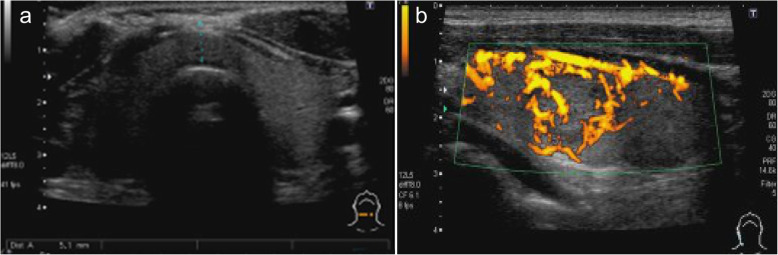
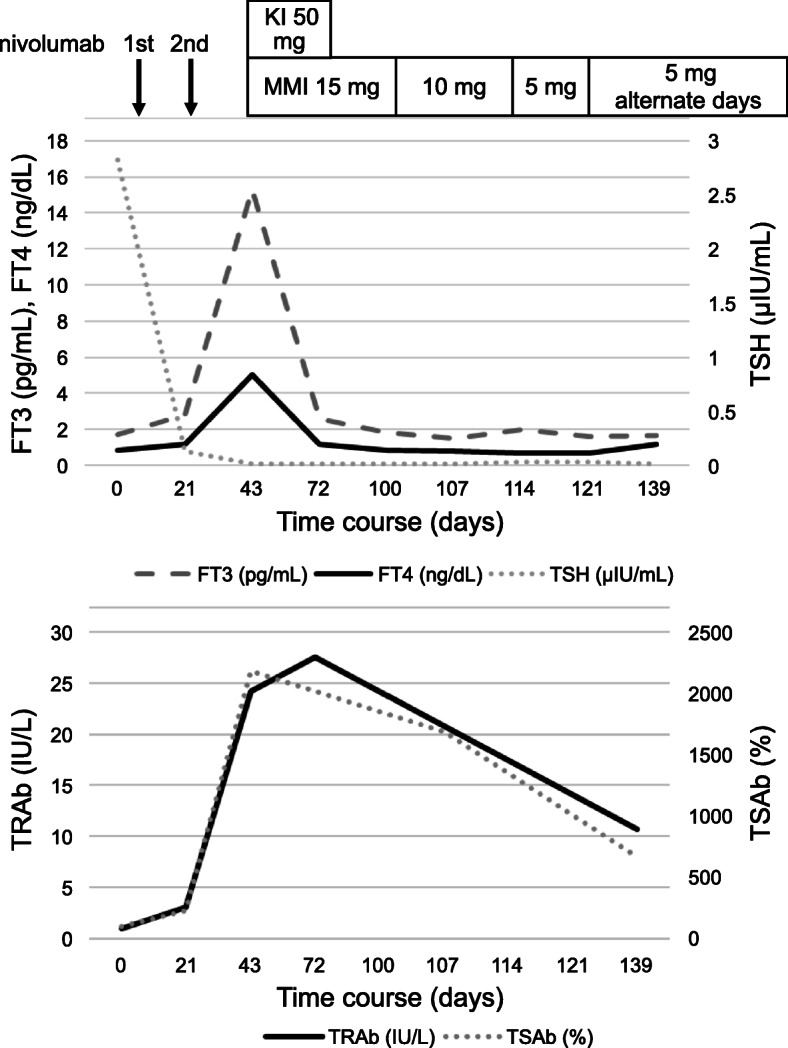
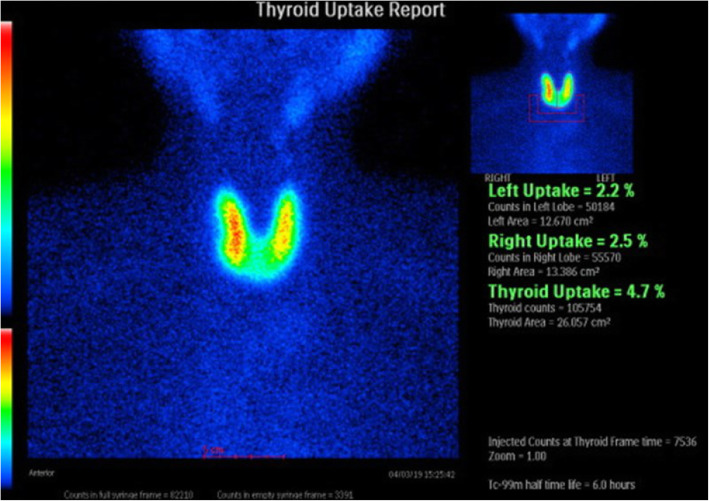
The patient was a 66-year-old Japanese man, who was administered nivolumab (240 mg every 3 weeks) as a third-line therapy for stage IVb gastric cancer. His thyroid function was normal before the initiation of nivolumab therapy. However, he developed thyrotoxicosis before the third administration of nivolumab. Elevated, bilateral, and diffuse uptake of radioactive tracer was observed in the Tc-pertechnetate scintigraphy. Furthermore, the thyroid-stimulating hormone receptor antibody (TRAb) and thyroid-stimulating antibody (TSAb) test results, which were negative before the first administration of nivolumab, were positive after starting the therapy. The patient was diagnosed with Graves' disease, and the treatment with methimazole and potassium iodide restored thyroid function.
This is the first complete report of a case of new-onset Graves' disease after starting nivolumab therapy, confirmed by diffusely increased thyroid uptake in scintigraphy and the positive conversion of antibodies against thyroid-stimulating hormone receptor. It is important to perform thyroid scintigraphy and ultrasonography to accurately diagnose and treat ICI-induced thyrotoxicosis, because there are various cases in which Graves' disease is developed with negative and positive TRAb titres.
免疫检查点抑制剂(ICI)可引起免疫相关不良事件(irAE),包括甲状腺功能障碍。仅有少数关于 ICI 引起的格雷夫斯病的报告。我们报告了一例新诊断的格雷夫斯病病例,该患者在接受胃癌治疗的同时接受了纳武利尤单抗治疗。
患者为 66 岁日本男性,在接受 IVb 期胃癌的三线治疗时,给予纳武利尤单抗(每 3 周 240mg)治疗。纳武利尤单抗治疗前甲状腺功能正常,但在第三次纳武利尤单抗给药前出现甲状腺毒症。Tc-过锝闪烁扫描显示双侧弥漫性放射性示踪剂摄取增加。此外,在开始治疗前阴性的促甲状腺激素受体抗体(TRAb)和促甲状腺刺激抗体(TSAb)检测结果在开始治疗后转为阳性。患者被诊断为格雷夫斯病,给予甲巯咪唑和碘化钾治疗恢复甲状腺功能。
这是首例新诊断的纳武利尤单抗治疗后格雷夫斯病病例报告,通过闪烁扫描弥漫性甲状腺摄取增加和促甲状腺激素受体抗体的阳性转化得到证实。重要的是要进行甲状腺闪烁扫描和超声检查以准确诊断和治疗 ICI 引起的甲状腺毒症,因为在 TRAb 滴度阴性和阳性的情况下会出现各种格雷夫斯病病例。