Department of Internal Medicine, University of Massachusetts Medical School-Baystate Medical Center, Springfield, MA, United States of America.
Department of Internal Medicine, University of Massachusetts Medical School-Baystate Medical Center, Springfield, MA, United States of America.
Cardiovasc Revasc Med. 2021 Feb;23:107-113. doi: 10.1016/j.carrev.2020.08.028. Epub 2020 Aug 18.
Severe acute respiratory syndrome coronavirus 2 (SARS-CoV-2), also referred to as COVID-19, was declared a pandemic by the World Health Organization in March 2020. The manifestations of COVID-19 are widely variable and range from asymptomatic infection to multi-organ failure and death. Like other viral illnesses, acute myocarditis has been reported to be associated with COVID-19 infection. However, guidelines for the diagnosis of COVID-19 myocarditis have not been established.
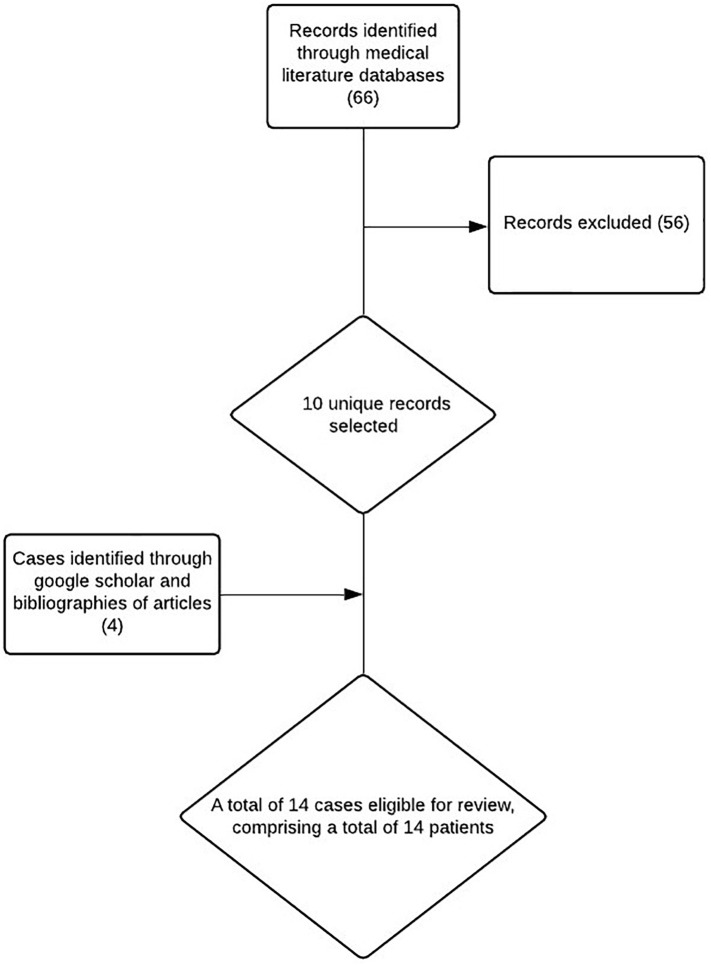
Using a combination of search terms in the PubMed/Medline, Ovid Medline and the Cochrane Library databases and manual searches on Google Scholar and the bibliographies of articles identified, we reviewed all cases reported in the English language citing myocarditis associated with COVID-19 infection.
Fourteen records comprising a total of fourteen cases that report myocarditis/myopericarditis secondary to COVID-19 infection were identified. There was a male predominance (58%), with the median age of the cases described being 50.4 years. The majority of patients did not have a previously identified comorbid condition (50%), but of those with a past medical history, hypertension was most prevalent (33%). Electrocardiogram findings were variable, and troponin was elevated in 91% of cases. Echocardiography was performed in 83% of cases reduced function was identified in 60%. Endotracheal intubation was performed in the majority of cases. Glucocorticoids were most commonly used in treatment of myocarditis (58%). Majority of patients survived to discharge (81%) and 85% of those that received steroids survived to discharge.
Guidelines for diagnosis and management of COVID-19 myocarditis have not been established and our knowledge on management is rapidly changing. The use of glucocorticoids and other agents including IL-6 inhibitors, IVIG and colchicine in COVID-19 myocarditis is debatable. In our review, there appears to be favorable outcomes related to myocarditis treated with steroid therapy. However, until larger scale studies are conducted, treatment approaches have to be made on an individualized case-by-case basis.
严重急性呼吸综合征冠状病毒 2(SARS-CoV-2),也称为 COVID-19,世界卫生组织于 2020 年 3 月宣布其为大流行。COVID-19 的临床表现广泛多变,从无症状感染到多器官衰竭和死亡不等。与其他病毒性疾病一样,已有报道称急性心肌炎与 COVID-19 感染有关。然而,尚未制定 COVID-19 心肌炎的诊断指南。
我们使用了 PubMed/Medline、Ovid Medline 和 Cochrane 图书馆数据库中的组合搜索词,并在 Google Scholar 上进行了手动搜索,以及对已确定文章的参考文献进行了搜索,对所有以 COVID-19 感染相关心肌炎为主题的英文报告病例进行了回顾。
共确定了 14 份记录,其中包括 14 例报告的 COVID-19 感染继发心肌炎/心包炎。男性居多(58%),所描述病例的中位年龄为 50.4 岁。大多数患者没有预先确定的合并症(50%),但在有既往病史的患者中,高血压最为常见(33%)。心电图表现多样,91%的病例肌钙蛋白升高。83%的病例进行了超声心动图检查,60%的病例发现心功能降低。大多数病例进行了气管插管。皮质类固醇是治疗心肌炎最常用的药物(58%)。大多数患者存活出院(81%),接受皮质类固醇治疗的患者中有 85%存活出院。
尚未制定 COVID-19 心肌炎的诊断和治疗指南,我们对其治疗方法的认识正在迅速变化。皮质类固醇和其他药物(包括 IL-6 抑制剂、IVIG 和秋水仙碱)在 COVID-19 心肌炎中的应用存在争议。在我们的综述中,似乎类固醇治疗的心肌炎患者有较好的预后。然而,在进行更大规模的研究之前,必须根据具体情况对治疗方法进行个体化。