Zheng Xiaowei, Xu Guanghua, Zhang Yubin, Liang Renghao, Zhang Kai, Du Yuhui, Xie Jun, Zhang Sicong
School of Mechanical Engineering, Xi'an Jiaotong University, Xi'an, China.
State Key Laboratory for Manufacturing Systems Engineering, Xi'an Jiaotong University, Xi'an, China.
Front Hum Neurosci. 2020 Jul 31;14:301. doi: 10.3389/fnhum.2020.00301. eCollection 2020.
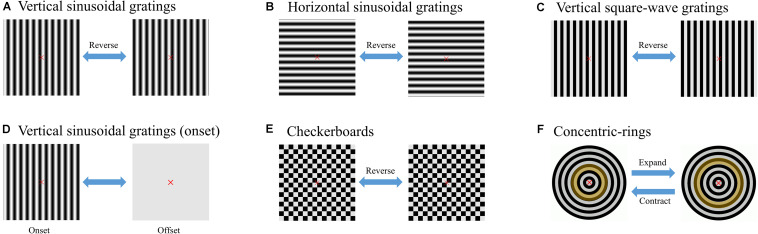
The occurrence of mental fatigue when users stare at stimuli is a critical problem in the implementation of steady-state visual evoked potential (SSVEP)-based visual acuity assessment, which may weaken the SSVEP amplitude and signal-to-noise ratio (SNR) and subsequently affect the results of visual acuity assessment. This study aimed to explore the anti-fatigue performance of six stimulus paradigms (reverse vertical sinusoidal gratings, reverse horizontal sinusoidal gratings, reverse vertical square-wave gratings, brief-onset vertical sinusoidal gratings, reversal checkerboards, and oscillating expansion-contraction concentric rings) in SSVEP acuity assessment.
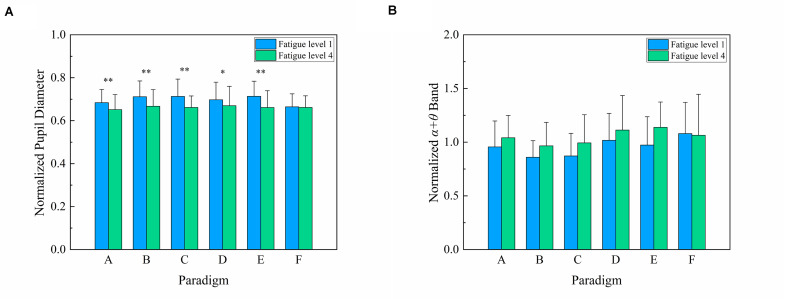
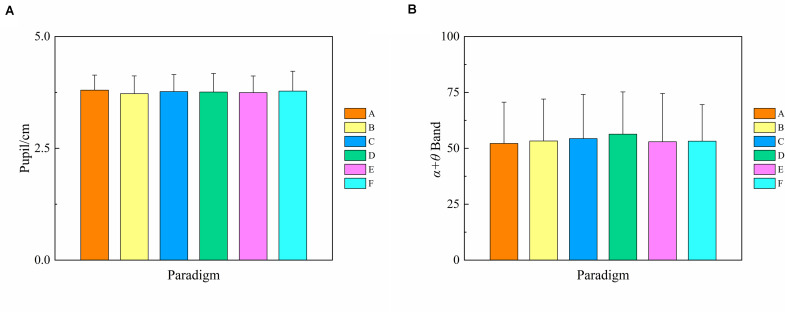
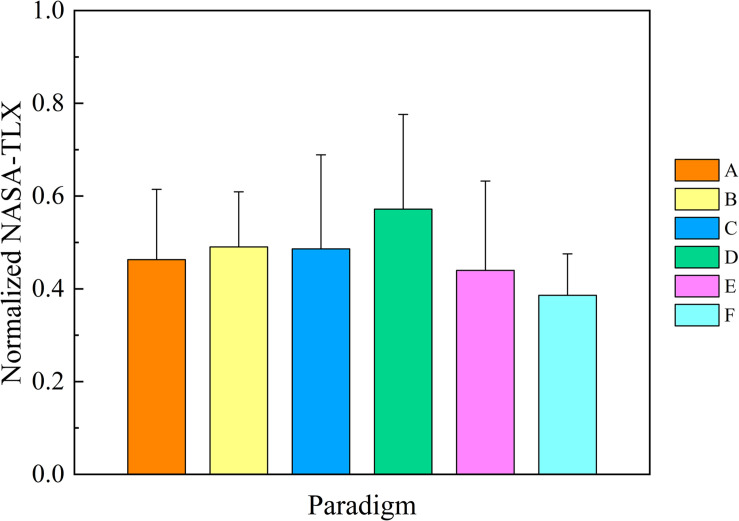
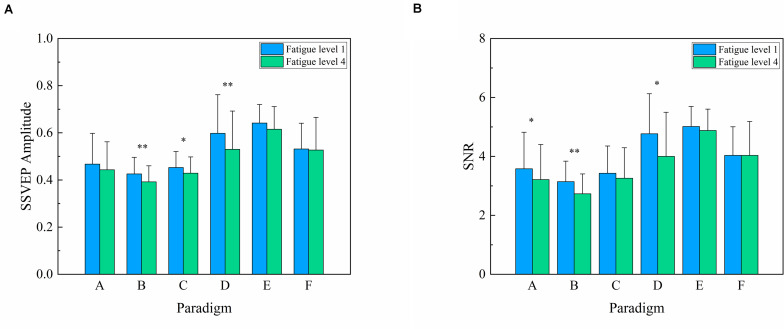
Based on four indices of α + θ index, pupil diameter, National Aeronautics and Space Administration Task Load Index (NASA-TLX), and amplitude and SNR of SSVEPs, this study quantitatively evaluated mental fatigue in six SSVEP visual attention runs corresponding to six paradigms with 12 subjects.
These indices of mental fatigue showed a good agreement. The results showed that the paradigm of motion expansion-contraction concentric rings had a superior anti-fatigue efficacy than the other five paradigms of conventional onset mode or pattern reversal mode during prolonged SSVEP experiment. The paradigm of brief-onset mode showed the lowest anti-fatigue efficacy, and the other paradigms of pattern reversal SSVEP paradigms showed a similar anti-fatigue efficacy, which was between motion expansion-contraction mode and onset mode.
This study recommended the paradigm of oscillating expansion-contraction concentric rings as the stimulation paradigm in SSVEP visual acuity because of its superior anti-fatigue efficacy.
在基于稳态视觉诱发电位(SSVEP)的视力评估中,用户注视刺激时出现精神疲劳是一个关键问题,这可能会削弱SSVEP的幅度和信噪比(SNR),进而影响视力评估结果。本研究旨在探讨六种刺激范式(反向垂直正弦光栅、反向水平正弦光栅、反向垂直方波光栅、短暂起始垂直正弦光栅、反转棋盘格和振荡扩张-收缩同心环)在SSVEP视力评估中的抗疲劳性能。
基于α+θ指数、瞳孔直径、美国国家航空航天局任务负荷指数(NASA-TLX)以及SSVEP的幅度和SNR这四个指标,本研究对12名受试者在对应六种范式的六次SSVEP视觉注意力测试中进行了精神疲劳的定量评估。
这些精神疲劳指标显示出良好的一致性。结果表明,在长时间的SSVEP实验中,振荡扩张-收缩同心环范式比其他五种传统起始模式或模式反转模式的范式具有更好的抗疲劳效果。短暂起始模式的范式显示出最低的抗疲劳效果,而其他模式反转SSVEP范式的抗疲劳效果相似,介于运动扩张-收缩模式和起始模式之间。
由于其优越的抗疲劳效果,本研究推荐振荡扩张-收缩同心环范式作为SSVEP视力测试中的刺激范式。