Lin Chih-Hsin, Wei Pei-Cih, Chen Chiung-Mei, Huang Yu-Ting, Lin Jia-Lan, Lo Yen-Shi, Lin Jia-Li, Lin Chung-Yin, Wu Yih-Ru, Chang Kuo-Hsuan, Lee-Chen Guey-Jen
Department of Neurology, Chang-Gung Memorial Hospital, Chang-Gung University College of Medicine, Taoyuan, Taiwan.
Taipei First Girls High School, Taipei, Taiwan.
Front Aging Neurosci. 2020 Jul 24;12:226. doi: 10.3389/fnagi.2020.00226. eCollection 2020.
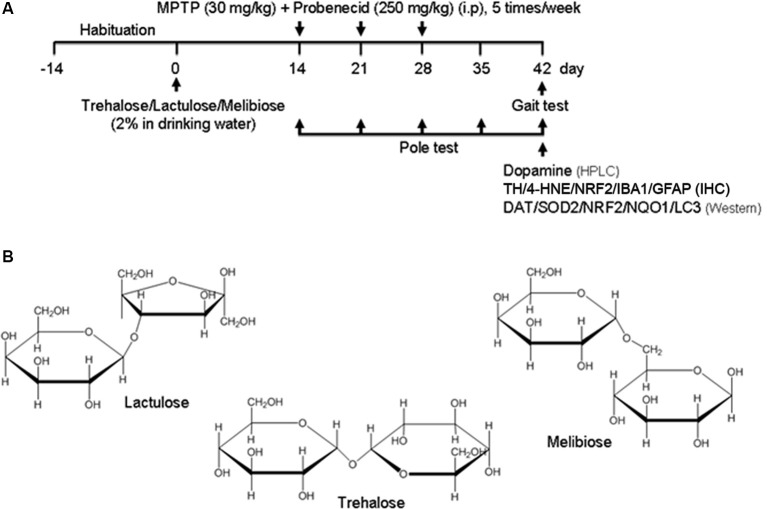
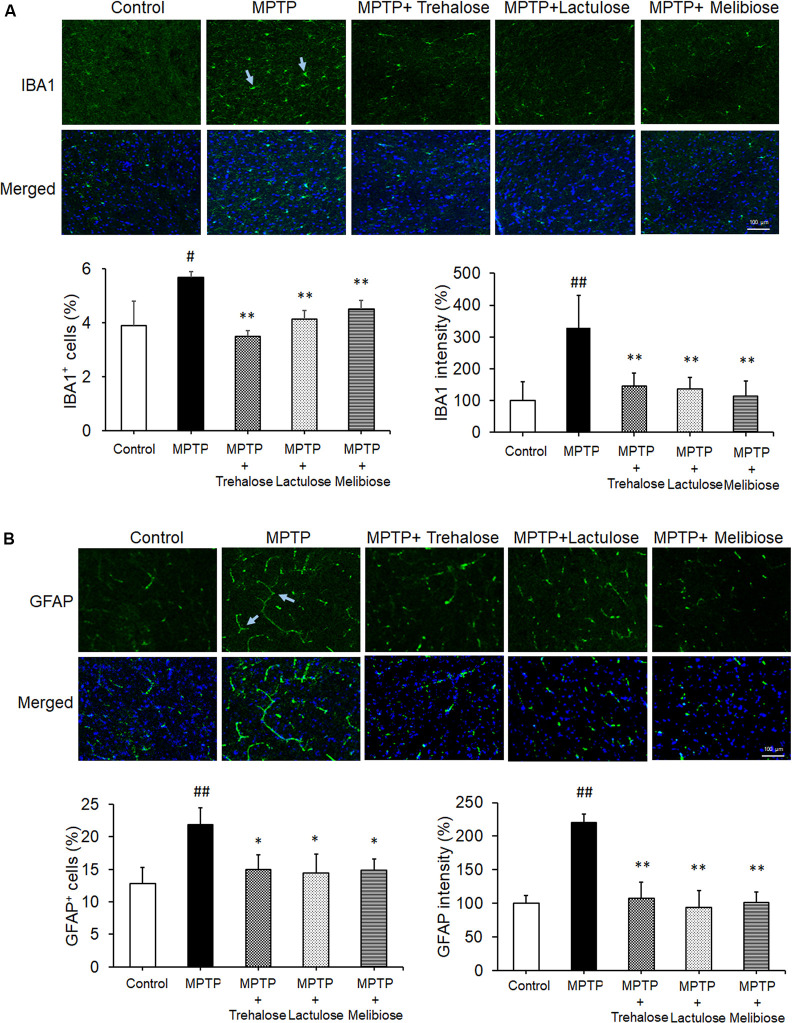
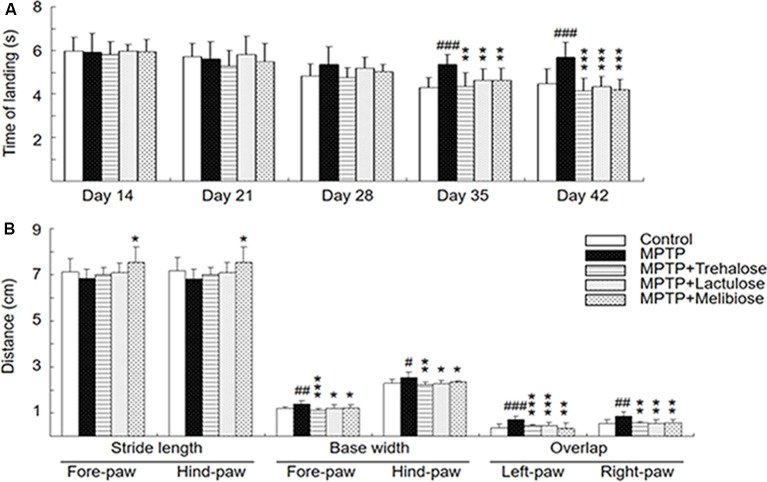
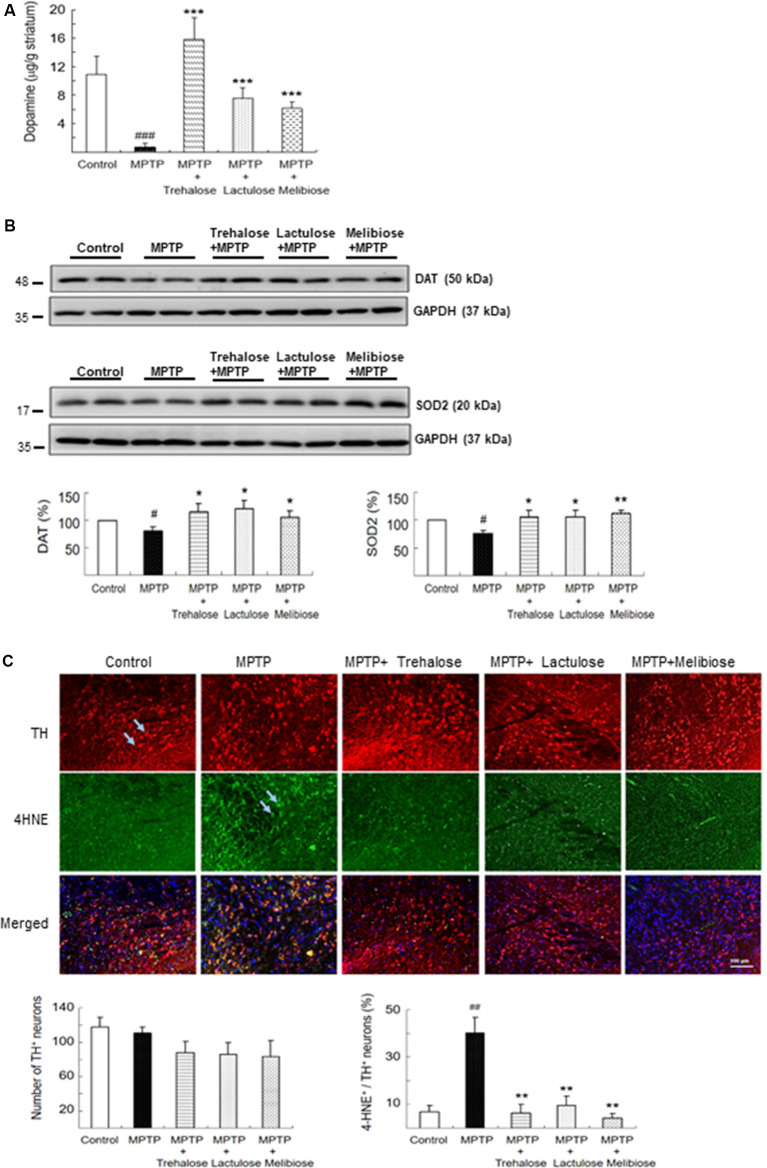
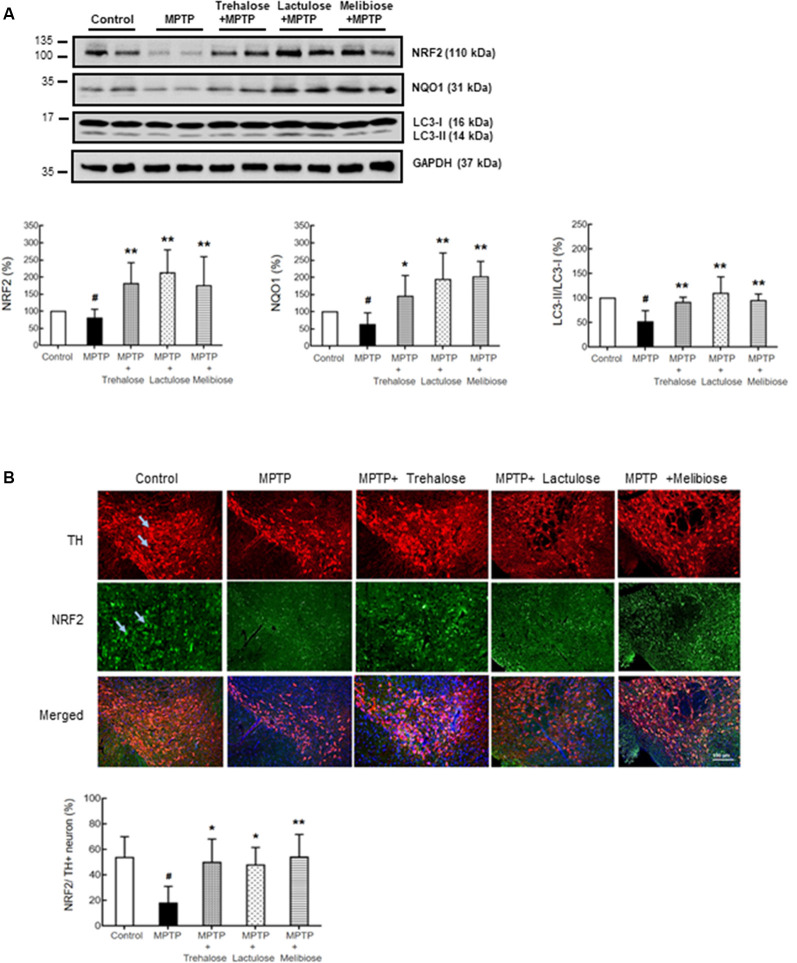
Parkinson's disease (PD) is a common neurodegenerative disease characterized by the progressive loss of dopaminergic (DAergic) neurons in the ventral brain. A disaccharide trehalose has demonstrated the potential to mitigate the DAergic loss in disease models for PD. However, trehalose is rapidly hydrolyzed into glucose by trehalase in the intestine, limiting its potential for clinical practice. Here, we investigated the neuroprotective potential of two trehalase-indigestible analogs, lactulose and melibiose, in sub-chronic 1-methyl-4-phenyl-1,2,3,6-tetrahydropyridine (MPTP)-induced mouse model of PD. Treatment with MPTP generated significant motor deficits, inhibited dopamine levels, and down-regulated dopamine transporter (DAT) in the striatum. Expression levels of genes involved in anti-oxidative stress pathways, including superoxide dismutase 2 (SOD2), nuclear factor erythroid 2-related factor 2 (NRF2), and NAD(P)H dehydrogenase (NQO1) were also down-regulated. Meanwhile, expression of the oxidative stress marker 4-hydroxynonenal (4-HNE) was up-regulated along with increased microglia and astrocyte reactivity in the ventral midbrain following MPTP treatment. MPTP also reduced the activity of autophagy, evaluated by the autophagosomal marker microtubule-associated protein 1 light chain 3 (LC3)-II. Lactulose and melibiose significantly rescued motor deficits, increased dopamine in the striatum, reduced microglia and astrocyte reactivity as well as decreased levels of 4-HNE. Furthermore, lactulose and melibiose up-regulated SOD2, NRF2, and NQO1 levels, as well as enhanced the LC3-II/LC3-I ratio in the ventral midbrain with MPTP treatment. Our findings indicate the potential of lactulose and melibiose to protect DAergic neurons in PD.
帕金森病(PD)是一种常见的神经退行性疾病,其特征是腹侧脑区多巴胺能(DAergic)神经元逐渐丧失。二糖海藻糖已被证明在帕金森病疾病模型中具有减轻多巴胺能神经元损失的潜力。然而,海藻糖在肠道中会被海藻糖酶迅速水解为葡萄糖,限制了其临床应用潜力。在此,我们研究了两种不可被海藻糖酶消化的类似物,乳果糖和蜜二糖,在亚慢性1-甲基-4-苯基-1,2,3,6-四氢吡啶(MPTP)诱导的帕金森病小鼠模型中的神经保护潜力。用MPTP处理会导致显著的运动功能缺陷,抑制纹状体中的多巴胺水平,并下调多巴胺转运体(DAT)。参与抗氧化应激途径的基因表达水平,包括超氧化物歧化酶2(SOD2)、核因子红细胞2相关因子2(NRF2)和NAD(P)H脱氢酶(NQO1)也被下调。同时,在MPTP处理后的腹侧中脑,氧化应激标志物4-羟基壬烯醛(4-HNE)的表达上调,小胶质细胞和星形胶质细胞的反应性增加。MPTP还降低了通过自噬体标志物微管相关蛋白1轻链3(LC3)-II评估的自噬活性。乳果糖和蜜二糖显著改善了运动功能缺陷,增加了纹状体中的多巴胺,降低了小胶质细胞和星形胶质细胞的反应性以及4-HNE水平。此外,乳果糖和蜜二糖上调了SOD2、NRF2和NQO1水平,并在MPTP处理的腹侧中脑增强了LC3-II/LC3-I比率。我们的研究结果表明乳果糖和蜜二糖在帕金森病中保护多巴胺能神经元的潜力。