Hall Rebecca J, Whelan Fiona J, McInerney James O, Ou Yaqing, Domingo-Sananes Maria Rosa
School of Life Sciences, University of Nottingham, Nottingham, United Kingdom.
Division of Evolution and Genomic Sciences, School of Biological Sciences, Faculty of Biology, Medicine and Health, The University of Manchester, Manchester, United Kingdom.
Front Microbiol. 2020 Jul 17;11:1569. doi: 10.3389/fmicb.2020.01569. eCollection 2020.
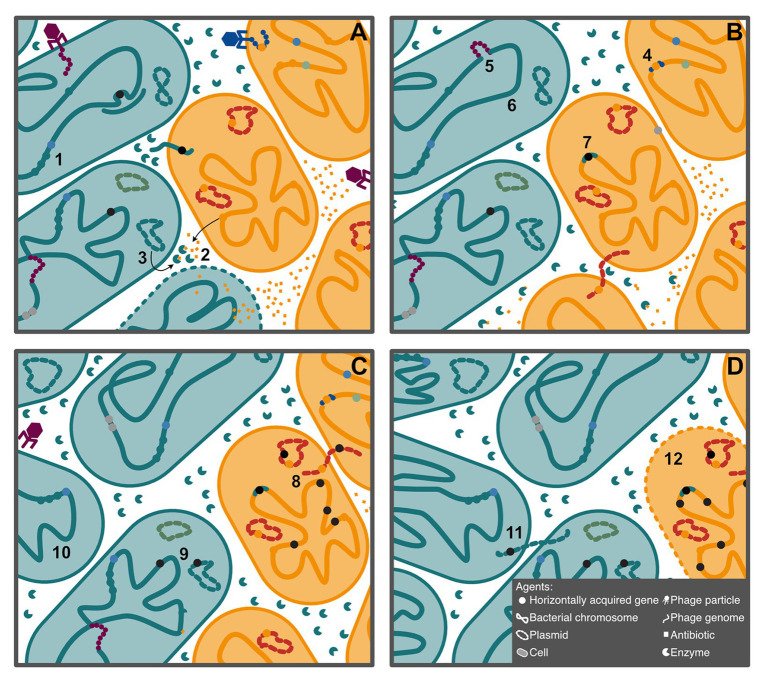
Horizontal gene transfer (HGT) is one of the most important processes in prokaryote evolution. The sharing of DNA can spread neutral or beneficial genes, as well as genetic parasites across populations and communities, creating a large proportion of the variability acted on by natural selection. Here, we highlight the role of HGT in enhancing the opportunities for conflict and cooperation within and between prokaryote genomes. We discuss how horizontally acquired genes can cooperate or conflict both with each other and with a recipient genome, resulting in signature patterns of gene co-occurrence, avoidance, and dependence. We then describe how interactions involving horizontally transferred genes may influence cooperation and conflict at higher levels (populations, communities, and symbioses). Finally, we consider the benefits and drawbacks of HGT for prokaryotes and its fundamental role in understanding conflict and cooperation from the gene-gene to the microbiome level.
水平基因转移(HGT)是原核生物进化中最重要的过程之一。DNA的共享可以在种群和群落间传播中性或有益基因,以及遗传寄生物,从而产生很大一部分受自然选择作用的变异性。在此,我们强调HGT在增加原核生物基因组内部以及不同原核生物基因组之间冲突与合作机会方面的作用。我们讨论水平获得的基因如何相互之间以及与受体基因组发生合作或冲突,从而产生基因共现、回避和依赖的特征模式。然后,我们描述涉及水平转移基因的相互作用如何在更高层次(种群、群落和共生关系)上影响合作与冲突。最后,我们考虑HGT对原核生物的利弊,以及它在理解从基因到基因再到微生物群落水平的冲突与合作方面的基础性作用。