Department of Immunology, University of Toronto, Toronto, ON, Canada.
Toronto Platelet Immunobiology Group, University of Toronto, Toronto, ON, Canada.
Front Immunol. 2020 Aug 7;11:1962. doi: 10.3389/fimmu.2020.01962. eCollection 2020.
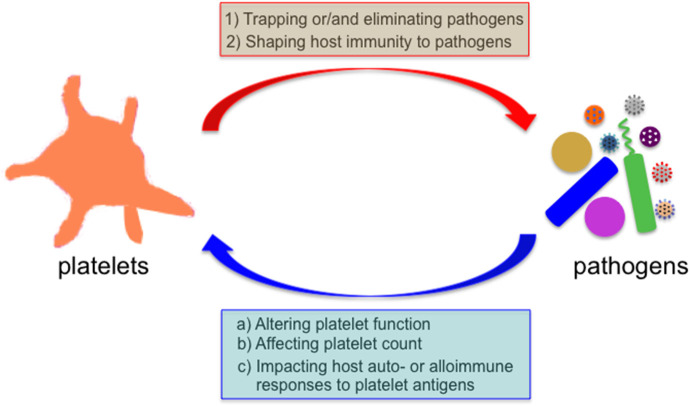
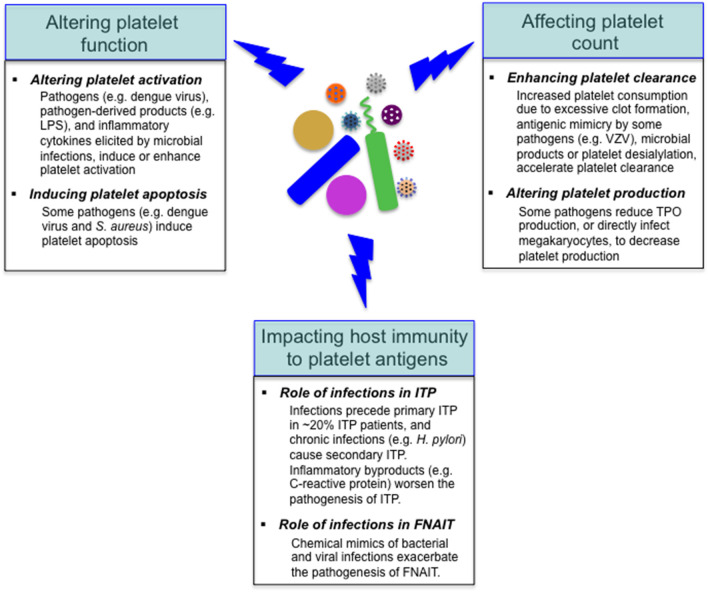
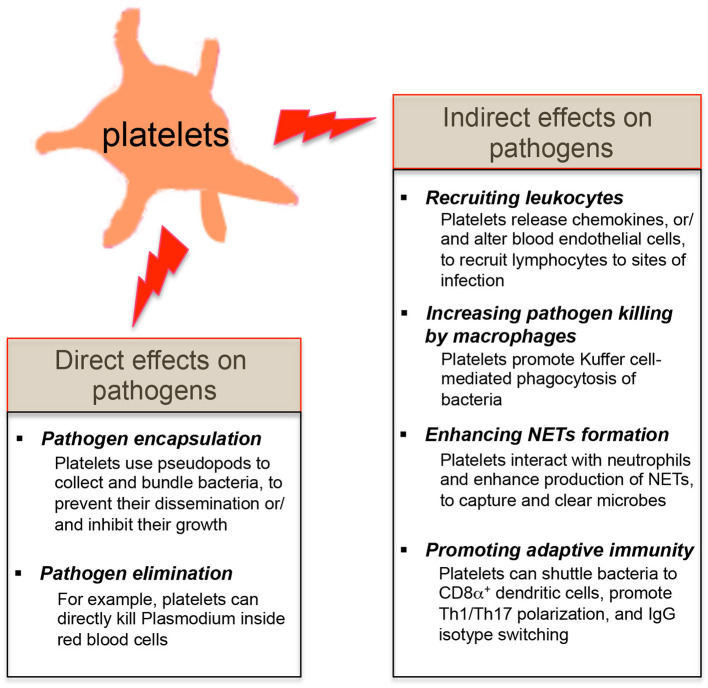
Platelets, small anucleate cells circulating in the blood, are critical mediators in haemostasis and thrombosis. Interestingly, recent studies demonstrated that platelets contain both pro-inflammatory and anti-inflammatory molecules, equipping platelets with immunoregulatory function in both innate and adaptive immunity. In the context of infectious diseases, platelets are involved in early detection of invading microorganisms and are actively recruited to sites of infection. Platelets exert their effects on microbial pathogens either by direct binding to eliminate or restrict dissemination, or by shaping the subsequent host immune response. Reciprocally, many invading microbial pathogens can directly or indirectly target host platelets, altering platelet count or/and function. In addition, microbial pathogens can impact the host auto- and alloimmune responses to platelet antigens in several immune-mediated diseases, such as immune thrombocytopenia, and fetal and neonatal alloimmune thrombocytopenia. In this review, we discuss the mechanisms that contribute to the bidirectional interactions between platelets and various microbial pathogens, and how these interactions hold relevant implications in the pathogenesis of many infectious diseases. The knowledge obtained from "well-studied" microbes may also help us understand the pathogenesis of emerging microbes, such as SARS-CoV-2 coronavirus.
血小板是循环血液中的小型无核细胞,是止血和血栓形成的关键介质。有趣的是,最近的研究表明,血小板包含促炎和抗炎分子,使血小板在先天和适应性免疫中具有免疫调节功能。在传染病的背景下,血小板参与对入侵微生物的早期检测,并被积极募集到感染部位。血小板通过直接结合来消除或限制传播来发挥对微生物病原体的作用,或者通过塑造随后的宿主免疫反应来发挥作用。反过来,许多入侵的微生物病原体可以直接或间接地靶向宿主血小板,改变血小板计数或/和功能。此外,微生物病原体可以在几种免疫介导的疾病中影响宿主自身和同种异体血小板抗原的自身和同种免疫反应,如免疫性血小板减少症和胎儿和新生儿同种免疫性血小板减少症。在这篇综述中,我们讨论了导致血小板与各种微生物病原体之间双向相互作用的机制,以及这些相互作用如何在许多传染病的发病机制中具有相关意义。从“研究充分”的微生物中获得的知识也可能有助于我们理解 SARS-CoV-2 冠状病毒等新兴微生物的发病机制。