Li J, Ran Q S, Hao B, Xu X, Yuan H F
Department of Ophthalmology, Daping Hospital, Army Medical University, Chongqing 400042, China.
Department of Radiology, Daping Hospital, Army Medical University, Chongqing 400042, China.
J Ophthalmol. 2020 Aug 12;2020:1870745. doi: 10.1155/2020/1870745. eCollection 2020.
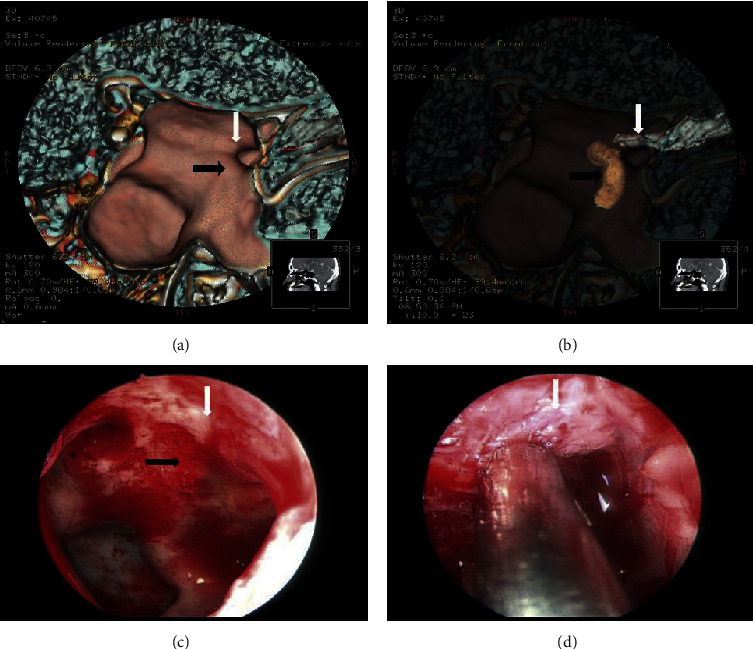
The endoscopic transethmoidal approach is favored for the lack of external scars, a wide field of view, and rapid recovery time. But the effect of iatrogenic trauma should not be ignored due to the removal of the uncinate process and anterior and posterior ethmoidal sinus. Anatomically, the optic nerve is close to the sphenoid sinus and Onodi cell. In order to preserve the uncinate process and ethmoidal sinus, we perform endoscopic transsphenoidal optic canal decompression (ETOCD), which is less invasive. However, the anatomy of sphenoid sinus is quite variable, and the anatomical landmarks are rare. Therefore, identifying the position of optic canal is particularly important during surgery. To solve this, we use a postprocessing technique to identify the position of the optic nerve and internal carotid artery on the sphenoid sinus wall. Our results find that VA in 13 patients improved, with a total improve rate of 59.1%. No serious complications were found. We also found that the length of optic canal is different and the medial wall of the optic canal was the longest ( < 0.05). The middle section of the optic canal is the narrowest, which was significantly different from cranial mouth and orbital mouth ( < 0.05). We assumed that decompression may not require removal of all medial wall. If we remove the length of the shortest wall on the medial wall of the optic canal, the compression may be relieved. Thus, ETOCD was a feasible, safe, effective, and less-invasive approach for patients with TON. The CT postprocessing imaging facilitated recognition of the optic canal during surgery. The decompression length of the medial wall may not need to be completely removed, especially near the cranial mouth.
经鼻内镜筛窦入路因无外部瘢痕、视野开阔及恢复时间快而受到青睐。但由于钩突及前后筛窦的切除,医源性创伤的影响不容忽视。从解剖学角度看,视神经靠近蝶窦和Onodi气房。为保留钩突和筛窦,我们采用了侵入性较小的经鼻内镜视神经管减压术(ETOCD)。然而,蝶窦的解剖结构变化很大,解剖标志很少。因此,手术中识别视神经管的位置尤为重要。为解决这一问题,我们使用一种后处理技术来识别蝶窦壁上的视神经和颈内动脉的位置。我们的结果发现,13例患者的视力得到改善,总改善率为59.1%。未发现严重并发症。我们还发现视神经管长度不同,视神经管内侧壁最长(<0.05)。视神经管中段最窄,与颅口和眶口有显著差异(<0.05)。我们推测减压可能不需要切除所有内侧壁。如果我们切除视神经管内侧壁最短的一段,压迫可能会得到缓解。因此,ETOCD对于创伤性视神经病变患者是一种可行、安全、有效且侵入性较小的方法。CT后处理成像有助于手术中识别视神经管。内侧壁的减压长度可能不需要完全切除,尤其是在颅口附近。