van der Schans Jort J, van de Donk Niels W C J, Mutis Tuna
Department of Hematology, Cancer Center Amsterdam, Amsterdam UMC, Vrije Universiteit Amsterdam, Amsterdam, Netherlands.
Front Oncol. 2020 Aug 5;10:1362. doi: 10.3389/fonc.2020.01362. eCollection 2020.
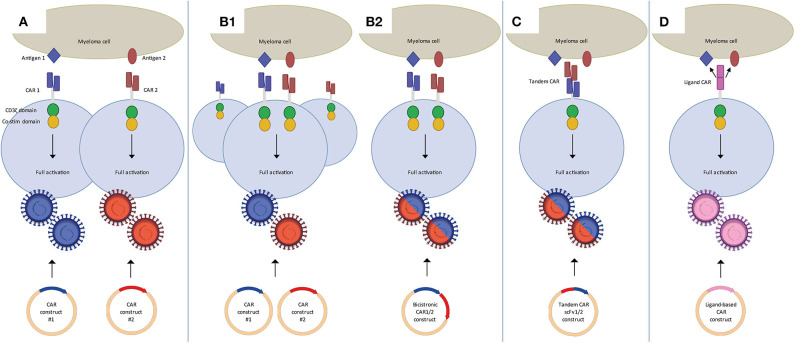
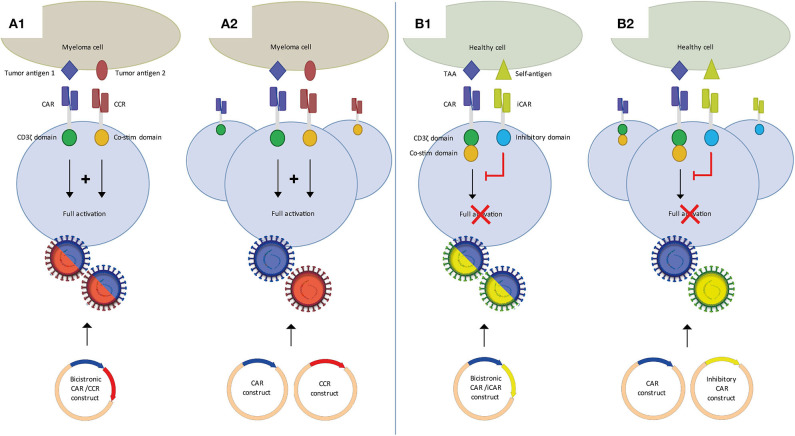
In the era of highly promising novel targeted-immunotherapy strategies for multiple myeloma (MM), the first series of clinical trials with CAR T-cells targeting the plasma cell-specific B-cell maturation antigen (BCMA) have shown excellent response rates. In the long-term, however, MM appears to escape the therapy likely due to initial low and heterogeneous expression or downregulation of BCMA expression. Several other molecules targeted by CAR T-cells in MM are expressed at high levels on MM cells, but many of these attractive targets are also expressed on various, sometimes vital non-malignant cells, posing major risks for on-target, off-tumor side effects. CAR T-cell therapy for MM therefore faces two urgent challenges: (i) improving the efficacy of BCMA CAR T-cells and (ii) establishing a MM-selectivity even when CAR T-cells are directed against not entirely MM-specific target antigens. In this review, we will outline the current attempts to tackle these challenges, with a specific focus on how dual CAR targeting might be applied to tackle both issues.
在针对多发性骨髓瘤(MM)的极具前景的新型靶向免疫治疗策略时代,首批针对浆细胞特异性B细胞成熟抗原(BCMA)的嵌合抗原受体(CAR)T细胞临床试验已显示出优异的缓解率。然而,从长远来看,MM似乎能够逃避这种治疗,这可能是由于最初BCMA表达水平低且异质性,或BCMA表达下调所致。MM中CAR T细胞靶向的其他几种分子在MM细胞上高水平表达,但这些有吸引力的靶点中有许多也在各种(有时是重要的)非恶性细胞上表达,这给靶向肿瘤外的副作用带来了重大风险。因此,MM的CAR T细胞疗法面临两个紧迫挑战:(i)提高BCMA CAR T细胞的疗效;(ii)即使CAR T细胞针对并非完全MM特异性的靶抗原,也要实现MM选择性。在本综述中,我们将概述目前应对这些挑战的尝试,特别关注双CAR靶向如何应用于解决这两个问题。