Shih Andrew J, Murphy Neal, Kozel Zachary, Shah Paras, Yaskiv Oksana, Khalili Houman, Liew Anthony, Kavoussi Louis, Hall Simon, Vira Manish, Zhu Xin-Hua, Lee Annette T
Feinstein Institutes for Medical Research, Manhasset, NY, United States.
Donald and Barbara Zucker School of Medicine at Hofstra/Northwell, Hempstead, NY, United States.
Front Oncol. 2020 Aug 11;10:1383. doi: 10.3389/fonc.2020.01383. eCollection 2020.
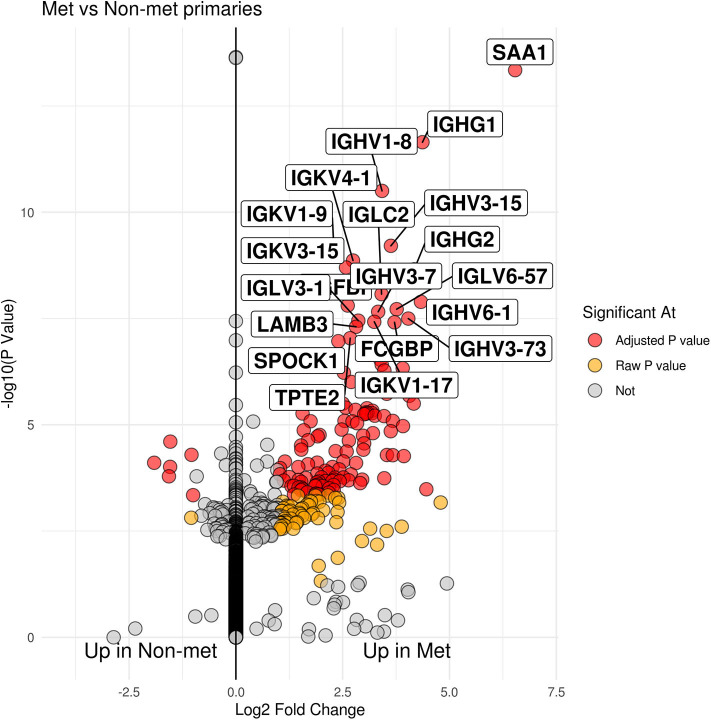
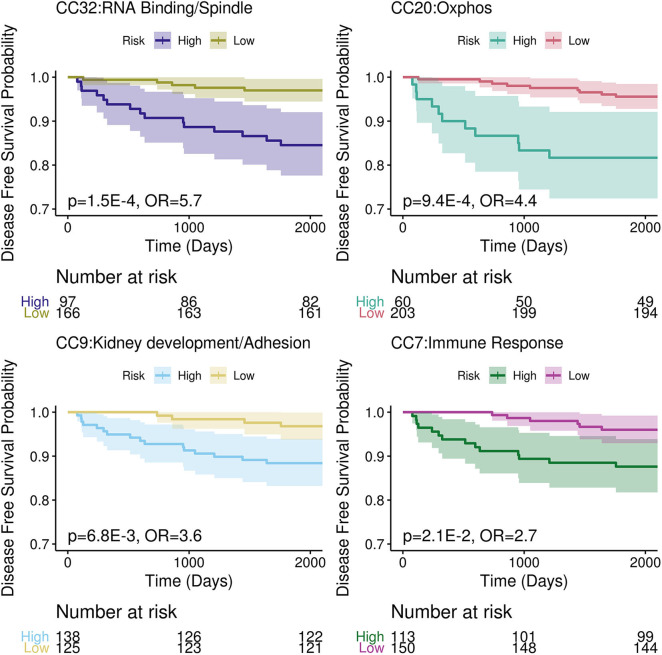
For patients with localized node-negative (Stage I and II) clear cell renal cell carcinomas (ccRCC), current clinicopathological staging has limited predictive capability because of their low risk. Analyzing molecular signatures at the time of nephrectomy can aid in understanding future metastatic potential. Develop a molecular signature that can stratify patients who have clinically low risk ccRCC, but have high risk genetic changes driving an aggressive metastatic phenotype. Presented is the differential expression of mRNA and miRNA in 44 Stage I and Stage II patients, 21 who developed metastasis within 5 years of nephrectomy, compared to 23 patients who remained disease free for more than 5 years. Extracted RNA from nephrectomy specimens preserved in FFPE blocks was sequenced using RNAseq. MiRNA expression was performed using the TaqMan OpenArray qPCR protocol. One hundred thirty one genes and 2 miRNA were differentially expressed between the two groups. Canonical correlation (CC) analysis was applied and four CCs (CC32, CC20, CC9, and CC7) have an AUC > 0.65 in our dataset with similar predictive power in the TCGA-KIRC dataset. Gene set enrichment showed CC9 as kidney development/adhesion, CC20 as oxidative phosphorylation pathway, CC32 as RNA binding/spindle and CC7 as immune response. In a multivariate Cox model, the four CCs were able to identify high/low risk groups for metastases in the TCGA-KIRC ( < 0.05) with odds ratios of CC32 = 5.7, CC20 = 4.4, CC9 = 3.6, and CC7 = 2.7. These results identify molecular signatures for more aggressive tumors in clinically low risk ccRCC patients who have a higher potential of metastasis than would be expected.
对于局限性淋巴结阴性(I期和II期)的透明细胞肾细胞癌(ccRCC)患者,由于其风险较低,目前的临床病理分期预测能力有限。在肾切除时分析分子特征有助于了解未来的转移潜能。开发一种分子特征,能够对临床上低风险但具有驱动侵袭性转移表型的高风险基因改变的ccRCC患者进行分层。本文展示了44例I期和II期患者中mRNA和miRNA的差异表达,其中21例在肾切除术后5年内发生转移,23例无病生存超过5年。从福尔马林固定石蜡包埋(FFPE)块中保存的肾切除标本中提取RNA,使用RNAseq进行测序。使用TaqMan OpenArray qPCR方案进行miRNA表达检测。两组之间有131个基因和2个miRNA差异表达。应用典型相关(CC)分析,在我们的数据集中四个CC(CC32、CC20、CC9和CC7)的曲线下面积(AUC)>0.65,在TCGA-KIRC数据集中具有相似的预测能力。基因集富集分析显示CC9与肾脏发育/黏附相关,CC20与氧化磷酸化途径相关,CC32与RNA结合/纺锤体相关,CC7与免疫反应相关。在多变量Cox模型中,这四个CC能够在TCGA-KIRC中识别转移的高/低风险组(<0.05),CC32的比值比为5.7,CC20为4.4,CC9为3.6,CC7为2.7。这些结果确定了临床上低风险ccRCC患者中更具侵袭性肿瘤的分子特征,这些患者发生转移的可能性高于预期。