Department of Microbiology and Immunology, Center for Molecular and Tumor Virology, Louisiana State University Health Sciences Center-Shreveport, Shreveport, LA, United States.
Vaccine and Gene Therapy Institute, Oregon Health and Science University, Beaverton, OR, United States.
Front Cell Infect Microbiol. 2020 Jul 31;10:368. doi: 10.3389/fcimb.2020.00368. eCollection 2020.
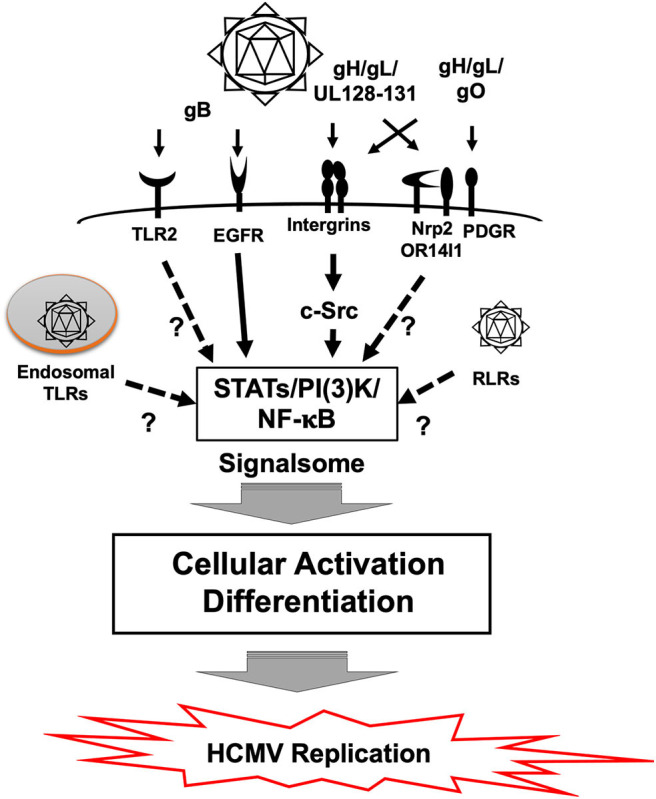
Viral dissemination is a key mechanism responsible for persistence and disease following human cytomegalovirus (HCMV) infection. Monocytes play a pivotal role in viral dissemination to organ tissue during primary infection and following reactivation from latency. For example, during primary infection, infected monocytes migrate into tissues and differentiate into macrophages, which then become a source of viral replication. In addition, because differentiated macrophages can survive for months to years, they provide a potential persistent infection source in various organ systems. We broadly note that there are three phases to infection and differentiation of HCMV-infected monocytes: (1) Virus enters and traffics to the nucleus through a virus receptor ligand engagement event that activates a unique signalsome that initiates the monocyte-to-macrophage differentiation process. (2) Following initial infection, HCMV undergoes a "quiescence-like state" in monocytes lasting for several weeks and promotes monocyte differentiation into macrophages. While, the initial event is triggered by the receptor-ligand engagement, the long-term cellular activation is maintained by chronic viral-mediated signaling events. (3) Once HCMV infected monocytes differentiate into macrophages, the expression of immediate early viral (IE) genes is detectable, followed by viral replication and long term infectious viral particles release. Herein, we review the detailed mechanisms of each phase during infection and differentiation into macrophages and discuss the biological significance of the differentiation of monocytes in the pathogenesis of HCMV.
病毒传播是导致人类巨细胞病毒(HCMV)感染后持续存在和发病的关键机制。单核细胞在原发性感染和潜伏后再激活期间向器官组织传播病毒方面发挥着关键作用。例如,在原发性感染期间,受感染的单核细胞迁移到组织中并分化为巨噬细胞,然后成为病毒复制的来源。此外,由于分化的巨噬细胞可以存活数月至数年,因此它们在各种器官系统中提供了潜在的持续性感染源。我们广泛注意到,HCMV 感染的单核细胞的感染和分化有三个阶段:(1)病毒通过与病毒受体配体结合的事件进入并运送到细胞核,该事件激活了独特的信号转导复合物,启动单核细胞向巨噬细胞分化过程。(2)初始感染后,HCMV 在单核细胞中经历持续数周的“类似静止状态”,并促进单核细胞分化为巨噬细胞。虽然初始事件是由受体配体结合触发的,但长期的细胞激活是由慢性病毒介导的信号事件维持的。(3)一旦 HCMV 感染的单核细胞分化为巨噬细胞,即可检测到早期即刻病毒(IE)基因的表达,随后进行病毒复制和长期传染性病毒颗粒释放。在此,我们综述了感染和分化为巨噬细胞过程中每个阶段的详细机制,并讨论了单核细胞分化在 HCMV 发病机制中的生物学意义。