Bartel Sabine, Deshane Jessy, Wilkinson Tom, Gabrielsson Susanne
Department of Pathology and Medical Biology, GRIAC Research Institute, University of Groningen, University Medical Center Groningen, Groningen, Netherlands.
Pulmonary Allergy and Critical Care Medicine, University of Alabama at Birmingham, Birmingham, AL, United States.
Front Med (Lausanne). 2020 Aug 4;7:326. doi: 10.3389/fmed.2020.00326. eCollection 2020.
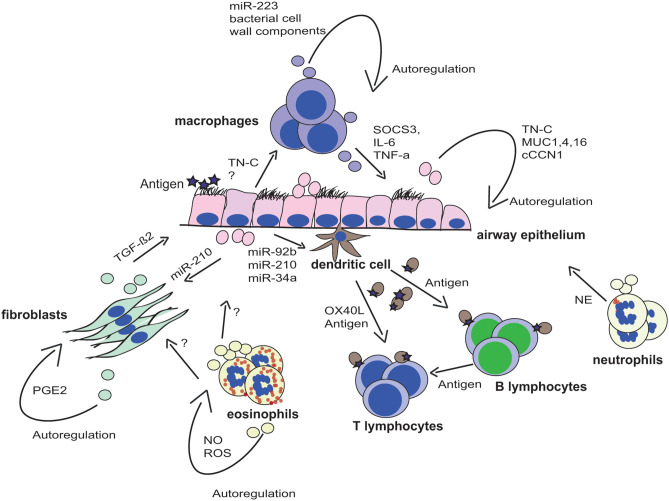
The human lung is a complex tissue subdivided into several regions that differ in size, function, and resident cell types. Despite years of intensive research, we still do not fully understand the cross talk between these different regions and diverse cell populations in the lung and how this is altered in the development of chronic respiratory disease. The discovery of extracellular vesicles (EVs), small membrane vesicles released from cells for intercellular communication, has added another layer of complexity to cellular cross talk in the complex lung microenvironment. EVs from patients with chronic obstructive pulmonary disease, asthma, or sarcoidosis have been shown to carry microRNAs, proteins, and lipids that may contribute to inflammation or tissue degeneration. Here, we summarize the contribution of these small vesicles in the interplay of several different cell types in the lung microenvironment, with a focus on the development of chronic respiratory diseases. Although there are already many studies demonstrating the adverse effects of EVs in the diseased lung, we still have substantial knowledge gaps regarding the concrete role of EV involvement in lung disease, which should be addressed in future studies.
人类肺脏是一种复杂组织,可细分为几个在大小、功能和驻留细胞类型上存在差异的区域。尽管经过多年深入研究,我们仍未完全理解肺内这些不同区域与多种细胞群体之间的相互作用,以及在慢性呼吸道疾病发展过程中这种相互作用是如何改变的。细胞外囊泡(EVs)的发现为复杂肺微环境中的细胞间通讯增添了另一层复杂性,细胞外囊泡是细胞释放的用于细胞间通讯的小膜泡。慢性阻塞性肺疾病、哮喘或结节病患者的细胞外囊泡已被证明携带可能导致炎症或组织退化的微小RNA、蛋白质和脂质。在这里,我们总结了这些小囊泡在肺微环境中几种不同细胞类型相互作用中的作用,重点关注慢性呼吸道疾病的发展。尽管已经有许多研究证明细胞外囊泡在患病肺脏中的不良影响,但我们对于细胞外囊泡参与肺部疾病的具体作用仍存在大量知识空白,这些空白应在未来的研究中加以解决。