Qiu Xiang, Ma Fei, Zhao Mingming, Cao Yaqiang, Shipp Lillian, Liu Angela, Dutta Arun, Singh Amit, Braikia Fatima Zohra, De Supriyo, Wood William H, Becker Kevin G, Zhou Weiqiang, Ji Hongkai, Zhao Keji, Atchison Michael L, Sen Ranjan
Laboratory of Molecular Biology and Immunology, National Institute on Aging, Baltimore, MD 21224, USA.
Laboratory of Epigenome Biology, Systems Biology Center, National Heart Lung and Blood Institute, Bethesda, MD 20892, USA.
Sci Adv. 2020 Aug 14;6(33):eaaz8850. doi: 10.1126/sciadv.aaz8850. eCollection 2020 Aug.
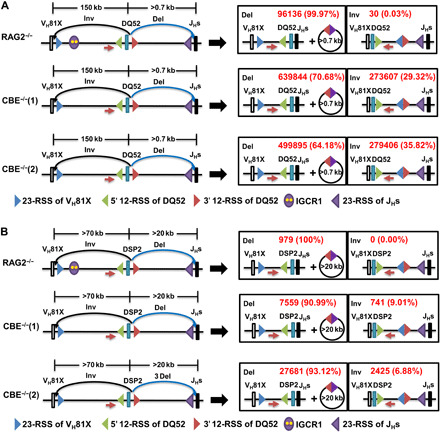
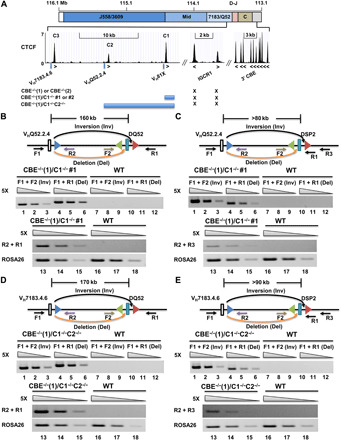
Immunoglobulin heavy chain () genes are assembled by two sequential DNA rearrangement events that are initiated by recombination activating gene products (RAG) 1 and 2. Diversity (D) gene segments rearrange first, followed by variable (V) gene rearrangements. Here, we provide evidence that each rearrangement step is guided by different rules of engagement between rearranging gene segments. D gene segments, which recombine by deletion of intervening DNA, must be located within a RAG1/2 scanning domain for efficient recombination. In the absence of intergenic control region 1, a regulatory sequence that delineates the RAG scanning domain on wild-type alleles, V and D gene segments can recombine with each other by both deletion and inversion of intervening DNA. We propose that V gene segments find their targets by distinct mechanisms from those that apply to D gene segments. These distinctions may underlie differential allelic choice associated with each step of gene assembly.
免疫球蛋白重链()基因通过两个连续的DNA重排事件组装而成,这两个事件由重组激活基因产物(RAG)1和2启动。多样性(D)基因片段首先重排,随后是可变(V)基因重排。在这里,我们提供证据表明,每个重排步骤都由重排基因片段之间不同的结合规则引导。通过删除中间DNA进行重组的D基因片段必须位于RAG1/2扫描域内才能进行有效重组。在缺乏基因间控制区1(一种在野生型等位基因上划定RAG扫描域的调控序列)的情况下,V和D基因片段可通过中间DNA的缺失和倒位彼此重组。我们提出,V基因片段通过与适用于D基因片段的机制不同的机制找到它们的靶标。这些差异可能是与基因组装每个步骤相关的等位基因选择差异的基础。