Yang Yang, Chen Min, Zheng Jun, Hao Jinsheng, Liu Bing, Liu Wei, Li Bei, Shao Jianbo, Liu Haihong, Ni Xin, Zhang Jie
Department of Otorhinolaryngology Head and Neck Surgery Beijing Children's Hospital Capital Medical University National Center for Children's Health Beijing China.
Beijing Key Laboratory for Pediatric Diseases of Otolaryngology-Head and Neck Surgery Beijing China.
Pediatr Investig. 2020 Jun 24;4(2):99-103. doi: 10.1002/ped4.12202. eCollection 2020 Jun.
Cochlear implantation (CI) is an effective therapy for patients with severe to profound sensorineural hearing loss. It remains controversial whether children younger than 12 months of age should undergo CI.
To evaluate the safety and effectiveness of CI in children younger than 12 months of age.
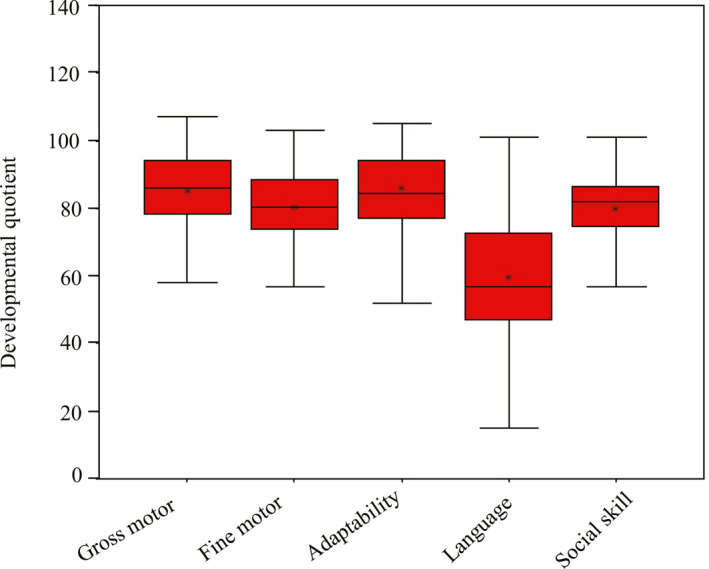
We performed a retrospective study of clinical data of pediatric patients younger than 12 months of age who underwent CI and were followed up for 1 to 2 years. Patients' developmental levels were evaluated by the Gesell score before CI. Intraoperative and postoperative complications were recorded to evaluate the safety of CI. Auditory and speech abilities were scored by the LittlEARS® auditory questionnaire (LEAQ), categories of auditory performance (CAP), speech intelligibility rating (SIR), infant-toddler meaningful auditory integration scale (IT-MAIS), and meaningful use of speech scale (MUSS) at 1, 2, 3, 6, 9, and 12 months after CI. The associations between clinical characteristics before CI and postoperative scores at 1 year after CI were analyzed by the linear mixed-effects model.
Eighty-nine children (47 boys and 42 girls) were included in this study (mean age at CI, 9.2 ± 1.6 months). Sixteen patients were diagnosed with cochlear malformation and 16 underwent bilateral CI. No severe complications occurred in any patients. The mean developmental quotient of the Gesell score was 78.00 ± 10.03. The median LEAQ scores were 0, 5, 10, 16, 22, 26 and 30 before and at 1, 2, 3, 6, 9, and 12 months after CI, respectively. These findings implied that the LEAQ score greatly improved in the first year after CI. The overall CAP, SIR, IT-MAIS, and MUSS scores also increased with increasing duration after CI. No significant associations were detected between clinical characteristics (age, sex, implant number, pre-CI Gesell score, and inner ear malformation) and LEAQ outcomes at 12 months after CI.
With increasing duration after CI, auditory and speech behavior dramatically improve in young children. Our findings indicate that CI is feasible for children younger than 12 months of age.
人工耳蜗植入(CI)是治疗重度至极重度感音神经性听力损失患者的有效方法。12个月以下儿童是否应接受人工耳蜗植入仍存在争议。
评估人工耳蜗植入在12个月以下儿童中的安全性和有效性。
我们对12个月以下接受人工耳蜗植入并随访1至2年的儿科患者的临床资料进行了回顾性研究。在人工耳蜗植入前通过格塞尔评分评估患者的发育水平。记录术中及术后并发症以评估人工耳蜗植入的安全性。在人工耳蜗植入后1、2、3、6、9和12个月,通过LittlEARS®听觉问卷(LEAQ)、听觉表现类别(CAP)、言语可懂度评分(SIR)、婴幼儿有意义听觉整合量表(IT-MAIS)和言语有意义使用量表(MUSS)对听觉和言语能力进行评分。采用线性混合效应模型分析人工耳蜗植入前的临床特征与人工耳蜗植入后1年的术后评分之间的关联。
本研究纳入了89名儿童(47名男孩和42名女孩)(人工耳蜗植入时的平均年龄为9.2±1.6个月)。16名患者被诊断为耳蜗畸形,16名接受了双侧人工耳蜗植入。所有患者均未发生严重并发症。格塞尔评分的平均发育商为78.00±10.03。人工耳蜗植入前及植入后1、2、3、6、9和12个月时,LEAQ评分的中位数分别为0、5、10、16、22、26和30。这些结果表明,人工耳蜗植入后的第一年LEAQ评分有显著改善。总体CAP、SIR、IT-MAIS和MUSS评分也随着人工耳蜗植入后时间的延长而增加。在人工耳蜗植入后12个月,未发现临床特征(年龄、性别、植入数量、人工耳蜗植入前格塞尔评分和内耳畸形)与LEAQ结果之间存在显著关联。
随着人工耳蜗植入后时间的延长,幼儿的听觉和言语行为显著改善。我们的研究结果表明,人工耳蜗植入对12个月以下的儿童是可行的。