College of Longrun Pu-erh Tea, Yunnan Agricultural University, Kunming, 650201, Yunnan, China.
Henan Key Laboratory of Tea Comprehensive Utilization in South Henan, Xinyang Agriculture and Forestry University, Xinyang, 464000, Henan, China.
BMC Microbiol. 2020 Aug 27;20(1):269. doi: 10.1186/s12866-020-01951-z.
Methylxanthines, including caffeine, theobromine and theophylline, are natural and synthetic compounds in tea, which could be metabolized by certain kinds of bacteria and fungi. Previous studies confirmed that several microbial isolates from Pu-erh tea could degrade and convert caffeine and theophylline. We speculated that these candidate isolates also could degrade and convert theobromine through N-demethylation and oxidation. In this study, seven tea-derived fungal strains were inoculated into various theobromine agar medias and theobromine liquid mediums to assess their capacity in theobromine utilization. Related metabolites with theobromine degradation were detected by using HPLC in the liquid culture to investigate their potential application in the production of 3-methylxanthine.
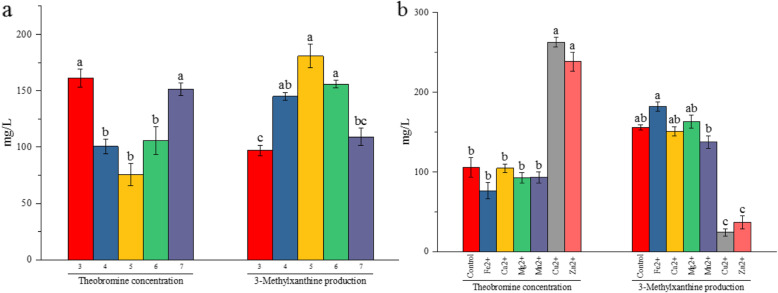
Based on theobromine utilization capacity, Aspergillus niger PT-1, Aspergillus sydowii PT-2, Aspergillus ustus PT-6 and Aspergillus tamarii PT-7 have demonstrated the potential for theobromine biodegradation. Particularly, A. sydowii PT-2 and A. tamarii PT-7 could degrade theobromine significantly (p < 0.05) in all given liquid mediums. 3,7-Dimethyluric acid, 3-methylxanthine, 7-methylxanthine, 3-methyluric acid, xanthine, and uric acid were detected in A. sydowii PT-2 and A. tamarii PT-7 culture, respectively, which confirmed the existence of N-demethylation and oxidation in theobromine catabolism. 3-Methylxanthine was common and main demethylated metabolite of theobromine in the liquid culture. 3-Methylxanthine in A. sydowii PT-2 culture showed a linear relation with initial theobromine concentrations that 177.12 ± 14.06 mg/L 3-methylxanthine was accumulated in TLM-S with 300 mg/L theobromine. Additionally, pH at 5 and metal ion of Fe promoted 3-methylxanthine production significantly (p < 0.05).
This study is the first to confirm that A. sydowii PT-2 and A. tamarii PT-7 degrade theobromine through N-demethylation and oxidation, respectively. A. sydowii PT-2 showed the potential application in 3-methylxanthine production with theobromine as feedstock through the N-demethylation at N-7 position.
甲基黄嘌呤,包括咖啡因、可可碱和茶碱,是茶中的天然和合成化合物,可被某些类型的细菌和真菌代谢。先前的研究证实,几种来自普洱茶的微生物分离株可以降解和转化咖啡因和茶碱。我们推测这些候选分离株也可以通过 N-去甲基化和氧化来降解和转化可可碱。在这项研究中,将七种茶衍生的真菌菌株接种到各种可可碱琼脂培养基和可可碱液体培养基中,以评估它们利用可可碱的能力。使用 HPLC 在液体培养中检测与可可碱降解相关的代谢物,以研究它们在生产 3-甲基黄嘌呤中的潜在应用。
根据可可碱利用能力,黑曲霉 PT-1、米曲霉 PT-2、棒曲霉 PT-6 和塔玛利曲霉 PT-7 表现出可可碱生物降解的潜力。特别是,米曲霉 PT-2 和塔玛利曲霉 PT-7 可以显著(p<0.05)降解所有给定液体培养基中的可可碱。在米曲霉 PT-2 和塔玛利曲霉 PT-7 培养物中分别检测到 3,7-二甲基尿酸、3-甲基黄嘌呤、7-甲基黄嘌呤、3-甲基尿酸、黄嘌呤和尿酸,证实了可可碱代谢过程中存在 N-去甲基化和氧化。3-甲基黄嘌呤是可可碱在液体培养中的常见和主要去甲基化代谢物。米曲霉 PT-2 培养物中的 3-甲基黄嘌呤与初始可可碱浓度呈线性关系,在 300mg/L 可可碱的 TLM-S 中积累了 177.12±14.06mg/L 的 3-甲基黄嘌呤。此外,pH 值为 5 和金属离子 Fe 显著促进 3-甲基黄嘌呤的生产(p<0.05)。
本研究首次证实,米曲霉 PT-2 和塔玛利曲霉 PT-7 分别通过 N-去甲基化和氧化降解可可碱。米曲霉 PT-2 具有通过 N-7 位的 N-去甲基化将可可碱作为原料生产 3-甲基黄嘌呤的应用潜力。