
那他珠单抗治疗多发性硬化症患者的应答预测因素和早期生物标志物。
Predictive factors and early biomarkers of response in multiple sclerosis patients treated with natalizumab.
机构信息
Grupo de Investigación de Factores Ambientales en Enfermedades Degenerativas, Pabellón B. Laboratorio Investigación Esclerosis Múltiple, Instituto de Investigación Sanitaria del Hospital Clínico San Carlos (IdISSC)/Hospital Clínico San Carlos, Red Española de Esclerosis Múltiple (REEM), C/ Martín Lagos S/N, 28040, Madrid, Spain.
Servicio de Inmunología, Hospital Universitario Ramón Y Cajal/Instituto Ramón y Cajal de Investigación Sanitaria (IRYCIS), Red Española de Esclerosis Múltiple (REEM), Madrid, Spain.
出版信息
Sci Rep. 2020 Aug 28;10(1):14244. doi: 10.1038/s41598-020-71283-5.
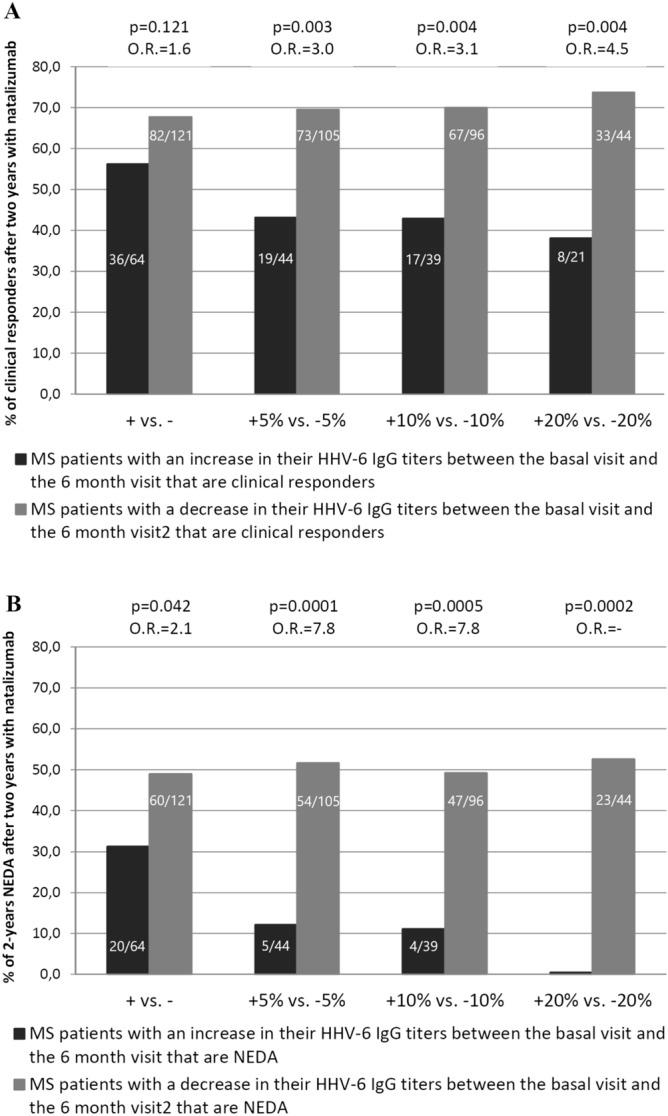
There are an increasing number of treatments available for multiple sclerosis (MS). The early identification of optimal responders to individual treatments is important to achieve individualized therapy. With this aim, we performed a multicenter retrospective longitudinal study including 186 MS patients treated with natalizumab who were followed for 2 years. We analyzed the following variables at recruitment: sex, current age, age at disease onset, disease duration, EDSS, number of T2 and Gd + lesions, IgG and IgM oligoclonal bands, HLA class II (DR, DRB, DQA, DQB, and DRB1*15:01), IgG and IgM antibody titers against human herpesvirus 6 (HHV-6) and the antibody response to Epstein-Barr virus (EBV) through the measurement of the anti-EBNA-1 and anti-VCA IgG titers, in relation to clinical response (no relapses or disability progression), and to NEDA-3 (no evidence of disease activity in terms of clinical response and no changes in MRI scans either) after 2-years follow-up. Baseline EDSS score, baseline EBNA-1 IgG titers and percentage change of HHV6 IgG titers between baseline and 6 month visits were significantly different in clinical responders and in NEDA-3 status (all of them remained significant in the multivariate analysis). We identified three variables for the early identification of natalizumab optimal responders in a rapid and cost-effective approach.
多发性硬化症(MS)的治疗方法越来越多。早期识别对个体治疗的最佳反应者对于实现个体化治疗很重要。为此,我们进行了一项多中心回顾性纵向研究,纳入了 186 名接受那他珠单抗治疗的 MS 患者,对他们进行了 2 年的随访。我们在招募时分析了以下变量:性别、当前年龄、发病年龄、病程、EDSS、T2 病变和 Gd+病变数量、IgG 和 IgM 寡克隆带、HLA Ⅱ类(DR、DRB、DQA、DQB 和 DRB1*15:01)、针对人类疱疹病毒 6(HHV-6)的 IgG 和 IgM 抗体滴度和针对 EBV 的抗体反应通过测量抗 EBVNA-1 和抗 VCA IgG 滴度,与临床反应(无复发或残疾进展)和 2 年后的 NEDA-3(无临床反应和 MRI 扫描变化的疾病活动证据)相关。基线 EDSS 评分、基线 EBVNA-1 IgG 滴度和基线至 6 个月随访期间 HHV6 IgG 滴度的百分比变化在临床反应者和 NEDA-3 状态之间存在显著差异(在多变量分析中仍然具有显著意义)。我们确定了三个变量,用于在快速且具有成本效益的方法中识别那他珠单抗的最佳反应者。
 Zotero 插件