Department of Pathology and Laboratory Medicine, Emory University School of Medicine, Atlanta, GA, 30322, USA.
Exp Mol Med. 2020 Aug;52(8):1275-1287. doi: 10.1038/s12276-020-00494-7. Epub 2020 Aug 28.
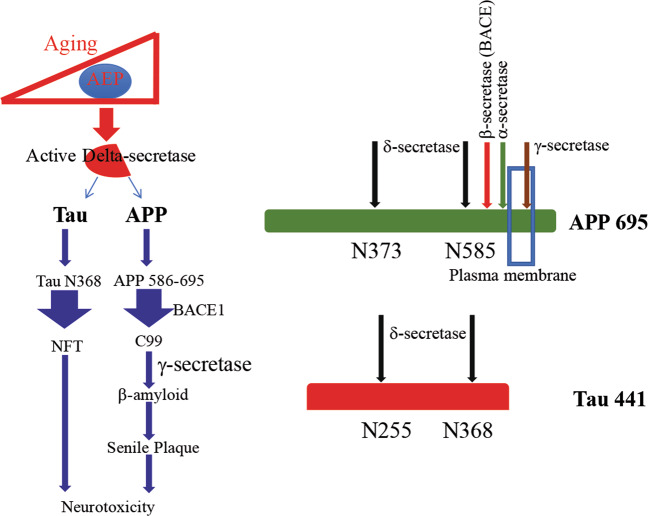
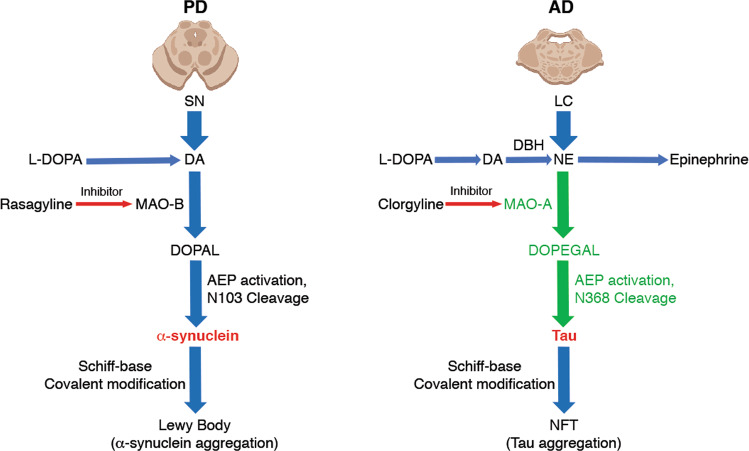
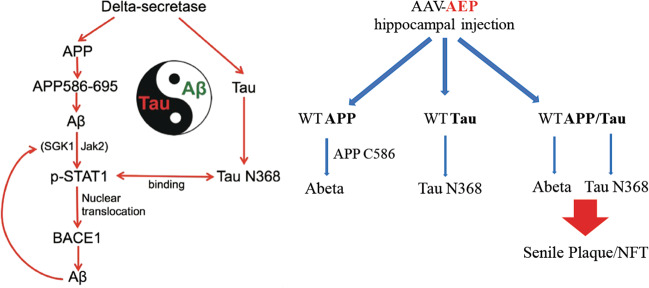
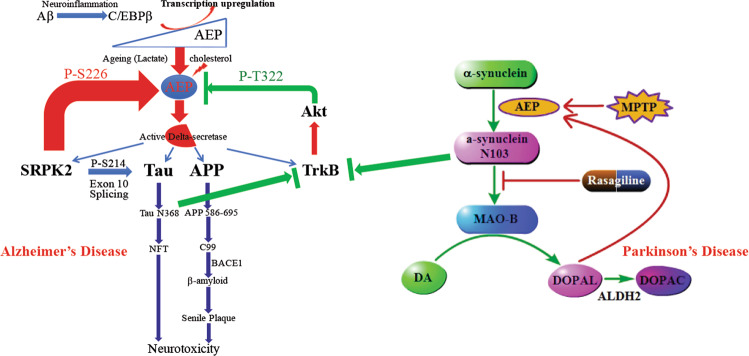
Alzheimer's disease (AD) is a progressive neurodegenerative disease with age as a major risk factor. AD is the most common dementia with abnormal structures, including extracellular senile plaques and intraneuronal neurofibrillary tangles, as key neuropathologic hallmarks. The early feature of AD pathology is degeneration of the locus coeruleus (LC), which is the main source of norepinephrine (NE) supplying various cortical and subcortical areas that are affected in AD. The spread of Tau deposits is first initiated in the LC and is transported in a stepwise manner from the entorhinal cortex to the hippocampus and then to associative regions of the neocortex as the disease progresses. Most recently, we reported that the NE metabolite DOPEGAL activates delta-secretase (AEP, asparagine endopeptidase) and triggers pathological Tau aggregation in the LC, providing molecular insight into why LC neurons are selectively vulnerable to developing early Tau pathology and degenerating later in the disease and how δ-secretase mediates the spread of Tau pathology to the rest of the brain. This review summarizes our current understanding of the crucial role of δ-secretase in driving and spreading AD pathologies by cleaving multiple critical players, including APP and Tau, supporting that blockade of δ-secretase may provide an innovative disease-modifying therapeutic strategy for treating AD.
阿尔茨海默病(AD)是一种进行性神经退行性疾病,年龄是主要的风险因素。AD 是最常见的痴呆症,其异常结构包括细胞外老年斑和神经元内神经原纤维缠结,是关键的神经病理学特征。AD 病理学的早期特征是蓝斑(LC)的退化,LC 是供应受 AD 影响的各种皮质和皮质下区域的去甲肾上腺素(NE)的主要来源。Tau 沉积物的扩散首先在 LC 中启动,并随着疾病的进展逐步从内嗅皮层传递到海马体,然后传递到新皮层的联合区域。最近,我们报道 NE 代谢物 DOPEGAL 激活 δ-分泌酶(AEP,天冬酰胺内肽酶)并引发 LC 中病理性 Tau 聚集,为 LC 神经元为何选择性易患早期 Tau 病理学并在疾病后期退化以及 δ-分泌酶如何介导 Tau 病理学向大脑其他部位扩散提供了分子见解。这篇综述总结了我们目前对 δ-分泌酶通过切割包括 APP 和 Tau 在内的多个关键分子在驱动和传播 AD 病理学中的关键作用的理解,支持抑制 δ-分泌酶可能为治疗 AD 提供一种创新的疾病修饰治疗策略。