Department of Life Science, College of Natural Sciences, Hanyang University, Seoul, Republic of Korea.
Research Institute for Natural Sciences, Hanyang University, Seoul, Republic of Korea.
Exp Mol Med. 2020 Aug;52(8):1255-1263. doi: 10.1038/s12276-020-00486-7. Epub 2020 Aug 28.
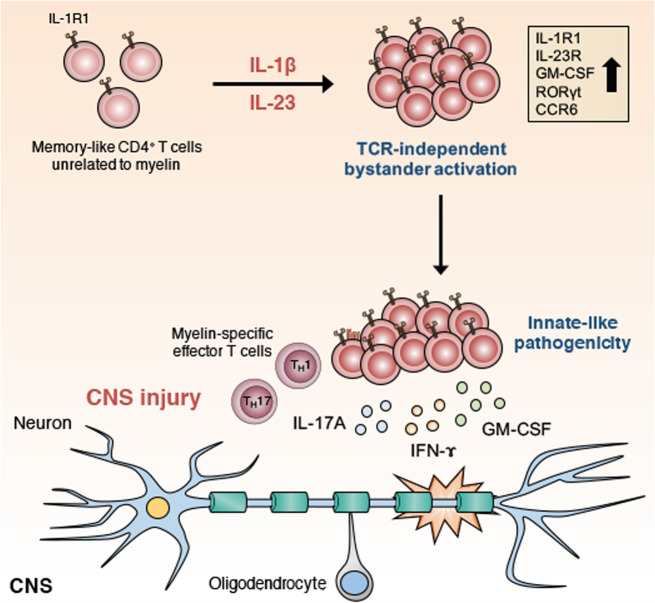
T cells are the central mediators of both humoral and cellular adaptive immune responses. Highly specific receptor-mediated clonal selection and expansion of T cells assure antigen-specific immunity. In addition, encounters with cognate antigens generate immunological memory, the capacity for long-term, antigen-specific immunity against previously encountered pathogens. However, T-cell receptor (TCR)-independent activation, termed "bystander activation", has also been found. Bystander-activated T cells can respond rapidly and secrete effector cytokines even in the absence of antigen stimulation. Recent studies have rehighlighted the importance of antigen-independent bystander activation of CD4 T cells in infection clearance and autoimmune pathogenesis, suggesting the existence of a distinct innate-like immunological function performed by conventional T cells. In this review, we discuss the inflammatory mediators that activate bystander CD4 T cells and the potential physiological roles of these cells during infection, autoimmunity, and cancer.
T 细胞是体液和细胞适应性免疫反应的主要介导者。高度特异性的受体介导的 T 细胞克隆选择和扩增可确保抗原特异性免疫。此外,与同源抗原的接触会产生免疫记忆,即对以前遇到的病原体产生长期、抗原特异性免疫的能力。然而,也发现了 T 细胞受体 (TCR) 非依赖性激活,称为“旁观者激活”。即使没有抗原刺激,旁观者激活的 T 细胞也可以快速响应并分泌效应细胞因子。最近的研究再次强调了 CD4 T 细胞在感染清除和自身免疫发病机制中抗原非依赖性旁观者激活的重要性,这表明传统 T 细胞具有独特的先天样免疫功能。在这篇综述中,我们讨论了激活旁观者 CD4 T 细胞的炎症介质,以及这些细胞在感染、自身免疫和癌症期间的潜在生理作用。