The Swedish School of Sport and Health Sciences, GIH, 11486, Stockholm, Sweden.
Department of Neuroscience, Karolinska Institutet, Stockholm, Sweden.
Exp Brain Res. 2020 Nov;238(11):2497-2506. doi: 10.1007/s00221-020-05866-z. Epub 2020 Aug 28.
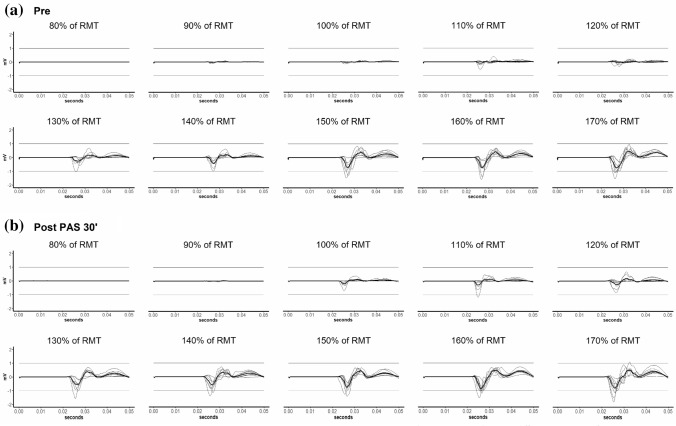
Paired associative stimulation (PAS) can induce plasticity in the motor cortex, as measured by changes in corticospinal excitability (CSE). This effect is attenuated in older and less active individuals. Although a single bout of exercise enhances PAS-induced plasticity in young, physically inactive adults, it is not yet known if physical activity interventions affect PAS-induced neuroplasticity in middle-aged inactive individuals. Sixteen inactive middle-aged office workers participated in a randomized cross-over design investigating how CSE and short-interval intracortical inhibition (SICI) were affected by PAS preceded by 3 h of sitting (SIT), 3 h of sitting interrupted every 30 min by 3 min of frequent short bouts of physical activity (FPA) and 2.5 h of sitting followed by 25 min of moderate-intensity exercise (EXE). Transcranial magnetic stimulation was applied over the primary motor cortex (M1) of the dominant abductor pollicis brevis to induce recruitment curves before and 5 min and 30 min post-PAS. Linear mixed models were used to compare changes in CSE using time and condition as fixed effects and subjects as random effects. There was a main effect of time on CSE and planned within-condition comparisons showed that CSE was significantly increased from baseline to 5 min and 30 min post-PAS, in the FPA condition, with no significant changes in the SIT or EXE conditions. SICI decreased from baseline to 5 min post-PAS, but this was not related to changes in CSE. Our findings suggest that in middle-aged inactive adults, FPAs may promote corticospinal neuroplasticity. Possible mechanisms are discussed.
配对关联刺激(PAS)可引起运动皮层的可塑性,其表现为皮质脊髓兴奋性(CSE)的变化。这种效应在年龄较大和活动较少的个体中减弱。尽管单次运动可增强年轻、不活跃成年人的 PAS 诱导的可塑性,但目前尚不清楚体育活动干预是否会影响中年不活跃个体的 PAS 诱导的神经可塑性。16 名不活跃的中年办公室工作人员参与了一项随机交叉设计研究,该研究调查了在 PAS 之前 3 小时静坐(SIT)、每 30 分钟中断 3 分钟频繁的短暂身体活动(FPA)和 2.5 小时静坐之后 25 分钟中等强度运动(EXE)的情况下,CSE 和短间隔内皮质抑制(SICI)如何受到 PAS 的影响。经颅磁刺激应用于优势外展拇指短肌的初级运动皮层(M1),以在 PAS 之前、之后 5 分钟和 30 分钟时诱导募集曲线。线性混合模型用于比较 CSE 的变化,使用时间和条件作为固定效应,受试者作为随机效应。CSE 存在时间的主要效应,计划的条件内比较显示,在 FPA 条件下,CSE 从基线显著增加到 PAS 后的 5 分钟和 30 分钟,而在 SIT 或 EXE 条件下没有显著变化。SICI 从基线到 PAS 后 5 分钟时降低,但这与 CSE 的变化无关。我们的研究结果表明,在中年不活跃的成年人中,FPAs 可能促进皮质脊髓神经可塑性。讨论了可能的机制。