Lulic Tea, El-Sayes Jenin, Fassett Hunter J, Nelson Aimee J
Department of Kinesiology, McMaster University, Hamilton, Canada.
PLoS One. 2017 Mar 9;12(3):e0173672. doi: 10.1371/journal.pone.0173672. eCollection 2017.
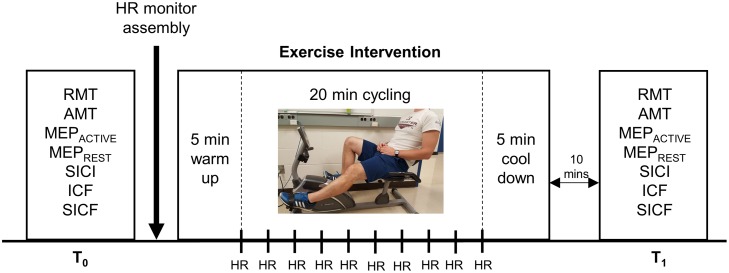
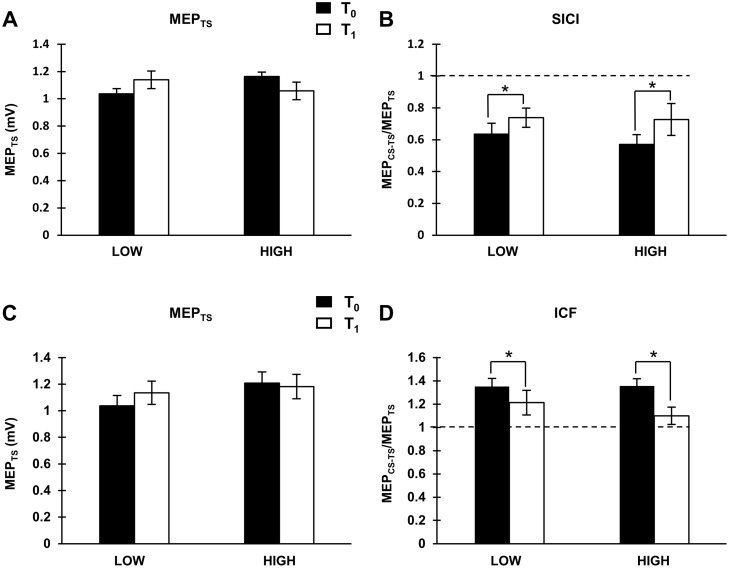
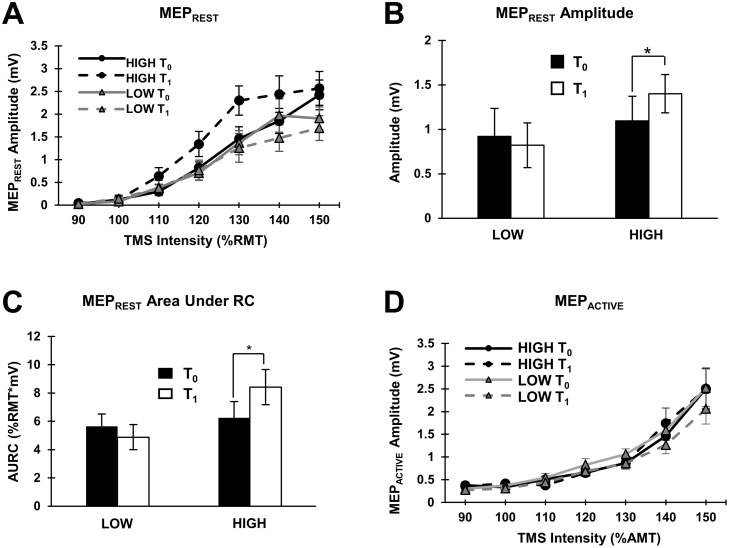
Emerging evidence suggests that regular physical activity can impact cortical function and facilitate plasticity. In the present study, we examined how physical activity levels influence corticospinal excitability and intracortical circuitry in motor cortex following a single session of moderate intensity aerobic exercise. We aimed to determine whether exercise-induced short-term plasticity differed between high versus low physically active individuals. Participants included twenty-eight young, healthy adults divided into two equal groups based on physical activity level determined by the International Physical Activity Questionnaire: low-to-moderate (LOW) and high (HIGH) physical activity. Transcranial magnetic stimulation was used to assess motor cortex excitability via motor evoked potential (MEP) recruitment curves for the first dorsal interosseous (FDI) muscle at rest (MEPREST) and during tonic contraction (MEPACTIVE), short-interval intracortical inhibition (SICI) and facilitation (SICF), and intracortical facilitation (ICF). All dependent measures were obtained in the resting FDI muscle, with the exception of AMT and MEPACTIVE recruitment curves that were obtained during tonic FDI contraction. Dependent measures were acquired before and following moderate intensity aerobic exercise (20 mins, ~60% of the age-predicted maximal heart rate) performed on a recumbent cycle ergometer. Results indicate that MEPREST recruitment curve amplitudes and area under the recruitment curve (AURC) were increased following exercise in the HIGH group only (p = 0.002 and p = 0.044, respectively). SICI and ICF were reduced following exercise irrespective of physical activity level (p = 0.007 and p = 0.04, respectively). MEPACTIVE recruitment curves and SICF were unaltered by exercise. These findings indicate that the propensity for exercise-induced plasticity is different in high versus low physically active individuals. Additionally, these data highlight that a single session of aerobic exercise can transiently reduce inhibition in the motor cortex regardless of physical activity level, potentially priming the system for plasticity induction.
新出现的证据表明,规律的体育活动会影响皮质功能并促进可塑性。在本研究中,我们考察了单次中等强度有氧运动后,体育活动水平如何影响运动皮质中的皮质脊髓兴奋性和皮质内环路。我们旨在确定运动诱发的短期可塑性在高体力活动个体与低体力活动个体之间是否存在差异。参与者包括28名年轻健康的成年人,根据国际体力活动问卷确定的体力活动水平分为两组:低至中等(LOW)体力活动组和高(HIGH)体力活动组。经颅磁刺激用于通过静息状态下(MEPREST)和强直收缩期间(MEPACTIVE)第一背侧骨间肌(FDI)的运动诱发电位(MEP)募集曲线、短间隔皮质内抑制(SICI)和易化(SICF)以及皮质内易化(ICF)来评估运动皮质兴奋性。除了在FDI强直收缩期间获得的AMT和MEPACTIVE募集曲线外,所有相关测量均在静息的FDI肌肉中进行。在卧式自行车测力计上进行中等强度有氧运动(20分钟,约为年龄预测最大心率的60%)前后获取相关测量值。结果表明,仅在HIGH组中,运动后MEPREST募集曲线幅度和募集曲线下面积(AURC)增加(分别为p = 0.002和p = 0.044)。无论体力活动水平如何,运动后SICI和ICF均降低(分别为p = 0.007和p = 0.04)。运动对MEPACTIVE募集曲线和SICF无影响。这些发现表明,运动诱发可塑性的倾向在高体力活动个体与低体力活动个体中有所不同。此外,这些数据突出表明,单次有氧运动可暂时降低运动皮质中的抑制,而与体力活动水平无关,这可能使该系统为可塑性诱导做好准备。