Ogata Ryohei, Kishino Emi, Saitoh Wataru, Koike Yoshikazu, Kurebayashi Junichi
Department of Breast and Thyroid Surgery, Kawasaki Medical School, 577 Matsushima, Kurashiki, Okayama, 701-0192, Japan.
Breast Cancer. 2021 Jan;28(1):206-215. doi: 10.1007/s12282-020-01150-8. Epub 2020 Aug 28.
Combined endocrine therapy with a cyclin-dependent kinase (CDK) 4/6 inhibitor has been indicated to improve not only progression-free survival, but also overall survival in patients with hormone receptor (HR)-positive, HER2-negative advanced breast cancer. However, resistance to this combination therapy inevitably develops. How to manage this resistant breast cancer is one of the most important clinical issues. To investigate the mechanisms of action responsible for resistance, we developed breast cancer cells resistant to CDK4/6 inhibitors, and analyzed their biological characteristics and sensitivity to different anticancer agents.
HR-positive, HER2-negative MCF-7 and KPL-1 breast cancer cells were cultivated in palbociclib (PAL) or abemaciclib (ABE)-added culture medium for over 5 months, and we successfully developed PAL- or ABE-resistant cells. The effects of PAL or ABE on the cell growth, basal RB expression, RB phosphorylation, cell cycle and cell senescence were compared between resistant and parental cells. Effects of the other CDK4/6 inhibitor, different chemotherapeutic agents and estrogen on the cell growth were also examined. The expression levels of cyclin D1, CDK2, CDK4, CDK6, cyclin E1 and estrogen receptor (ER)-ɑ were measured using RT-PCR.
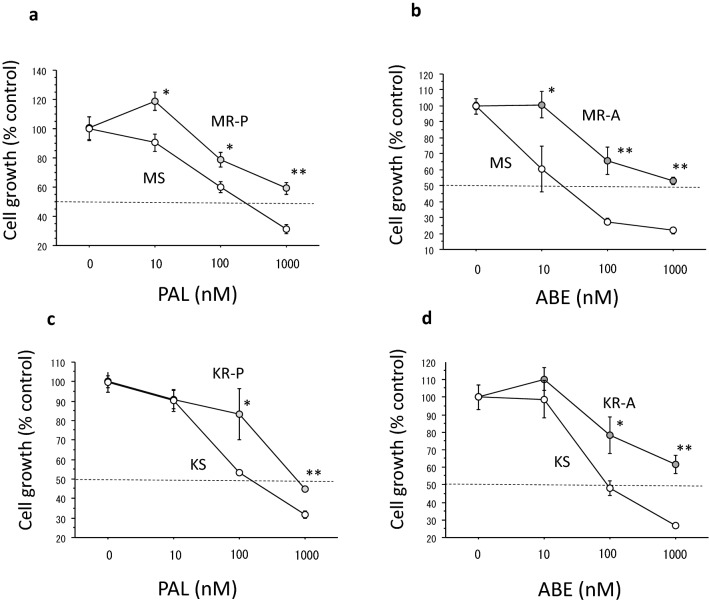
Long-term exposure to up to 200 nM PAL or ABE resulted in the development of PAL- or ABE-resistant MCF-7 or KPL-1 breast cancer cells. Basal expression levels of RB in both resistant cells were down-regulated. Inhibitory effects of either PAL or ABE on RB phosphorylation were reduced in both resistant cells. Accordingly, G1-S cell cycle retardation and cell senescence induced by either inhibitor were also attenuated in both resistant cells. Both resistant cells were cross-resistant to the other CDK4/6 inhibitor but almost as equally sensitive to different chemotherapeutic agents (5-fluorouracil, gemcitabine, paclitaxel, docetaxel, doxorubicin and eribulin) as the parental cells. The mRNA expression level of CDK6 significantly increased in the resistant MCF-7 cells and that of Rb1 significantly decreased in the resistant KPL-1 cells. Although both resistant cells were less sensitive to estrogen than the parental cells, the expression levels of ER-ɑ did not significantly change in either.
Our study suggests that acquired resistance to PAL or ABE confers cross-resistance to the other CDK4/6 inhibitor but not to chemotherapeutic agents in HR-positive, HER2-negative breast cancer cells. Down-regulation of basal RB expression and normalized RB phosphorylation reduced by CDK4/6 inhibitors may be responsible for the attenuated anti-cell growth effects of the inhibitors.
联合内分泌治疗与细胞周期蛋白依赖性激酶(CDK)4/6抑制剂已被证明不仅可改善激素受体(HR)阳性、人表皮生长因子受体2(HER2)阴性晚期乳腺癌患者的无进展生存期,还可改善其总生存期。然而,这种联合治疗不可避免地会产生耐药性。如何治疗这种耐药性乳腺癌是最重要的临床问题之一。为了研究耐药的作用机制,我们培养了对CDK4/6抑制剂耐药的乳腺癌细胞,并分析了它们的生物学特性以及对不同抗癌药物的敏感性。
将HR阳性、HER2阴性的MCF-7和KPL-1乳腺癌细胞在添加了帕博西尼(PAL)或阿贝西利(ABE)的培养基中培养5个多月,成功培养出对PAL或ABE耐药的细胞。比较耐药细胞和亲本细胞中PAL或ABE对细胞生长、基础视网膜母细胞瘤(RB)表达、RB磷酸化、细胞周期和细胞衰老的影响。还检测了另一种CDK4/6抑制剂、不同化疗药物和雌激素对细胞生长的影响。使用逆转录聚合酶链反应(RT-PCR)检测细胞周期蛋白D1、CDK2、CDK4、CDK6、细胞周期蛋白E1和雌激素受体(ER)-α的表达水平。
长期暴露于高达200 nM的PAL或ABE导致MCF-7或KPL-1乳腺癌细胞对PAL或ABE产生耐药性。两种耐药细胞中RB的基础表达水平均下调。两种耐药细胞中PAL或ABE对RB磷酸化的抑制作用均降低。因此,两种耐药细胞中由任何一种抑制剂诱导的G1-S期细胞周期阻滞和细胞衰老也均减弱。两种耐药细胞对另一种CDK4/6抑制剂均产生交叉耐药,但对不同化疗药物(5-氟尿嘧啶、吉西他滨、紫杉醇、多西他赛、阿霉素和艾日布林)的敏感性与亲本细胞几乎相同。耐药的MCF-7细胞中CDK6的mRNA表达水平显著升高,耐药的KPL-1细胞中Rb1的mRNA表达水平显著降低。虽然两种耐药细胞对雌激素的敏感性均低于亲本细胞,但两种细胞中ER-α的表达水平均未显著变化。
我们的研究表明,在HR阳性、HER2阴性乳腺癌细胞中,对PAL或ABE获得性耐药会导致对另一种CDK4/6抑制剂产生交叉耐药,但对化疗药物不会产生交叉耐药。基础RB表达下调以及CDK4/6抑制剂导致的RB磷酸化正常化可能是抑制剂抗细胞生长作用减弱的原因。