Medical Oncology, Department of Internal Medicine, CHA Bundang Medical Center, CHA University, Seongnam, South Korea.
Department of Biomedical Science, The Graduate School, CHA University, Seongnam, South Korea.
Int J Cancer. 2019 Sep 1;145(5):1179-1188. doi: 10.1002/ijc.32020. Epub 2019 Jan 7.
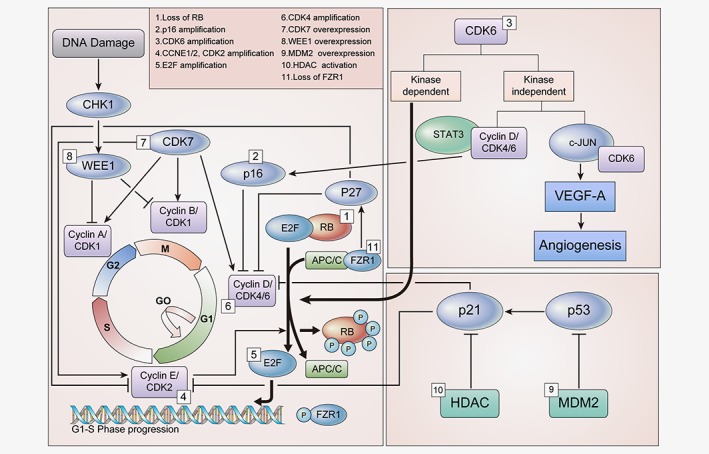
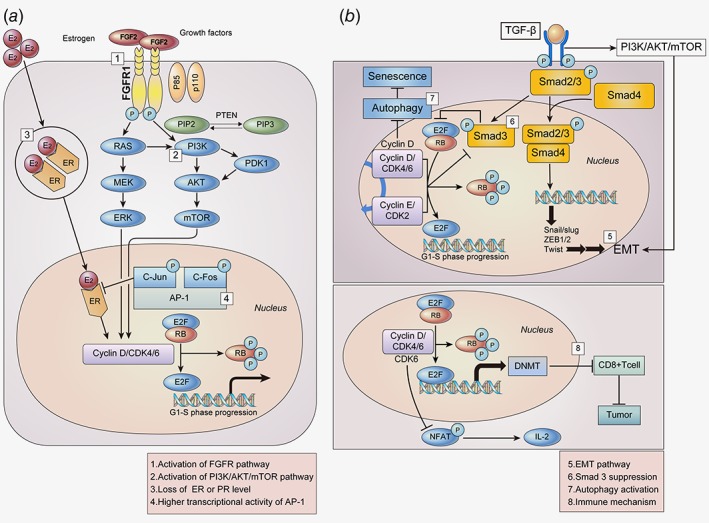
Deregulation of the cyclin D-CDK4/6-INK4-RB pathway leading to uncontrolled cell proliferation, is frequently observed in breast cancer. Currently, three selective CDK4/6 inhibitors have been FDA approved: palbociclib, ribociclib and abemaciclib. Despite promising clinical outcomes, intrinsic or acquired resistance to CDK4/6 inhibitors has limited the success of these treatments; therefore, the development of various strategies to overcome this resistance is of great importance. We highlight the various mechanisms that are directly or indirectly responsible for resistance to CDK4/6 inhibitors, categorizing them into two broad groups; cell cycle-specific mechanisms and cell cycle-nonspecific mechanisms. Elucidation of the diverse mechanisms through which resistance to CDK4/6 inhibitors occurs, may aid in the design of novel therapeutic strategies to improve patient outcomes. This review summarizes the currently available knowledge regarding mechanisms of resistance to CDK4/6 inhibitors, and possible therapeutic strategies that may overcome this resistance as well.
细胞周期蛋白 D-CDK4/6-INK4-RB 通路的失调导致不受控制的细胞增殖,这在乳腺癌中经常观察到。目前,三种选择性 CDK4/6 抑制剂已获得 FDA 批准:哌柏西利、瑞博西利和阿贝西利。尽管有有前景的临床结果,但对 CDK4/6 抑制剂的内在或获得性耐药限制了这些治疗的成功;因此,开发各种克服这种耐药性的策略非常重要。我们强调了直接或间接导致 CDK4/6 抑制剂耐药的各种机制,将它们分为两类:细胞周期特异性机制和细胞周期非特异性机制。阐明 CDK4/6 抑制剂耐药的不同机制,可能有助于设计新的治疗策略以改善患者的预后。这篇综述总结了目前关于 CDK4/6 抑制剂耐药机制的相关知识,以及可能克服这种耐药性的治疗策略。